Asana vs Motion
Asana and Motion are powerful platforms enhanced by artificial intelligence. Asana is the classic choice for robust project management and enterprise scaling. Motion is a focused, expensive AI workforce that manages your time entirely. The choice is between structure (Asana) and automated high-efficiency optimization (Motion).
Great features, poor customer support.
We find that Asana offers powerful project management features, excellent organizational scalability, and a generous free plan suitable for small teams. However, recurring external reports indicate severe problems with customer service responsiveness and billing transparency, heavily detracting from the product’s core strengths. Overall, we recommend caution for small businesses or any organization prioritizing reliable, direct customer support.
Pros
- Powerful free tier available for individuals and small teams (up to 10 users).
- Flexible design for managing tasks, projects, and team workflows efficiently.
- Supports excellent scalability, trusted by many Fortune 100 companies.
- Advanced features like Gantt charts and Timeline views are available starting on the Starter plan.
Cons
- Customer service is widely reported as non-existent, slow, or dependent on ineffective chatbots.
- Numerous complaints regarding deceptive auto-renewal practices and unauthorized charges.
- Refund requests are frequently denied, increasing costs for unintended subscriptions.
- Users often lose access or tasks when attempting to downgrade from a paid trial to the free plan.
AI scheduling that manages your work.
We observed that Motion delivers on its promise of powerful, AI-driven task management and scheduling. Users consistently report massive time savings and reduced cognitive load, but the complex credit and seat pricing structure requires careful study. Overall, Motion is a transformative tool for dedicated users who commit to mastering its full capabilities.
Pros
- Reduces mental load using intelligent auto-scheduling and task prioritization.
- Integrates tasks, projects, and calendar into a single, cohesive productivity suite.
- Helps teams break down major goals into manageable, achievable steps for progress.
- High-quality AI note-taker joins meetings and summarizes them effectively.
Cons
- High price point ($50/month cited as excessive by some single users).
- Steep learning curve requires significant upfront time to fully master the system.
- Reported UX/UI glitches, such as obstructive task preview pop-ups.
- Users note that the mobile app and notification features need improvement.
AboutAsana
Asana is an online platform built specifically to manage your team’s work, projects, and tasks. It supports powerful Human + AI collaboration.
This AI component understands your specific business context, helping to move your most important work forward efficiently. Because it's a centralized ecosystem, it easily brings all doers and stakeholders together in one place. 💡
AboutMotion
Motion transforms how teams work by offering the world's first AI workforce at your fingertips. ✨ This platform goes far beyond simple automation; it lets you create and deploy enterprise-grade AI Employees specifically built for your business needs. It merges an entire productivity suite—including AI Projects, AI Calendar, and AI Tasks—where all your work is managed and recorded. Motion is trusted by over a million top performers and teams who want a single, powerful platform for managing work efficiently.
Highlights
Feature Comparison
Features Overview
We highlight the main differences and pick a winner for each feature.
AI Capabilities
Motion uses transformative AI employees; Asana's AI enhances standard PM workflows.
Asana utilizes its AI Studio to optimize existing processes and handle repetitive tasks. The Asana AI understands context to improve automation rules effectively. Motion's core focus is creating custom AI Employees using natural language instructions. Motion’s AI agents handle complex, end-to-end work across the entire integrated suite. Asana enhances human work with AI assistance. Motion aims to replace redundant human coordination with AI autonomy. Motion’s AI agents execute tasks and gather context across the platform for superior accuracy.
Pricing Structure
Asana is predictable and offers a great free plan; Motion is high-cost and usage-based.
Asana has a generous permanent free tier supporting up to 10 users. Paid Asana plans scale with clean, flat per-user license fees annually or monthly. Motion requires a high entry cost starting at $29/month for one seat. Motion’s pricing also introduces usage-based monthly AI credits you must purchase. Asana offers cost predictability crucial for budgeting. Motion is only worth the cost if the AI provides massive efficiency gains. Motion requires annual payment for its standard tiers. Asana offers more flexible monthly payment options.
Customer Support
Motion has responsive support staff; Asana’s support is widely reported as abysmal.
Asana’s customer service is frequently cited as slow, absent, or relying on chatbots. Only Asana’s highest Enterprise tier receives dedicated 24/7 support availability. Motion receives positive user reports regarding staff responsiveness, especially for billing issues. Higher Motion plans like AI Employees Plus receive dedicated Priority Business Support. User reviews heavily penalize Asana for poor service and unfriendly billing. Motion successfully handles basic support functions crucial for daily operations.
Core Project Management
Asana offers detailed views and structure; Motion focuses on automated task flow.
Asana provides classic project management with unlimited tasks and projects. Users gain access to essential views like Timeline and Gantt charts. Motion merges Projects, Calendar, and Docs into one highly automated suite. Motion’s AI Project module automatically generates plans and manages status tracking. Asana is crucial for visualizing complex dependencies via traditional Gantt charts. Motion’s approach removes the administrative burden entirely for the project manager.
Auto-Scheduling
Motion is fully autonomous; Asana requires full manual resource management.
Asana requires project managers to manually prioritize tasks and schedules. Asana's automation rules handle routine actions, not timing adjustments. Motion automatically creates, assigns, and prioritizes work instantly. Motion rebalances tasks when deadlines or schedules unexpectedly shift. Motion eliminates the constant time wasted on rescheduling tasks. This is the single biggest time-saver reported by Motion users. Asana is better for teams who prefer to maintain rigid, manual control over their calendar.
Scalability
Asana is proven for massive enterprises; Motion scales via custom AI contracts.
Asana is trusted by Fortune 100 companies and handles massive user bases effectively. Its Enterprise+ tiers support strict compliance like HIPAA and SIEM integration. Motion scales by requiring clients to purchase more seats and AI credits monthly. The Motion Enterprise tier offers engagement with dedicated Forward Deployed Engineers. Asana is better suited for organizations requiring deeply complex compliance and administrative controls. Motion focuses on scaling AI capacity rather than organizational visibility complexity.
Integration Ecosystem
Asana offers 300+ unlimited integrations; Motion limits connections per plan.
Asana connects with over 300 major and enterprise tools seamlessly. Its integration with Salesforce, Tableau, and Power BI is key for advanced tiers. Motion integrates with hundreds of tools to gather essential context. However, Motion quotas connections, limiting them to 3–50 depending on your plan. Asana provides a far wider, unlimited ecosystem for general connectivity needs. Motion uses integrations primarily to feed data context to its powerful AI agents.
Resource Management
Asana includes native resource visualization; Motion requires relying on capacity data.
Asana provides dedicated Resource Management starting with the Advanced plan. Users can visualize team staffing and check available capacity easily across the business. Motion’s capacity planning is driven by the AI balancing task loads. It does not offer the same high-level, human-driven resource visualization. Asana is essential if you need explicit tools to manage human workload and bandwidth. Motion aims to manage capacity automatically to prevent resource bottlenecks.
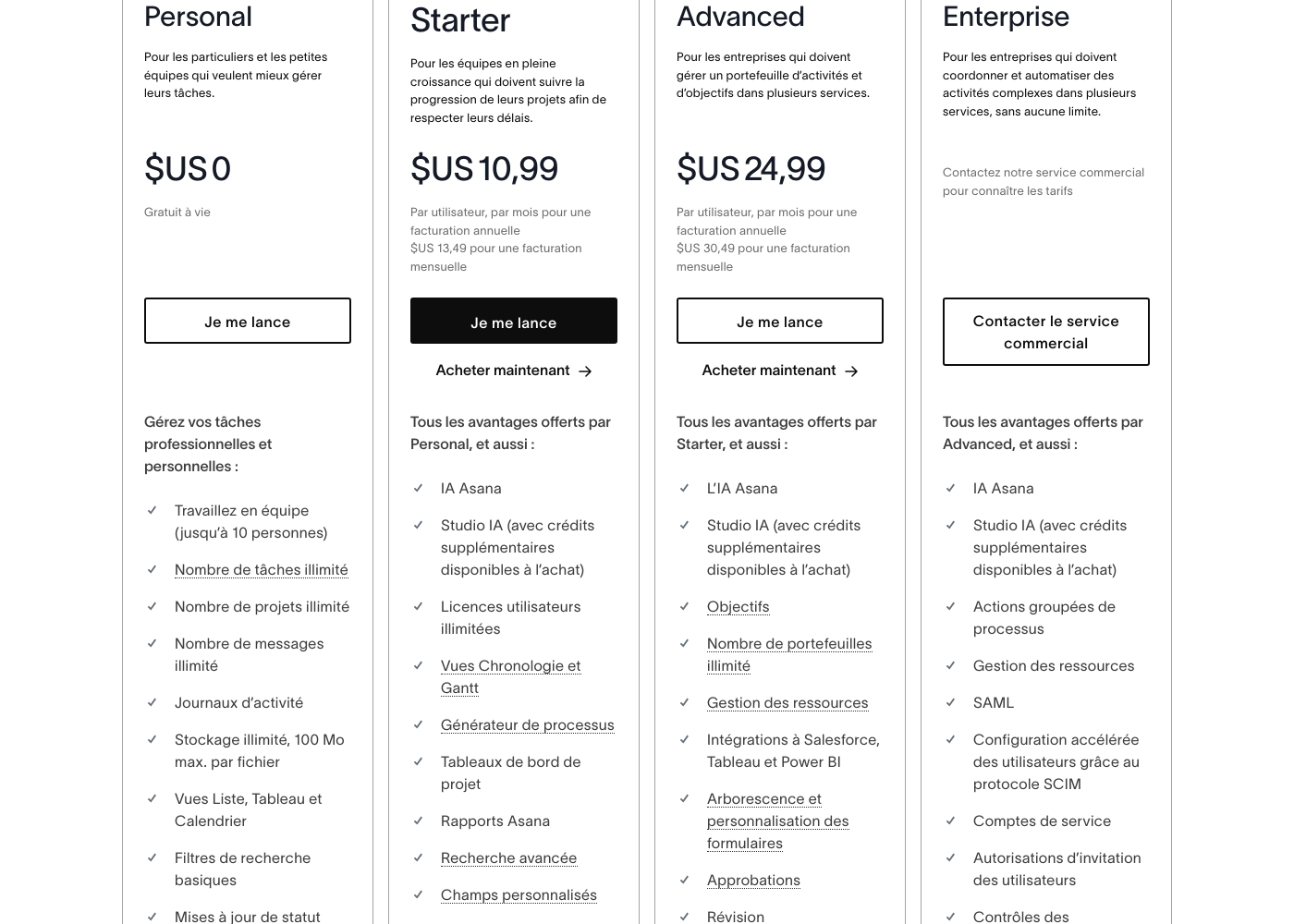
Asana costs between $US 0 and $24.99 per user per month (annual billing) with 5 plans: Personal at $US 0, Starter at $US 10.99, Advanced at $US 24.99, Enterprise at Contact Sales, and Enterprise+ at Contact Sales.
Here is a breakdown of what each plan offers your team.
Personal
Price: $US 0 (Free for life) Websites Supported: Not explicitly stated Best For: Individuals and small teams wanting better task management Refund Policy: Not explicitly stated Other Features:
- Work in teams (up to 10 people)
- Unlimited tasks, projects, and messages
- Unlimited storage (100 MB max. per file)
- List, Board, and Calendar views
- Basic search filters
- Work in teams (up to 10 people)
- Unlimited tasks, projects, and messages
- Unlimited storage (100 MB max. per file)
- List, Board, and Calendar views
- Basic search filters
- Unlimited user licenses
- Asana AI Studio access
- Timeline and Gantt Views
- Process Generator
- Advanced Search and Custom Fields
- Objectives and unlimited portfolios
- Resource Management
- Integrations to Salesforce, Tableau, and Power BI
- Form customization and approvals
- Native time tracking
- Bulk process actions
- SAML and SCIM for accelerated user configuration
- Service accounts
- 24/7 support
- Custom branding
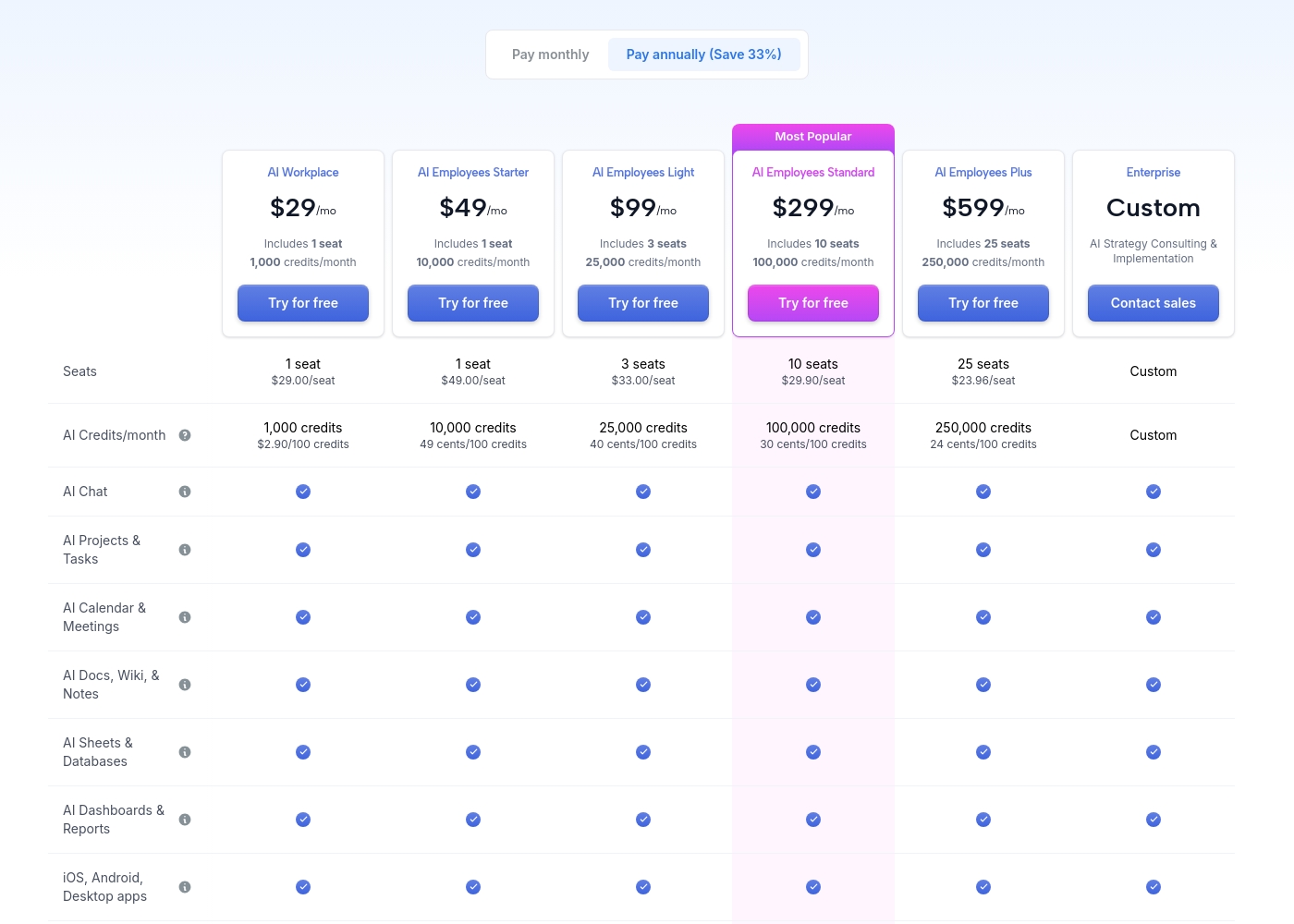
Motion costs between $29 and $599 per month (when billed annually) with 5 primary subscription plans: AI Workplace ($29/mo), AI Employees Starter ($49/mo), AI Employees Light ($99/mo), AI Employees Standard ($299/mo), and AI Employees Plus ($599/mo). There is also a custom Enterprise option.
The prices shown reflect annual billing, which gives you a savings of 33% compared to paying monthly. All plans offer a free trial period.
AI Workplace
Price: $29/mo (billed annually) Websites Supported: Not explicitly stated Best For: Individuals and small startups starting AI integration Refund Policy: Not explicitly stated Other Features:
- Includes 1 seat
- 1,000 credits/month ($2.90 per 100 credits)
- 3 integration connections
- Access to core AI tools (Chat, Projects, Calendar, Docs, Sheets, Dashboards)
- 1 seat
- 1,000 credits/month
- 3 integration connections
- AI Chat, Projects & Tasks, Calendar & Meetings, Docs, Wiki & Notes, Sheets & Databases, Dashboards & Reports
- iOS, Android, Desktop apps
- 1 seat
- 10,000 credits/month
- 5 integration connections
- Everything in AI Workplace
- 3 seats
- 25,000 credits/month
- 10 integration connections
- Everything in AI Employees Starter
- 10 seats (Most Popular)
- 100,000 credits/month
- 20 integration connections
- HTTP Blocks
- Everything in AI Employees Light
Pricing Notes
- Asana includes a powerful, permanent free tier for up to 10 users.
- Motion requires annual billing for standard tiers and offers no monthly option.
- Motion pricing is based on seats plus usage, measured in monthly AI Credits.
- Asana explicitly states that refund requests are generally denied once a paid subscription begins.
- Motion's cost per AI credit decreases significantly on higher-tier plans.
- The Motion Enterprise plan includes a dedicated Forward Deployed Engineer for custom builds.
Pricing Head-to-Head
User Reviews
External feedback, predominantly showcased through Trustpilot, reveals widespread dissatisfaction among users, giving the service a significantly low overall rating. Customers frequently criticize the subscription and billing practices, often citing unexpected auto-renewals or unauthorized charges occurring months after cancellation or trial expiration. The inability to secure refunds, even in cases of clear error, is a major pain point.
🚨 The most significant complaint centers on support responsiveness. Reviewers report slow service, sometimes waiting a week for an email reply, reliance on frustrating chatbots, and difficulties contacting a human representative. While some users acknowledge the base product is flexible and has good design features, the company's operational infrastructure and seeming focus on larger enterprises leaves smaller businesses feeling neglected, leading many to label the experience customer-hostile or deceptive.
The app itself is great, offering good design, projects, and flexible team spaces. However, the customer service experience is awful. The only way to talk to CS is often through slow, ineffective emails.
Motion receives overwhelmingly positive feedback, primarily focused on its powerful auto-scheduling and prioritization features. Users frequently praise the application for reducing mental load and decision fatigue by automatically organizing tasks and project workflows.
Many reviewers, including those dealing with complex schedules or ADHD, state that Motion has revolutionized their workflow, saving significant time and boosting productivity. The ability to break down complex goals into achievable tasks is consistently highlighted as a major benefit, making Motion a game-changer for project management teams and individuals alike.
I was recently diagnosed with ADHD, and Motion has made a huge difference in how I structure my day. It removes the stress of figuring out what to do next. It has been well worth the time invested in learning the system, as the benefits are truly clear.
Our Verdict
Choosing between Asana and Motion comes down to structure versus intense automation. If you need traditional project management, Asana is the proven veteran. If you desire pure autonomous scheduling, Motion is the expensive disruptor. For most large teams, the foundational structure of Asana will be more familiar and affordable. Asana excels at giving enterprise teams unparalleled control and deep visibility. Asana provides resource management, Gantt charts, and unlimited portfolio tracking. It's built for complexity and offers a generous free tier for up to 10 users. Asana is the safer bet for organizations requiring stringent regulatory compliance and reporting. Motion’s superpower is its intelligent, personalized AI workforce and auto-scheduling. Motion automatically creates, prioritizes, and rebalances all tasks across your schedule. This saves managers hours of manual coordination and dramatically reduces decision fatigue. Motion users call this AI automation transformative and life changing. Ultimately, the decider is budget versus administrative relief. Motion costs significantly more due to its usage-based pricing model. Asana offers better cost predictability and proven organizational scalability. Pick Motion if you are willing to spend more for AI efficiency. Choose Asana if you need core project reliability and a massive Fortune 100 ecosystem.
Frequently Asked Questions
Which is better for small teams: Asana or Motion?
Asana offers a powerful, permanent free tier supporting up to 10 users easily. Motion has no free plan and starts at $29/month for only one seat. Asana is clearly the superior choice for small teams starting project management.
Does Asana have auto-scheduling features like Motion?
No, Asana focuses on human prioritization and manual project organization. Motion’s unique core strength is its powerful AI that prioritizes and adjusts your entire schedule automatically. This difference greatly impacts daily workflow.
Is Motion worth the higher cost over Asana?
Motion justifies its higher cost through transformative time savings and reduced administration. If your priority is eliminating manual scheduling and coordination, Motion is worth the premium. If you need budget compliance, Asana is a much cheaper solution.
How do Asana's and Motion's AI capabilities differ?
Asana uses AI Studio primarily for enhancing automation and repetitive tasks. Motion lets you build custom AI Employees that perform end-to-end work via natural language instructions. Motion’s AI is integrated deeper into the entire productivity suite.
Which tool provides better customer service responsiveness?
Reviews consistently show Motion users reporting successful and responsive support staff. Asana’s customer support is widely criticized as unresponsive and reliant on frustrating chatbots. Motion wins based on user experience.
Which tool is better for integrating with external business apps?
Asana offers an extensive and unlimited ecosystem of over 300 integrations. Motion ties integrations to plan quotas, limiting the number of connections allowed per tier. Asana is better for complex, unlimited connectivity.
Ready to Choose?
Both tools have their strengths. Choose based on your specific needs.