Asana vs Teamwork
These two platforms tackle project management very differently. Asana is built for powerful internal scaling and centralized workflows. Teamwork focuses intensely on resource planning and project profitability. It’s the difference between enterprise alignment and agency efficiency.
Great features, poor customer support.
We find that Asana offers powerful project management features, excellent organizational scalability, and a generous free plan suitable for small teams. However, recurring external reports indicate severe problems with customer service responsiveness and billing transparency, heavily detracting from the product’s core strengths. Overall, we recommend caution for small businesses or any organization prioritizing reliable, direct customer support.
Pros
- Powerful free tier available for individuals and small teams (up to 10 users).
- Flexible design for managing tasks, projects, and team workflows efficiently.
- Supports excellent scalability, trusted by many Fortune 100 companies.
- Advanced features like Gantt charts and Timeline views are available starting on the Starter plan.
Cons
- Customer service is widely reported as non-existent, slow, or dependent on ineffective chatbots.
- Numerous complaints regarding deceptive auto-renewal practices and unauthorized charges.
- Refund requests are frequently denied, increasing costs for unintended subscriptions.
- Users often lose access or tasks when attempting to downgrade from a paid trial to the free plan.
Powerful features and frustrating business practices.
We found Teamwork offers robust, unified project and resource management tools essential for professional services needing deep profitability tracking and resource forecasting. Overall, the software's powerful feature set is unfortunately being undermined by confusing, opaque upgrade paths and extremely restrictive feature limits in lower tiers.
Pros
- Unified platform combining PM, time tracking, resource forecasting, and budgeting.
- Specifically built to manage complex client work and track project profitability.
- Real-time visibility into staff availability prevents common overbooking issues.
- Simple interface with TONS of functionality and detailed project data scope.
Cons
- Upgrade processing and pricing for Scale plan are opaque and require sales engagement.
- Artificially restrictive feature limits (like budgeting caps) force expensive, premature upgrades.
- Recent new interfaces and UI changes have broken essential functions for some users.
- Customer support availability seems limited primarily to UK business work hours.
AboutAsana
Asana is an online platform built specifically to manage your team’s work, projects, and tasks. It supports powerful Human + AI collaboration.
This AI component understands your specific business context, helping to move your most important work forward efficiently. Because it's a centralized ecosystem, it easily brings all doers and stakeholders together in one place. 💡
AboutTeamwork
Teamwork.com is project and resource management software specifically built for client work and powered by AI. It goes beyond traditional project tools by combining essential functions like resource forecasting, cost control, and profitability reporting into a single platform.
This platform is trusted by professional services businesses globally. These include agencies, consulting firms, IT service providers, and accounting teams. Teamwork helps them efficiently schedule resources, manage billable hours, and track project profitability from start to finish. ✅
Highlights
Feature Comparison
Features Overview
We highlight the main differences and pick a winner for each feature.
Resource Management
Teamwork provides more detailed resource planning for billable teams.
Asana’s resource management visualizes staffing and team capacity. It helps leaders allocate resources across unlimited project portfolios. Teamwork excels with the Workload Resource Planner and utilization reports. This tool optimizes workload distribution and prevents staff overbooking.
Financial Tracking
Teamwork is built to track project costs and overall profitability.
Asana focuses on task management and requires third-party tools for budgets. It integrates highly with analytical tools like Tableau and Power BI. Teamwork includes native budgeting, cost control, and financial tracking. Scale plan users get comprehensive profitability reports built right in.
AI Functionality
Asana AI Studio offers deeper contextual AI features for workflows.
The Asana AI Studio manages routine work using full business context. It handles repetitive tasks and aids faster achievement of crucial goals. Teamwork AI provides project management assistance starting on the Free plan. Teamwork AI supports smarter decision-making and reduces overall busywork.
Automation Rules
Asana allows unlimited automation rules on paid plans, Teamwork limits them.
Asana allows users on Starter and above to utilize unlimited automation rules. Standardization and acceleration of key workflows are easily scalable. Teamwork severely limits automation actions, even on paid plans. The Grow plan caps users at 20,000 monthly automation actions, forcing upgrades.
Free Tier Value
Asana's Free plan serves double the users compared to the Teamwork Free plan.
Asana's Personal plan supports up to 10 users with unlimited projects. It’s perfect for small professional teams starting project management. Teamwork’s Free plan limits usage to 5 users and only 5 total projects. Teamwork's free tier offers built-in time tracking, which Asana lacks initially.
Scalability & Enterprise
Asana is designed for Fortune 100 scale; Teamwork focuses on client firms.
Asana offers Enterprise+ features like HIPAA and SIEM integration support. It’s trusted by large corporations for organizational alignment and governance. Teamwork’s enterprise focus is complex resource scheduling and high-volume agencies. Their Scale plan requires consultation for advanced security like SSO (add-on).
Customer Support
Both platforms receive heavy criticism for their customer service quality.
Asana users report non-existent support, chatbots, and slow email response times. Mishandled billing and denied refunds are major, recurring complaints. Teamwork support seems limited, possibly reflecting UK business hours only. Teamwork also has reports of very high charges ($500) to export data history.
External Integration
Asana connects to 300+ tools; Teamwork integrates specific financial tools.
Asana boasts integrations with over 300 enterprise tools out of the box. Connectors include major systems like Salesforce, Tableau, and Power BI. Teamwork prioritizes agency systems like Quickbooks, Harvest, and HubSpot. Teamwork supports one-click migration from tools like Asana and Trello.
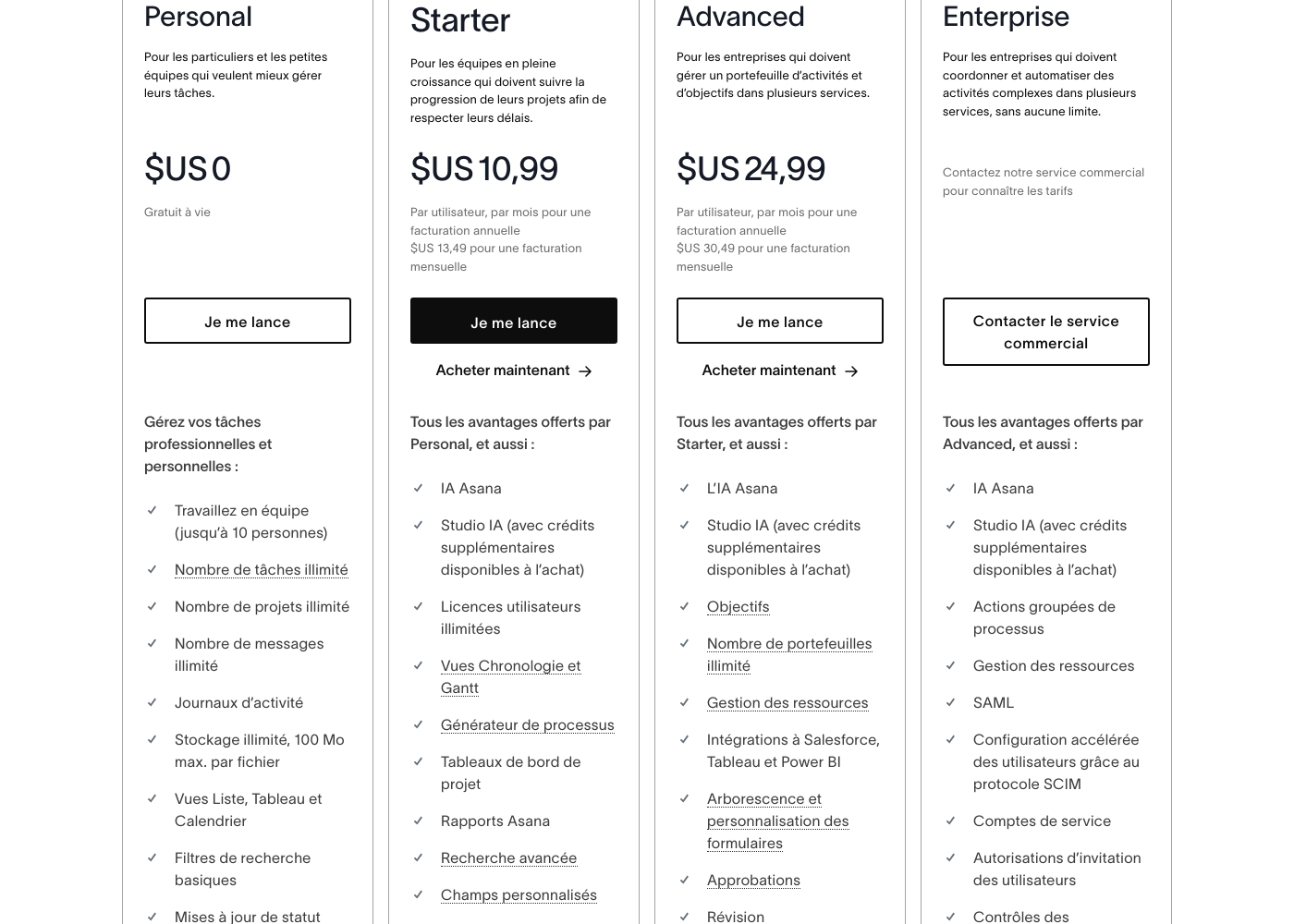
Asana costs between $US 0 and $24.99 per user per month (annual billing) with 5 plans: Personal at $US 0, Starter at $US 10.99, Advanced at $US 24.99, Enterprise at Contact Sales, and Enterprise+ at Contact Sales.
Here is a breakdown of what each plan offers your team.
Personal
Price: $US 0 (Free for life) Websites Supported: Not explicitly stated Best For: Individuals and small teams wanting better task management Refund Policy: Not explicitly stated Other Features:
- Work in teams (up to 10 people)
- Unlimited tasks, projects, and messages
- Unlimited storage (100 MB max. per file)
- List, Board, and Calendar views
- Basic search filters
- Work in teams (up to 10 people)
- Unlimited tasks, projects, and messages
- Unlimited storage (100 MB max. per file)
- List, Board, and Calendar views
- Basic search filters
- Unlimited user licenses
- Asana AI Studio access
- Timeline and Gantt Views
- Process Generator
- Advanced Search and Custom Fields
- Objectives and unlimited portfolios
- Resource Management
- Integrations to Salesforce, Tableau, and Power BI
- Form customization and approvals
- Native time tracking
- Bulk process actions
- SAML and SCIM for accelerated user configuration
- Service accounts
- 24/7 support
- Custom branding
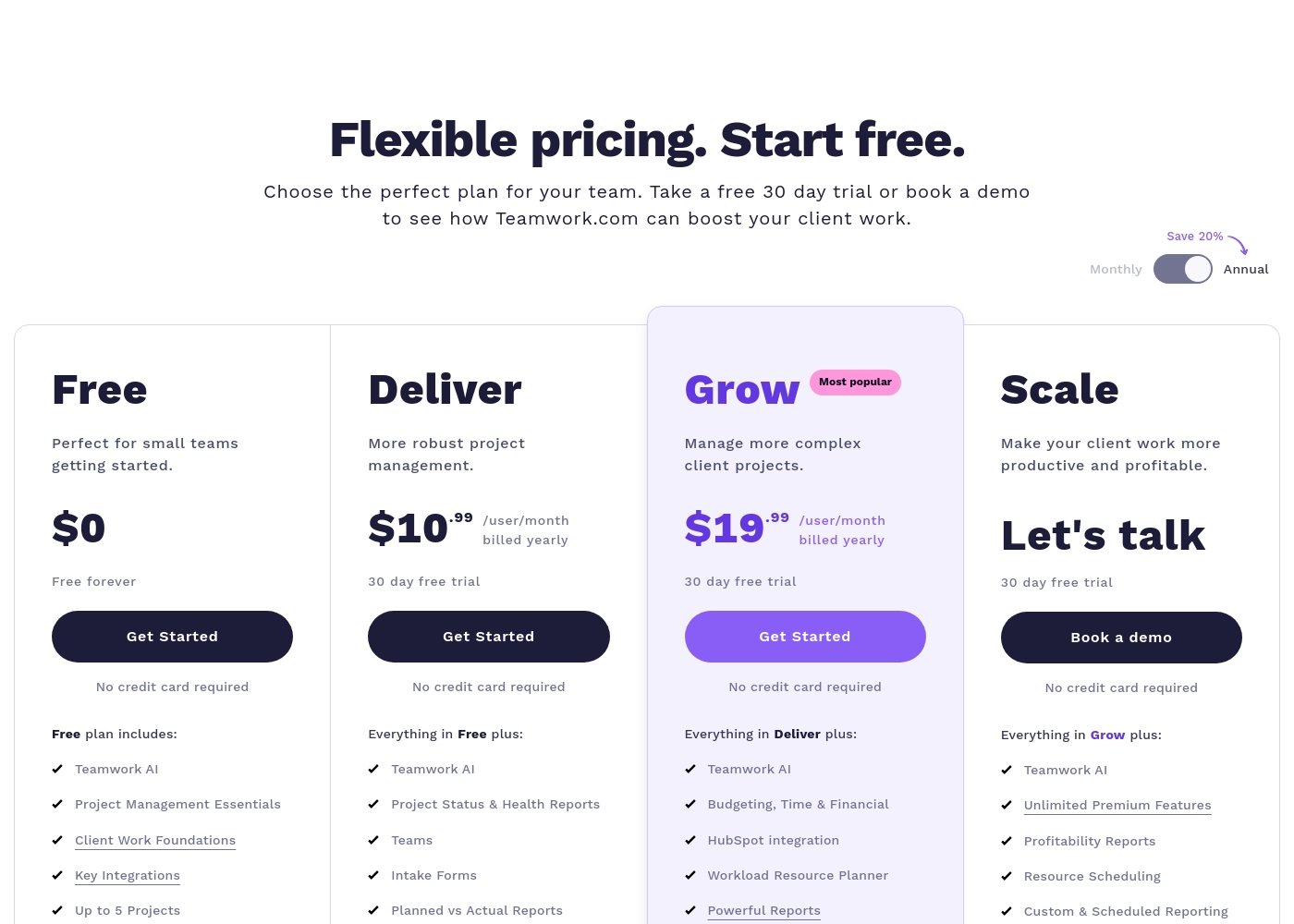
Teamwork costs between $0 and Talk to Sales per month with 4 plans: Free at $0, Deliver at $10.99/user/month, Grow at $19.99/user/month, and Scale at Talk to Sales.
Teamwork offers flexible pricing tailored to your team's size and complexity needs. You can choose to pay monthly or save 20% by selecting an annual subscription.
Free
Price: $0 (Free forever) Websites Supported: Not explicitly stated Best For: Perfect for small teams getting started. Refund Policy: Not explicitly stated Other Features:
- Teamwork AI and Project Management Essentials
- Built-in Time Tracking and Client Work Foundations
- Key Integrations including Slack, Zapier, and MS Teams
- Up to 5 Users and 5 Projects; 100 Automations monthly
- Teamwork AI
- Project Management Essentials
- Client Work Foundations
- Built-in Time Tracking
- Key Integrations (Slack, Zapier, MS Teams)
- Project Status & Health Reports
- Teams
- Intake Forms
- Planned vs Actual Reports
- Integrations (Quickbooks, Harvest and many others)
- Budgeting, Time & Financial
- HubSpot integration
- Workload Resource Planner
- Powerful Reports (Utilization, Time Spent)
- 50 Project Templates
- Unlimited Premium Features
- Profitability Reports
- Resource Scheduling
- Custom & Scheduled Reporting
- Retainer Management (beta)
Pricing Notes
- Asana offers a strong free tier supporting up to 10 users.
- Teamwork offers a 30-day, no credit card required free trial.
- Asana explicitly states refunds are not offered once a paid subscription begins.
- Teamwork users complain about artificial feature limits forcing premature, expensive upgrades.
- Teamwork is generally cheaper per user at the mid-tiers, but higher tiers require sales quotes.
Pricing Head-to-Head
User Reviews
External feedback, predominantly showcased through Trustpilot, reveals widespread dissatisfaction among users, giving the service a significantly low overall rating. Customers frequently criticize the subscription and billing practices, often citing unexpected auto-renewals or unauthorized charges occurring months after cancellation or trial expiration. The inability to secure refunds, even in cases of clear error, is a major pain point.
🚨 The most significant complaint centers on support responsiveness. Reviewers report slow service, sometimes waiting a week for an email reply, reliance on frustrating chatbots, and difficulties contacting a human representative. While some users acknowledge the base product is flexible and has good design features, the company's operational infrastructure and seeming focus on larger enterprises leaves smaller businesses feeling neglected, leading many to label the experience customer-hostile or deceptive.
The app itself is great, offering good design, projects, and flexible team spaces. However, the customer service experience is awful. The only way to talk to CS is often through slow, ineffective emails.
Teamwork's external feedback presents a sharp contrast. Users consistently praise the core software for its powerful functionality, describing it as having a simple interface and a broad scope of data that is essential for running a business.
Clients reportedly appreciate the transparency it offers. However, positive sentiment is heavily outweighed by severe criticism directed at business practices and pricing.
Teamwork is an excellent tool with an extremely simple interface and TONS of functionality. As a former project manager, the level of detail and broad scope of data available sets this tool apart easily.
Our Verdict
Choosing between Asana and Teamwork depends entirely on your primary goal. If you need to align thousands of employees across strategic goals, Asana is the clear winner for organizational scale. Asana handles complex dependencies and connections between daily work and executive objectives. Asana's superpower is its enterprise-ready scalability, advanced AI studio, and superior automation engine. The generous free plan and unlimited automation on paid plans offer fantastic value for large internal teams. However, be aware of the widely criticized customer service and billing practices at Asana. Teamwork’s superpower is its deep focus on profitability and resource efficiency for client-facing teams. Teamwork embeds resource forecasting and cost control right into the management process. This ensures maximum efficiency and clearly tracks billable hours from the start. The critical deciding factor is whether you sell time or manage processes. If every project needs detailed financial tracking and resource utilization reports, Teamwork is unmatched. If you need robust organizational control, advanced compliance, and seamless multi-department coordination, stick with Asana. Ultimately, pick Teamwork if you are an agency managing client budgets and billable hours. Select Asana if you are a scaling business focused purely on internal execution, goal tracking, and needing world-class automation and AI capabilities.
Frequently Asked Questions
Which is better for small teams: Asana or Teamwork?
Asana offers a much more generous free Personal plan supporting up to 10 users. Teamwork’s Free plan is limited to 5 users and 5 projects. Therefore, Asana provides better scalability for small teams and startups.
Can Teamwork replace my dedicated financial tracking software?
Teamwork offers superb native budgeting tools and profitability reports on higher tiers. It tightly integrates financial tracking with project delivery, unlike Asana. It integrates directly with tools like Quickbooks for streamlined workflows.
Does Asana offer better automation rules than Teamwork?
Yes, Asana offers unlimited automation rules on its paid tiers. Teamwork severely caps the monthly automation actions, even on its popular Grow plan (20,000 actions). Asana is better for high-volume automated workflows.
Does Teamwork have resource management capabilities like Asana?
Teamwork is superior for capacity planning, offering Workload Resource Planner and utilization reports. Asana uses resource management for overall staffing visualization. Teamwork is optimized for preventing overbooking billable employees.
Which platform has better customer support reviews?
Neither platform excels here, but Teamwork has a slightly better overall review rating. Asana faces widespread criticism for extremely slow, absent support and aggressive auto-renewal issues. Be prepared for self-service with both options.
Is Asana a good choice if I need HIPAA compliance?
Asana offers HIPAA compliance support through its top Enterprise+ tier. Teamwork does not publicly advertise or provide specific compliance features like HIPAA. Asana is the only choice here for highly regulated industries.
Ready to Choose?
Both tools have their strengths. Choose based on your specific needs.