Canopy vs Mobicip
Canopy and Mobicip both promise excellent digital safety, but they cater to very different needs. Canopy uses aggressive AI to block severe content, achieving industry-leading filtration results. Mobicip focuses on consistent rules, scalability, and better cost per device for large families.
Potent Protection, Crippling Performance Issues
We recognize Canopy's sophisticated AI engine provides industry-leading filtration for explicit material across various devices, making it a powerful tool by design. Overall, while the core technology is advanced, significant user reports of unresponsive support, device lockouts, and severe performance degradation necessitate a low cautionary rating.
Pros
- Highly effective at blocking explicit and pornographic content using AI/machine learning.
- Comprehensive coverage across major operating systems (IOS, Android, Windows, Mac, Chromebooks).
- Includes aggressive anti-tampering/removal prevention features.
- Offers a risk-free 7-day trial and a 30-day money-back guarantee.
Cons
- Dramatically decreases internet speed and overall device performance for many users.
- Customer support is widely cited as unresponsive, unreliable, or non-existent.
- Difficulty removing the application once its protection is fully enabled.
- Inconsistent content blocking, sometimes failing to filter suggestive images or social media.
Comprehensive Features, Criticized Reliability.
We found Mobicip offers comprehensive, multi-platform features like robust screen time limits and social media monitoring at a competitive annual price. Overall, we are concerned by multiple reports indicating that controls are easily circumvented by tech-savvy children, which fundamentally undermines the security promise of the product.
Pros
- App blocking and time schedules work effectively for basic enforcement.
- Supports a wide range of platforms (iOS, Android, Windows, Chromebooks).
- Competitive annual pricing tiers based on family device count.
- Email customer support is rated highly and is helpful during initial setup.
Cons
- Controls are easily bypassed by children changing device time or disabling the VPN.
- Settings frequently get corrupted or unblocked following software updates.
- Administrative functions, like account cancellation, are not available in the web portal and require contacting support.
- Technical glitches can cause connectivity problems and significant battery drain.
AboutCanopy
Canopy is a powerful digital parenting app built to keep children safer across their devices. It uses advanced computing technology, including artificial intelligence and machine learning. This technology instantly recognizes and filters out sensitive or pornographic content, even on your child’s smartphone camera. Setting up Canopy is simple: you download the Canopy App to manage settings and install the Shield App on each device you want to protect. ✅
AboutMobicip
Mobicip is a comprehensive Smart Parental Control App built specifically for the needs of busy families. It aims to simplify digital parenting by offering reliable protection across many different platforms. 💡
Unlike tools restricted to a single company, Mobicip bridges the gap by applying consistent settings across nearly any device. It protects your family on iOS, Android, macOS, Windows, Chromebook, and even Kindle. The app is simple to set up and keeps detailed track of everything your child does online.
Highlights
Feature Comparison
Features Overview
We highlight the main differences and pick a winner for each feature.
Content Filtering Depth
Canopy provides unmatched AI filtering for explicit content and specific sexting alerts. Mobicip offers powerful filtering but doesn't claim the same depth.
Canopy uses powerful AI and machine learning to enforce consistent content filtering. It successfully detects and blocks pornography across every single website. Canopy also filters suggestive content, like images of lingerie and swimsuits. Mobicip utilizes its own powerful AI web filter to block inappropriate material. Its focus is more general filtering and app blocking across all devices. The filtration depth is high, but Canopy's focus is explicitly on complex visual filtering. If blocking the most sensitive visual content is your priority, Canopy is the clear winner here. Mobicip is great for general web safety across many popular sites. Canopy’s instant alerts about risky photos being shared offer protection Mobicip does not explicitly provide.
Supported Devices & Scale
Mobicip supports up to 20 devices across a wider OS range including Kindle. Canopy caps out at 10 devices maximum.
Mobicip is designed for large households, securing up to 20 devices on its PREMIUM plan. It supports iOS, Android, Windows, Mac, Chromebook, and even Kindle devices. Mobicip applies consistent rules to all 20 devices seamlessly. Canopy's largest monthly plan covers a maximum of 10 devices total. Canopy supports the major platforms like iOS, Android, Windows, and Mac. Mobicip is more scalable and platform-inclusive than Canopy's offering. Choose Mobicip if you have a massive device network or use Kindle tablets often. Mobicip offers superior value for money when securing more than 10 separate devices.
Customer Support Quality
Mobicip's email support is rated highly, whereas Canopy users cite extremely poor and unresponsive support.
Canopy receives critically negative feedback regarding its support staff responsiveness. Users frequently report unreturned calls and non-existent help after filing detailed trouble tickets. Support failures severely undermine Canopy’s specialized technology. Mobicip's email customer service is praised as helpful, especially during initial complicated setup. Their support team is available Monday through Friday. Good support is crucial when tech goes wrong, making Mobicip a safer bet for accessibility. The difference in user reviews suggests Canopy needs major improvements in this area. If you are not highly technical, Mobicip's reliable support helps ensure a smoother initial experience.
Performance Impact
Canopy is infamous for crippling device speed; Mobicip has fewer severe performance complaints.
Canopy users report a dramatic decrease in internet speed and overall device performance while the app is active. Many apps and legitimate software stop working entirely for Canopy users. This performance hit is a major recurring complaint. Mobicip users report occasional technical glitches, settings corruption, and battery drain issues. However, these issues are less catastrophic than the crippling slowdowns reported by Canopy users. The aggressive filtration used by Canopy appears to heavily tax the device resources. Mobicip’s performance faults are less system-wide and seem more manageable than Canopy’s. For a stable day-to-day experience without significant lag or interruptions, Mobicip appears to be the better choice.
Subscription Flexibility
Canopy offers monthly plans for maximum flexibility, unlike Mobicip’s mandatory annual commitment.
Canopy provides true flexibility by offering monthly subscription tiers for 3, 5, or 10 devices. This allows users to pay month-to-month without a long-term contract. Mobicip advertises attractively low monthly rates starting at $2.99, but all plans require annual billing. You must commit to a full year upfront with Mobicip. Canopy also provides a 30-day money-back guarantee, lowering the financial risk for trying the service. Mobicip lacks an explicit money-back guarantee. If financial flexibility or short-term trials are essential, Canopy provides better terms and less commitment.
Bypass Resilience
Canopy's anti-tampering is aggressive, but Mobicip is reportedly easier to bypass by tech-savvy kids.
Canopy includes an aggressive Anti-tampering Removal Prevention feature. This robust protection stops adolescents from disabling the Shield app entirely. Its main user complaint is difficulty *by the parent* to remove it. Mobicip offers Uninstall Protection, but many user reviews mention easy vulnerabilities. Children can reportedly bypass Mobicip controls by changing the device’s time or disabling the VPN service. While Canopy’s strength causes support issues, its protective feature is fundamentally sound. Mobicip’s protective features are more easily circumvented, challenging its reliability. If your child is highly technical and actively trying to break controls, Canopy's enforcement is likely superior.
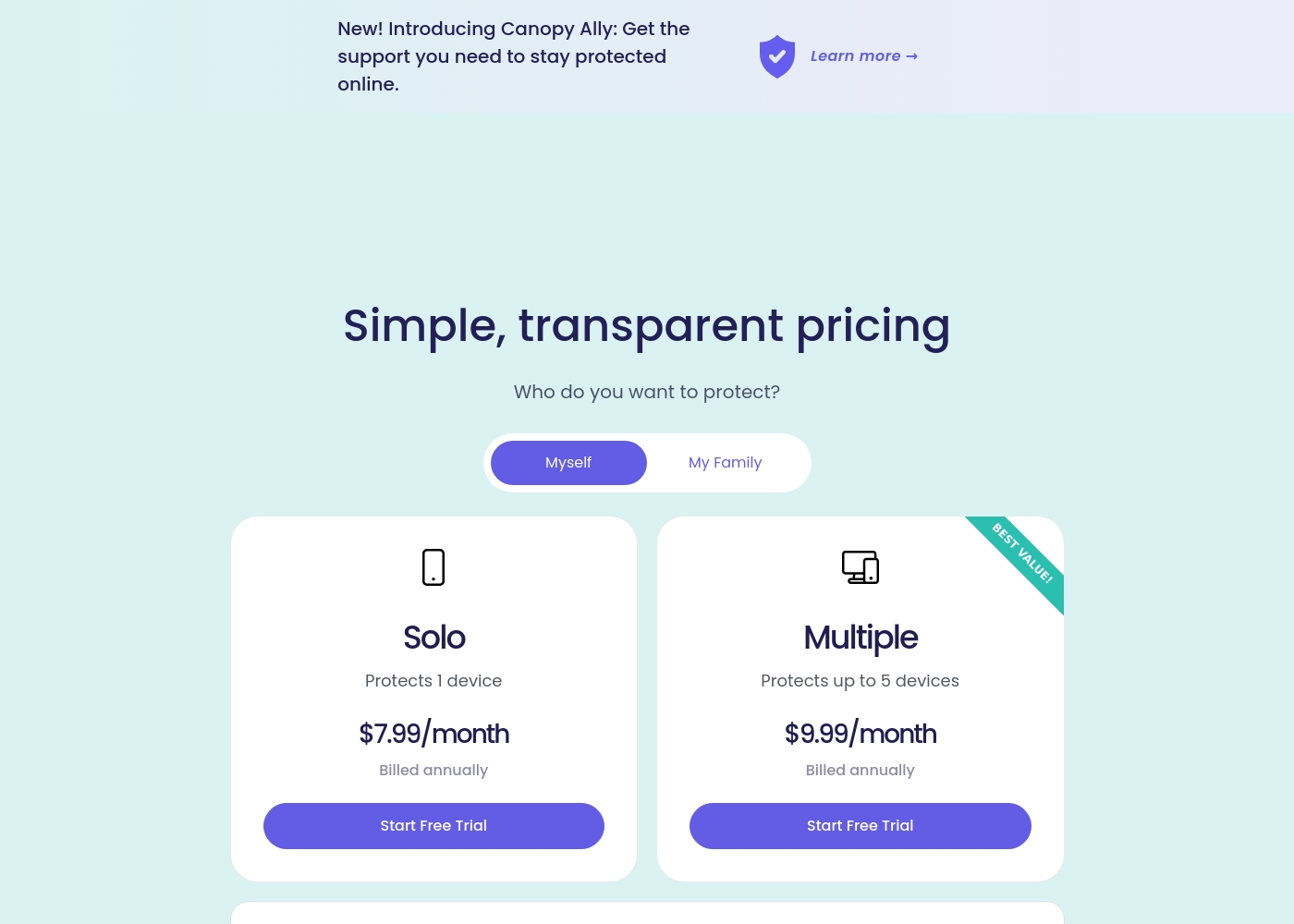
Canopy costs between $9.99 and $15.99 per month with three main monthly device plans: Up to 3 devices at $9.99/month, Up to 5 devices at $11.99/month, and Up to 10 devices at $15.99/month.
Canopy offers clear, device-based pricing designed to fit your family's needs. You can easily select the minimum number of devices required for full protection.
Up to 3 Devices
Price: $9.99 per month Websites Supported: Not explicitly stated (Pornography detection/blocking on every website) Best For: Small families or protecting a few critical devices Refund Policy: 30-day money-back guarantee Other Features:
- Access to all great features
- Email & phone support included
- Instant safety peace of mind
- Protects 1 device
- Access to all features
- Email & phone support
- Protects up to 5 devices
- Access to all features
- Email & phone support
- Access to all features
- Email & phone support
- Access to all features
- Email & phone support
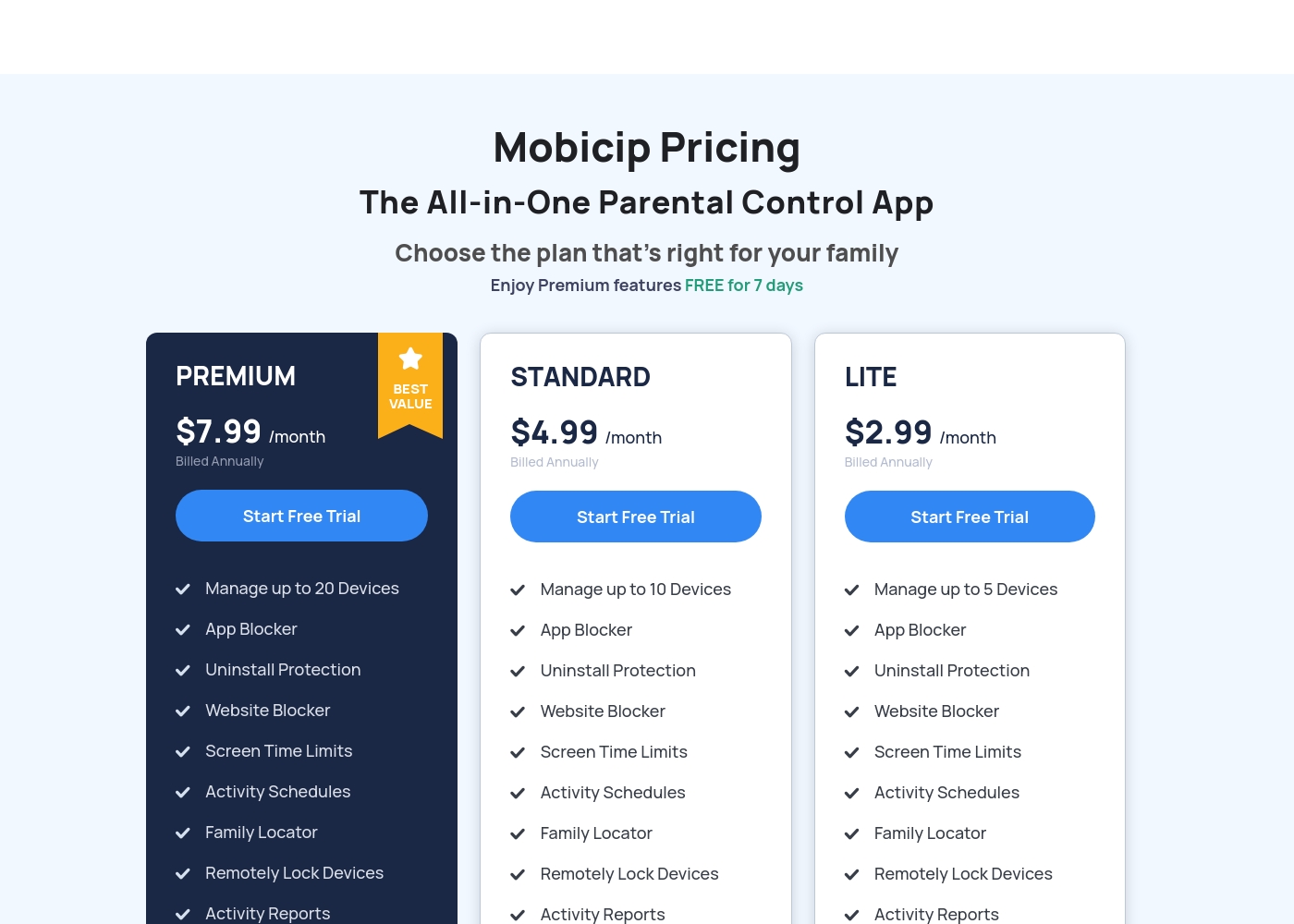
Mobicip costs between $2.99 and $7.99 per month (when billed annually) with three plans: LITE at $2.99/month, STANDARD at $4.99/month, and PREMIUM at $7.99/month.
You can easily choose the right plan for your family's needs below. All options include a 7-day free trial of Premium features.
LITE
Price: $2.99/month (Billed Annually) Websites Supported: Not explicitly stated Best For: Families with 5 or fewer devices Refund Policy: Not explicitly stated Other Features: Uninstall Protection, Website Blocker, Screen Time Limits, Activity Schedules, Activity Reports, Family Locator
- Manage up to 5 Devices
- App Blocker
- Uninstall Protection
- Website Blocker
- Screen Time Limits
- Manage up to 10 Devices
- App Blocker
- Uninstall Protection
- Website Blocker
- Screen Time Limits
- Manage up to 20 Devices
- App Blocker
- Uninstall Protection
- Website Blocker
- Screen Time Limits
Pricing Notes
- Mobicip pricing appears cheaper ($2.99–$7.99/month), but all tiers require annual upfront payment.
- Canopy offers true month-to-month flexibility with plans up to $15.99/month.
- Mobicip provides significantly better cost-per-device, covering up to 20 devices on its highest plan.
- Canopy offers a 30-day money-back guarantee, which Mobicip does not explicitly state.
- Both Canopy and Mobicip offer a 7-day free trial on their respective services.
Pricing Head-to-Head
User Reviews
Canopy receives critically mixed but predominantly negative feedback from users, resulting in a low 2.3-star Trustpilot rating. A major point of praise is its accuracy; several users confirm it is the most effective application they have found for blocking explicit/pornographic content using its specialized AI. However, this functionality comes at a severe cost to reliability and performance. The most recurring complaints center on the app dramatically slowing down internet speeds (in some cases dropping connection speeds by over 80%) and causing other legitimate applications or software to malfunction. 😔
Support responsiveness is also deeply criticized; users repeatedly report unresponsive customer service, difficulties contacting staff, or complete silence after submitting detailed troubleshooting information. Functionality issues include inconsistent blocking (failing to filter suggestive content or social media as requested) and, critically, inability to remove the app easily due to its anti-tamper protection. Multiple accounts reported being locked out of essential work devices for days while waiting for updates or support. The consensus suggests that while the core filtering technology is powerful, the crippling performance slowdowns and unacceptable support failures severely undermine its value.
This is a great app. I’ve had it for years and it’s the most effective one for blocking objectionable sites I've tried. Their tech support is superior and always willing to help.
Mobicip holds a "Great" 4.1-star rating on Trustpilot, though this score is based on a very limited number of reviews. Users generally appreciate the core functions like app blocking and setting screen time schedules, which successfully helps keep young children focused, and email customer service has been highly praised as "Excellent" during setup.
However, significant reliability concerns challenge Mobicip's effectiveness as a true parental control tool. Several parents report that the app is easily bypassed—teenagers can circumvent controls by changing phone time, disabling the VPN, or simply deleting the app to regain full access.
App blocking and screen time schedules work well, especially for keeping my children focused during class time. We successfully use it across both iPhones and Windows PCs. It is an effective tool for setting digital boundaries.
Our Verdict
Choosing between Canopy and Mobicip is a classic trade-off between power and reliability. Canopy has aggressive protection, but Mobicip offers better consistency for the average family. Ultimately, you must decide which failure mode is less disruptive to your household. Canopy's superpower is its industry-leading, AI-driven content enforcement. It uniquely sends instant alerts for sexting and blocks pornography on every website. Pick Canopy if stopping the most toxic visual content is your absolute priority, despite the risks. Mobicip’s superpower is its broad scalability and excellent consistency across devices. It allows you to protect 20 devices, even Kindles, with one set of global rules. Plus, Mobicip’s customer support is widely praised, unlike Canopy’s criticized service. The deciding factor is likely daily performance or advanced filtering. Canopy might severely slow down your internet speed while Mobicip is often exploited by clever teens. Mobicip also has features like the Child Dashboard to encourage self-regulation. Pick Mobicip if you manage 10+ devices and value reliability, support, and low annual cost. Choose Canopy only if you require maximum explicit content protection and are prepared for potential performance downsides.
Frequently Asked Questions
Which tool is cheaper for a large family: Canopy or Mobicip?
Mobicip is significantly cheaper per device since it supports up to 20 devices. Mobicip's highest tier costs only $7.99/month (billed annually). Canopy’s top plan is $15.99/month and only covers 10 devices.
Can Canopy or Mobicip be easily uninstalled by a child?
Canopy has aggressive anti-tampering protection, making removal very difficult. Mobicip has Uninstall Protection, but controls are reportedly bypassed by children disabling the VPN or changing the device time. Canopy offers stronger enforcement protection.
Which focuses more on collaboration with the child: Canopy or Mobicip?
Mobicip is designed around collaboration and includes a Child Dashboard for kids to monitor their own screen time. Canopy focuses purely on top-down parental enforcement. Mobicip helps foster self-regulation skills in your children.
Does Canopy offer a free trial like Mobicip?
Yes, both Canopy and Mobicip offer a 7-day free trial on their premium features. Canopy adds an explicit 30-day money-back guarantee. Mobicip does not explicitly advertise a money-back period.
Why is Canopy's user rating so much lower than Mobicip's?
Canopy users widely complain that the app dramatically slows down device and internet performance. Canopy's customer support is also frequently unresponsive and unhelpful. Mobicip has better overall user satisfaction and higher ratings.
Which tool offers the best protection for mixed Apple and Windows devices?
Mobicip is known for applying consistent rules across many operating systems, including Kindles. Mobicip's scalability to 20 devices makes it superior for large, highly mixed device households. Canopy still supports major platforms but with a lower device limit.
Ready to Choose?
Both tools have their strengths. Choose based on your specific needs.