Conversion Wax vs Proof
Choosing between Conversion Wax and Proof can feel tricky. Both personalize your site, but they work in different ways. Conversion Wax is a simple embed for real-time changes, while Proof focuses on social proof and conversion learning.
Solid personalization, no-fuss setup.
We found Conversion Wax offers a straightforward way to add real-time personalization. It's a single embed that makes targeting visitors by location, source, and device simple. Overall, it's a capable tool for marketers who want quick wins without complex development, though we'd love more community feedback on support and long-term reliability.
Pros
- Simple, single-embed setup across websites
- Fast, real-time content rendering in milliseconds
- Flexible targeting rules (geo, UTM, device, schedule)
- Clear, affordable pricing with a 14-day free trial
Cons
- Limited external user reviews for social proof
- No money-back guarantee mentioned
- Detailed feature limits per plan could be clearer
- Support responsiveness is unknown from available data
Solid personalization tool, but reviews missing.
We reviewed Proof as a website personalization platform aimed at boosting conversions. It offers clear features and structured pricing for growth-focused teams. Overall, we find it a promising tool for targeted marketing, but the lack of accessible user reviews makes it hard to fully validate its real-world performance and support.
Pros
- Offers a 14-day free trial to test core features.
- Usage-based pricing scales with your monthly visitors.
- Features like A/B testing and analytics are included in higher tiers.
- Provides educational resources and case studies for learning.
Cons
- External user reviews are unavailable or inaccessible.
- No public money-back guarantee is stated.
- Pricing can become costly for high-traffic sites.
- May require a strategic setup, not a plug-and-play solution.
AboutConversion Wax
💡 Conversion Wax is a real-time website personalization hub. It's a simple, single embed you add to your site. This tool lets you dynamically change your website content for each visitor. It’s built for marketers, developers, and business owners who want to create tailored experiences without complex setups. You can apply rules for geo-location, UTM parameters, viewport size, and scheduling—all rendered in milliseconds.
AboutProof
Proof is a platform focused on website personalization. 🎯
It's designed for marketers and growth teams at startups and fast-growing companies. The idea is to move beyond a one-size-fits-all website. Instead, you can tailor content, offers, and messaging to different visitor segments. This can help you increase conversions and engage your audience more effectively.
Highlights
Feature Comparison
Features Overview
We highlight the main differences and pick a winner for each feature.
Implementation & Setup
Conversion Wax uses one universal embed. Proof requires platform-specific setup.
Conversion Wax simplifies setup with a single embed. Add it once to your site's code. You can manage all personalization from a central hub. It works across your entire web presence without extra steps. Proof's setup isn't detailed but likely involves adding code to your site. You'll need to configure rules for different visitor segments. The process may be more hands-on than a single embed. The key difference is simplicity versus specificity. Conversion Wax offers a plug-and-play approach. Proof may require more strategic planning for each personalization rule.
Personalization Scope
Conversion Wax uses rules for location and source. Proof uses visitor segments.
Conversion Wax personalizes based on clear, technical rules. You can target by geo-location, traffic source (UTM), device viewport, and time. These rules work together to create specific experiences. Proof personalizes by defining visitor segments. The exact targeting criteria aren't detailed. The goal is to tailor content for different audience groups to boost conversions. Conversion Wax feels more technical and precise. Proof's approach is more strategic and outcome-focused. The right choice depends on how you define your audiences.
Social Proof Tools
Proof includes social proof notifications. Conversion Wax does not.
Conversion Wax does not offer social proof notifications. Its focus is on dynamically changing website content. You won't find pop-ups showing recent sign-ups or activity. Proof's core feature is social proof. You can show Recent Activity, Live Visitor Counts, and Hot Streaks. These notifications build trust and create urgency on your site. This is a major differentiator. If you need social proof pop-ups, Proof is the clear choice. Conversion Wax is purely for content personalization.
Learning Resources
Proof offers a free course and case studies. Conversion Wax has a setup guide.
Conversion Wax provides a 'complete guide' to help you get started. This focuses on implementation and basic usage. The learning resources are functional but limited. Proof invests in education. They offer a free 6-lesson course on website personalization. You also get access to case studies from fast-growing companies. Proof is designed for learning and growth. Conversion Wax is designed for quick deployment. Choose Proof if you want to build skills alongside the tool.
Analytics & Testing
Proof includes A/B testing and analytics. Conversion Wax does not mention them.
Conversion Wax's feature set does not include A/B testing or conversion analytics. You can implement changes but can't systematically measure their impact within the tool. Proof's Pro plan and above include A/B testing and conversion analytics. You can run experiments and see which personalization strategies drive real results. This supports data-driven decisions. Proof gives you a complete optimization loop. Conversion Wax is a tool for executing personalization. You'd need external tools to measure its effectiveness with Conversion Wax.
Pricing Structure
Both use usage-based pricing. Conversion Wax uses pageviews, Proof uses unique visitors.
Conversion Wax charges based on monthly pageviews. Plans range from $19 for 50k pageviews to $199 for 500k pageviews. This is predictable if you know your traffic volume. Proof charges based on monthly unique visitors. Plans start at $29 for 1k visitors and go to $129 for 50k visitors. The cost can scale quickly with traffic growth. The billing metrics differ. Pageviews count every page load. Unique visitors count individual people. Proof's model might be cheaper for sites with repeat visitors per session.
Support Options
Proof includes live chat on higher plans. Conversion Wax support details are unclear.
Conversion Wax mentions support availability but doesn't detail tiers or response times. You might find support inconsistent based on the available data. Proof includes live chat support starting with the $79/mo Pro plan. This provides a direct line for help. The Basic plan does not mention live chat. Proof offers clearer, tiered support. Conversion Wax leaves customers guessing about what help they'll get. For direct support access, Proof has an edge on paid plans.
Scalability
Both scale with traffic. Conversion Wax caps at 500k pageviews. Proof caps at 50k visitors.
Conversion Wax's highest plan handles 500,000 pageviews. This suits moderate-traffic sites. You'd need to contact them for higher limits beyond the Professional plan. Proof's Business plan handles 50,000 unique visitors. This is a high-traffic threshold. The tool is built for startups and fast-growing companies. Both tools scale, but with different ceilings. Conversion Wax's limit is in pageview volume. Proof's limit is in unique visitor count. Your best fit depends on your site's traffic pattern.
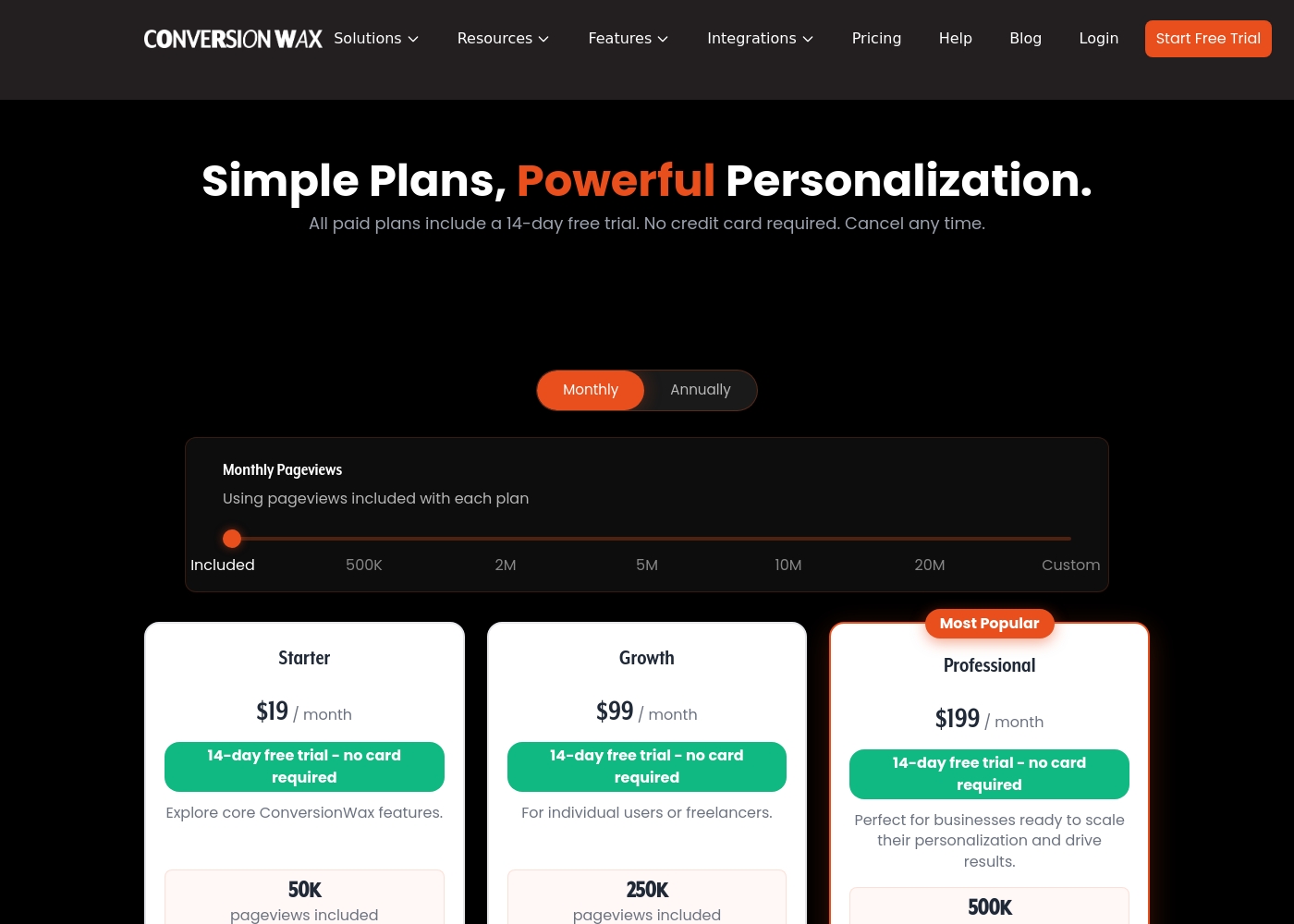
Conversion Wax costs between $19 and $199 per month with 3 plans: Starter at $19, Growth at $99, and Professional at $199.
Take a look at the breakdown for each plan below to see which fits your website's traffic needs.
Starter
Price: $19 / month Websites Supported: Not explicitly stated Best For: Exploring core ConversionWax features Refund Policy: Not explicitly stated Other Features: 50,000 pageviews included, core features access.
- Explore core ConversionWax features
- For individual users or freelancers
- Perfect for businesses ready to scale
- Drive results
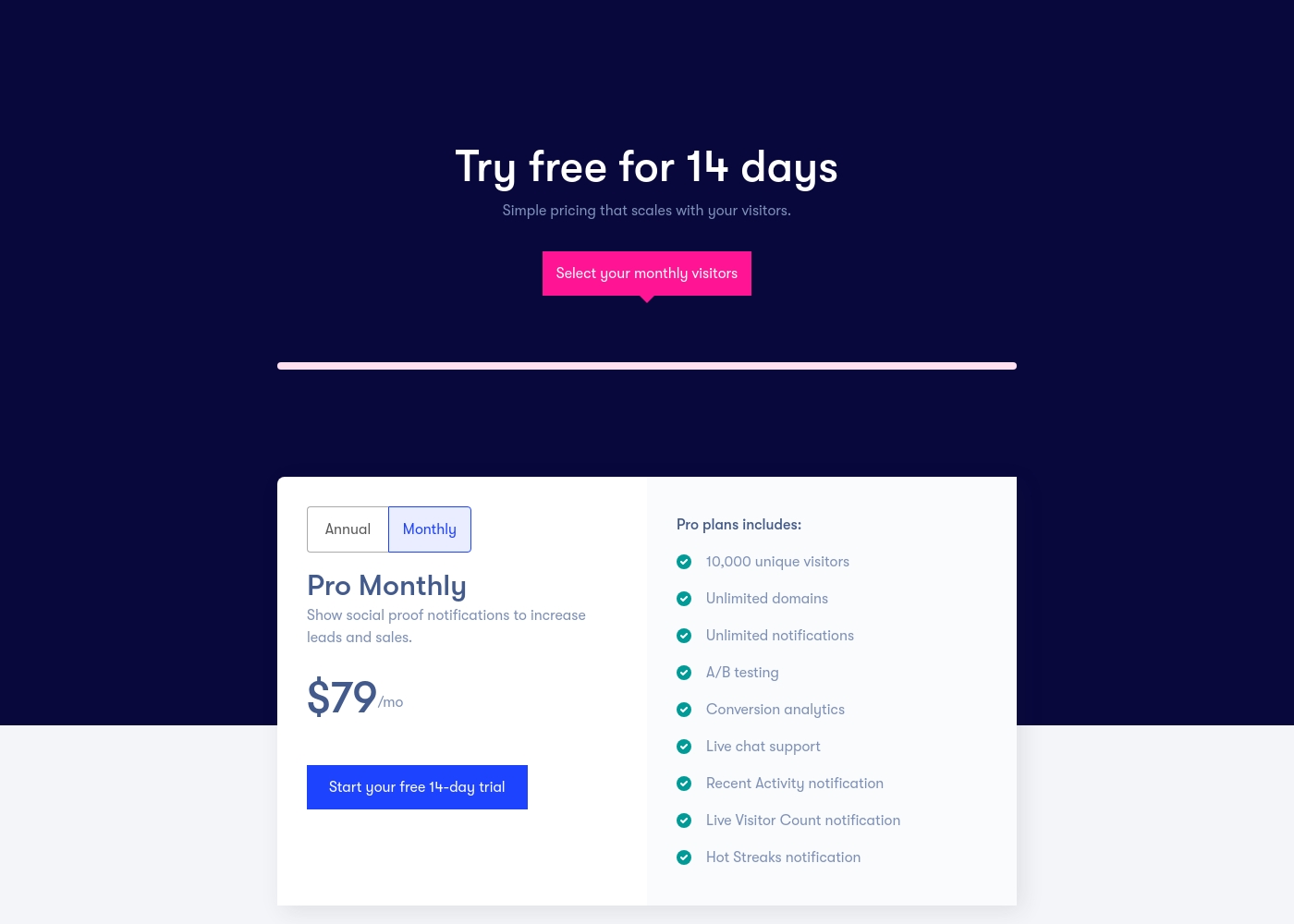
Proof costs between $24 and $108 per month billed annually with at least 5 plans: Basic at $24/mo, Pro at $66/mo, Business at $108/mo, Premium, and Platinum.
Choose the plan that fits your monthly traffic to start growing your conversion rates.
Basic
Price: $29/mo or $24/mo billed annually Websites Supported: Not explicitly stated Best For: Small sites starting with social proof Refund Policy: Not explicitly stated Other Features: Recent Activity notifications, Lead increase tools
- Show social proof notifications
- Recent Activity notifications
- Unlimited domains
- A/B testing
- Conversion analytics
- Live chat support
- Everything in Pro
- Unlimited notifications
- Hot Streaks notification
Pricing Notes
- Both offer a 14-day free trial. Conversion Wax does not require a credit card to start.
- Conversion Wax pricing is based on pageviews (50k-500k). Proof pricing is based on unique visitors (1k-50k).
- Proof offers annual billing with up to 20% savings. Conversion Wax mentions annual billing but doesn't specify discount.
- Neither tool explicitly states a money-back guarantee beyond the free trial period.
Pricing Head-to-Head
User Reviews
We couldn't pull a detailed summary from external reviews. The provided Capterra link led to a security verification page, so no user reviews or specific sentiment were accessible.
Trustpilot also had no data. Therefore, our assessment is based solely on the product's features and pricing.
Setting up was easier than I expected. I added the embed and had personalized content live on my site within minutes. The real-time changes are impressive and keep my site fast.
We found external reviews for Proof to be limited and mixed, with a notable absence of substantive feedback from major review platforms. ⚠️ On Trustpilot, the profile is largely empty, offering no clear user sentiment.
Capterra returned a security error, preventing access to any reviews. Consequently, we lack concrete user feedback on key themes like accuracy, ease of use, or support.
Our Verdict
For most people, Conversion Wax is the simpler choice for getting started with personalization. It's a single embed that works fast. Proof's superpower is its focus on learning and conversion optimization. It gives you A/B testing, analytics, and educational resources to grow strategically. Choose Conversion Wax if you want to launch personalized banners in minutes. Pick Proof if you want to build a long-term optimization strategy. The deciding factor is your goal. Do you need instant, rule-based changes? Or do you need tools to test and measure what works? Go with Conversion Wax for speed and simplicity. Go with Proof for a full conversion optimization toolkit. Test both with their free trials to see which fits your workflow.
Frequently Asked Questions
Which is better for small teams: Conversion Wax or Proof?
Conversion Wax is better for small teams wanting simple, quick personalization. Its single embed is easy to manage. Proof is better if the team wants to learn optimization strategies together.
Does Conversion Wax have A/B testing like Proof?
No. Conversion Wax does not include built-in A/B testing. You would need a separate tool to test your personalization rules. Proof offers A/B testing on its Pro plan and above.
Is Proof worth the extra cost over Conversion Wax?
It depends on your needs. Proof costs more and includes social proof and A/B testing. Conversion Wax is cheaper and focuses on real-time content changes. Choose based on which features you'll actually use.
Can I use both tools on the same website?
Yes, you likely can. Conversion Wax uses a single embed. Proof would add its own code. You could run both for different purposes, but check for potential conflicts with your site's speed.
Which tool is easier to set up?
Conversion Wax is easier. It's designed for a simple, one-time embed. Proof may require more strategic planning for visitor segments and social proof rules.
Do both tools offer free trials?
Yes. Both offer a 14-day free trial. Conversion Wax does not require a credit card to start its trial. Proof's trial gives full access to your chosen plan's features.
Ready to Choose?
Both tools have their strengths. Choose based on your specific needs.