DigitalOcean vs Google Cloud
Developers often compare DigitalOcean and Google Cloud for cloud infrastructure needs. DigitalOcean champions simplicity, predictable pricing, and amazing customer support. Google Cloud focuses on massive enterprise scale and deep, world-class AI integration. This comparison helps guide you to the platform that truly fits your project.
Predictable Pricing, Powerful Dev Tools, Excellent Support
We find DigitalOcean excels by combining powerful Linux virtual machines and advanced AI infrastructure with remarkable ease of use and developer-centric pricing. The service consistently earns high marks for its stellar, quick customer support, strong reliability, and clear usage-based billing practices that prevent bill surprises. Overall, DigitalOcean is highly recommended for developers and businesses requiring predictable, high-value cloud services.
Pros
- Customer support is exceptionally quick, helpful, and provides detailed solutions.
- The platform is highly reliable with consistent performance and minimal reported downtime.
- Intuitive control panel and great guides make server setup very easy and clear.
- Overs a $200 free credit to new users for testing services over 60 days.
Cons
- The company strictly states that it does not offer refunds for utilized services.
- Occasional reports from long-time users concerning unexpected hardware failures.
- Users have noted an occasional lack of specific advanced features, often requiring workarounds.
Powerful Infrastructure, Risky Billing and Support.
We recognize Google Cloud delivers leading infrastructure, offering powerful AI integration and significant scaling for enterprise workloads. However, the high volume of reports detailing inaccessible customer support and confusing, non-transparent billing is deeply concerning. Overall, we see this platform as high-risk for users prioritizing responsive help or granular cost control.
Pros
- Access to top-tier generative AI tools like Gemini and Vertex AI.
- Supports open source, multilcloud, and hybrid development strategies.
- New users receive $300 in free credits upon signing up.
- Offers potential savings up to 57% via committed use discounts.
Cons
- Customer service support is frequently inaccessible and hidden.
- Users report non-transparent billing and unexpected charges despite having credits.
- Extremely high costs for technical support subscriptions (up to $12,500/month).
- Lack of hard spending limits for pay-as-you-go services is a common pain point.
AboutDigitalOcean
DigitalOcean provides core infrastructure, focusing on versatile Linux cloud architecture. It’s the right choice for developers who need robust cloud services and specialized platforms. The service supports everything from fundamental system setup, like installing Docker on Ubuntu, to sophisticated deployments. If you're exploring open source AI platforms, or need the muscle of H100 GPUs for models like Ollama, this platform delivers. 💡
AboutGoogle Cloud
Google Cloud is a comprehensive cloud platform offering more than 150 products and capabilities. It helps businesses modernize existing infrastructure or build entirely new AI-driven applications from scratch. The service is designed for developers, business leaders, and startups ready to digitally grow and transform.
New customers can try Google Cloud with free usage of over 20 products. Plus, you’ll receive $300 in free credits upon signing up to help you explore. 💡
Highlights
Feature Comparison
Features Overview
We highlight the main differences and pick a winner for each feature.
Pricing Clarity
DigitalOcean bills are predictable; Google Cloud pricing is complex and often surprises users.
DigitalOcean focuses on clear, predictable starting costs, such as Droplets at $4/month. Billing is usage-based but minimizes unpleasant surprises, earning high user praise. Google Cloud uses a pay-as-you-go model that users find non-transparent and confusing. Committed Use Discounts offer large savings, but the complex structure remains a barrier. DigitalOcean prevents dreaded 'bill shock' by maintaining developer-friendly transparency. Google Cloud's structure, lacking hard limits, causes frequent frustration and terrible review scores. If cost stability is your priority, DigitalOcean offers a more trustworthy financial model.
AI & Generative Tools
Google Cloud leads in breadth with Gemini; DigitalOcean offers powerful, focused AI infrastructure.
DigitalOcean’s Gradient AI Platform simplifies LLM integration and agent creation efficiently. It also provides powerful H100 GPU Droplets necessary for heavy AI/ML training. Google Cloud's Vertex AI is enhanced by Gemini, granting access to an incredible 200+ foundation models. Gemini Code Assist provides immediate, AI-powered assistance to developers. Google Cloud built a massive ecosystem specifically for building next-generation generative AI applications. DigitalOcean provides the essential, high-performance compute resources needed for model training. For projects needing the widest selection of managed AI tools, Google Cloud is the superior platform.
Ease of Use
DigitalOcean’s console is intuitive; Google Cloud’s UX is often slow and overly complicated.
DigitalOcean’s intuitive control panel and documentation promote a quick, self-service developer experience. Users find server setup and management easy and clear. Google Cloud reviews frequently cite the console as 'unusably slow' and difficult to navigate. Simple tasks, like finding an API key, often require excessive clicks. DigitalOcean highly prioritizes developer workflow and functional simplicity over extreme feature density. Google Cloud's sheer product volume often compromises its management user experience. Choose DigitalOcean if rapid deployment and minimizing administrative overhead are crucial for your team.
Customer Support
DigitalOcean support is fast and effective; Google Cloud support is repeatedly slammed as unreachable.
DigitalOcean receives overwhelming praise for its support team being 'exceptionally quick' and helpful. They provide detailed solutions, often responding faster than 24 hours. Google Cloud users report being unable to reach human support, stuck in frustrating, endless loops. Standard fees only cover billing support; technical help is costly. DigitalOcean makes responsive, human assistance a core pillar of its offering. Google Cloud’s lack of accessible technical support is a major financial and operational risk factor. Prioritizing responsiveness and reliable help means DigitalOcean is the better choice for peace of mind.
Scaling & Enterprise Power
Google Cloud handles global, unlimited scale; DigitalOcean offers reliable, predictable scaling for most needs.
DigitalOcean’s foundational Droplets and Managed Kubernetes scale reliably as projects grow on demand. It supports robust performance across medium to large cloud workloads. Google Cloud features specialized tools like Spanner, designed for unlimited scale and 99.999% availability. It handles massive data processing and complex global deployments. If your organizational needs demand five-nines reliability and global data center reach, Google Cloud is necessary. DigitalOcean provides excellent scaling but targets the high-growth developer market. Mission-critical applications requiring absolute maximum availability should be hosted on Google Cloud.
Data Analytics
Google Cloud leads in massive-scale data analytics; DigitalOcean provides stable managed database backends.
DigitalOcean offers necessary Managed Databases (PostgreSQL, MySQL) and Spaces for object storage. These provide stable, reliable data layers for running applications. Google Cloud's BigQuery allows running analytics efficiently at a massive scale. It offers a 26%–34% lower TCO compared to similar data warehouse alternatives. Google Cloud is built for organizations whose core business relies on large-scale data processing and intelligence. DigitalOcean's data tools are application-focused, not analytics-focused. For making smarter, faster decisions using huge datasets, BigQuery within Google Cloud is superior.
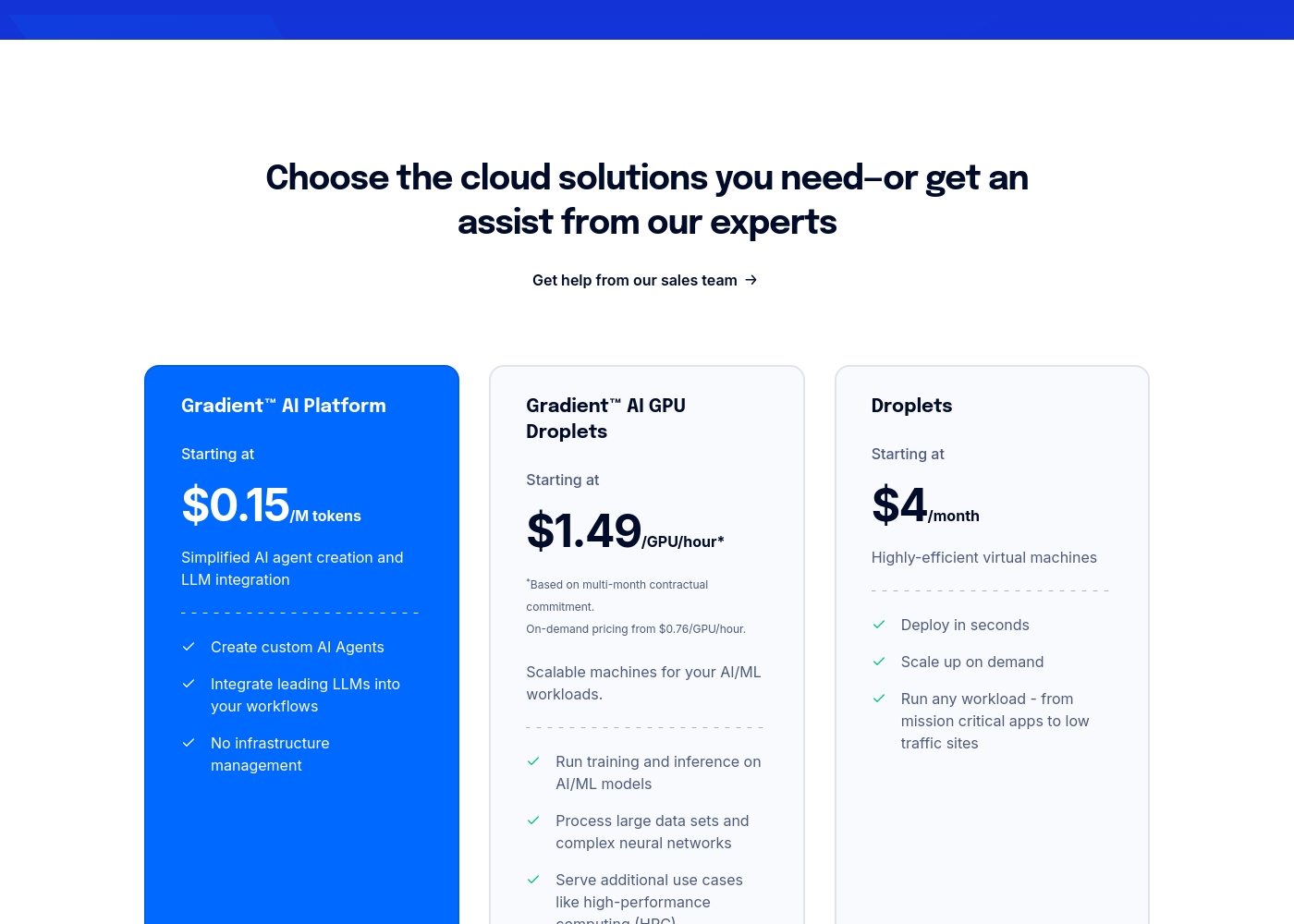
DigitalOcean costs between $0 and $15 per month with 13 core services, including App Platform at $0/month, Droplets at $4/month, and Databases starting at $15/month.
DigitalOcean offers simple, predictable pricing for all its core cloud solutions. Here are the starting costs and key features for some of the most popular infrastructures available.
Gradient™ AI Platform
Price: Starting at $0.15 /M tokens Websites Supported: Not explicitly stated Best For: Simplified AI agent creation and LLM integration Refund Policy: We do not offer refunds. Other Features:
- Create custom AI Agents
- Integrate leading LLMs into your workflows
- No infrastructure management
- Highly-efficient virtual machines
- Deploy in seconds
- Scale up on demand
- Simple, managed Kubernetes
- Includes load balancing and networking
- Fully managed and maintained
- High availability and scaling
- Simple, fully-managed infrastructure solution
- Zero base cost for basic usage
- Automatic application deployment
Google Cloud costs vary widely as it uses a usage-based payment structure, offering new customers $300 in free credits and access to 20+ free products.
You won't find fixed monthly plans here, but instead three flexible ways to utilize the platform's computational resources.
Pay-as-you-go (Standard Pricing)
Price: Not explicitly stated (Usage-based) Websites Supported: Not explicitly stated Best For: Organizations of all sizes needing flexible scaling Refund Policy: Not explicitly stated Other Features:
- You only pay for the services you use.
- No up-front fees or termination charges.
- Potential savings up to 57% with committed use discounts.
- Includes free 24/7 billing support.
- Only pay for the services you use
- No up-front fees or termination charges
- Save up to 57% with committed use discounts
- Free 24/7 billing support
- $300 in free credits
- Access to 20+ products for free
- Run, test, and deploy workloads
- Up to $350,000 in Cloud credits
- Customized support and solutions
- Scaling support for innovative companies
Pricing Notes
- DigitalOcean offers clearer, lower starting rates, like Droplets at $4/month, preventing bill shock.
- Google Cloud's pricing revolves around complex usage, which users often report as non-transparent and surprisingly high.
- DigitalOcean does not offer refunds for utilized services or expired credits, a clear policy.
- Google Cloud offers significant savings potential (up to 57%) through committed use discounts for heavy users.
- Both offer substantial free credits for new users, DigitalOcean: $200, Google Cloud: $300.
Pricing Head-to-Head
User Reviews
DigitalOcean consistently receives overwhelming praise across external review platforms, reflected in its impressive 4.6-star rating on Trustpilot. Customers frequently highlight the exceptional quality and responsiveness of the customer support team. Users often report that the support staff is helpful, patient, and provides detailed, clear explanations, frequently responding much quicker than the published 24-hour service level agreement (SLA). Many consumers state that DigitalOcean offers the best combination of pricing, value, and support in the cloud computing sector. The platform is described as straightforward and easy to use, featuring an intuitive control panel and extensive documentation that simplifies complex server configurations.
Reliability is a major selling point. Many long-term users report consistent performance and minimal, or even zero, downtime over several years, ensuring smooth project operation. Furthermore, the pricing structure is seen as economical, fair, and transparent, preventing unexpected monthly charges. Whether users are deploying simple web apps or handling advanced AI/ML workloads on beefy GPUs, the general sentiment confirms DigitalOcean provides a powerful, reliable hosting environment with excellent service delivery. 🤩
I have been using DigitalOcean for more than seven years now. I never experienced any downtime during this period, which is essential for our business continuity. Their support team has always been quick and helpful when I needed assistance.
The external sentiment, primarily captured by Trustpilot, is overwhelmingly negative, resulting in a very poor 1.5-star rating. The most frequently cited issues revolve around non-transparent billing and absolutely dysfunctional customer support ⚠️. Users report unexpected charges, sometimes totaling hundreds of dollars, even when they possess substantial free credits. Many feel this lack of transparency is a "deliberate trap" designed for new users. Furthermore, getting help is nearly impossible; users describe support as intentionally hidden and unreachable, sending them into frustrating, endless loops. Those requiring technical help face exorbitant fees, with specialized technical support costing steep thousands per month.
Beyond cost management, users criticize the low ease of use. Complaints include the console being "unusably slow" and the process for simple tasks, like retrieving an API key, demanding excessive clicks. Users also struggle with important account management functions, such as deleting active projects that continue to generate fees or updating billing information. This strongly indicates that while the platform is technologically powerful, the surrounding user experience, administration, and financial control are severely flawed.
My account incurred €327 in API costs, even though I had €264 in free credits available which weren't used. Support is completely hidden and impossible to reach, making it seem like a deliberate trap. This platform has an extremely non-transparent pricing structure.
Our Verdict
Choosing between DigitalOcean and Google Cloud is a choice between developer delight and enterprise power. The winner depends entirely on your project's scaling trajectory and complexity needs. For most modern startups and small teams, DigitalOcean is the clear functional winner. DigitalOcean excels in simplicity, stability, and trust. It offers transparent pricing, preventing dreaded bill shock with low starting costs. Developers love the intuitive console and the consistently fast, human customer support. DigitalOcean is your partner for reliable, powerful Linux architecture without the steep learning curve. Google Cloud dominates the enterprise space and cutting-edge AI integration. Tools like Vertex AI and Gemini provide unmatched generative AI capabilities and scaling. Specialized services like Spanner support virtually unlimited growth and 99.999% uptime. Google Cloud is necessary for massive data analytics like BigQuery. The core trade-off is complexity versus manageability and cost control. DigitalOcean users praise its transparent billing and accessible support team. Google Cloud users consistently complain about hidden costs and inaccessible support, despite the massive feature set. If you are launching a web application or an LLM project and need predictable value and excellent help, choose DigitalOcean. Only switch to Google Cloud if you genuinely require its massive, global enterprise features or access to its $350,000 startup credit program.
Frequently Asked Questions
Which is easier to use: DigitalOcean or Google Cloud?
DigitalOcean is consistently rated higher for ease of use and its intuitive dashboard. Its clear interface speeds up deployment and ongoing management. Google Cloud's console is often described as complex and frustrating to navigate.
Which cloud service offers better customer support?
DigitalOcean is highly praised for quick and helpful support staff and excellent transparency. Users report immediate, detailed solutions for complex problems. Google Cloud users report extreme difficulty reaching any human support.
Is DigitalOcean infrastructure powerful enough for AI/ML workloads?
Yes, DigitalOcean supports intense AI/ML training using specialized H100 GPU Droplets. The Gradient AI Platform simplifies managing and integrating large language models (LLMs). Google Cloud offers a broader, fully managed AI ecosystem via Vertex AI.
How do the free credits compare between DigitalOcean and Google Cloud?
DigitalOcean gives $200 in credits for 60 days of service testing. Google Cloud offers $300 in credits plus permanent free access to 20+ products within usage limits. Google Cloud also offers up to $350k for eligible startups.
Which platform has more transparent and predictable billing?
DigitalOcean's pricing is known for being clear and predictable, minimizing surprise charges. Google Cloud often faces criticism for non-transparent usage costs and unexpected high charges. Reviews show billing shock is a major issue for Google Cloud users.
Does Google Cloud offer dedicated support for security?
Yes, Google Cloud provides world-class security technology, protecting data as Google protects its own. This includes Google Security Operations to help detect and respond to threats faster. DigitalOcean offers foundational security like firewalls and backups.
Ready to Choose?
Both tools have their strengths. Choose based on your specific needs.