DigitalOcean vs Utho
DigitalOcean and Utho both pitch competitive cloud infrastructure to developers. DigitalOcean guarantees robust reliability and powerful AI/ML capabilities for serious projects. Utho promises massive cost savings but risks critical stability and severe billing issues.
Predictable Pricing, Powerful Dev Tools, Excellent Support
We find DigitalOcean excels by combining powerful Linux virtual machines and advanced AI infrastructure with remarkable ease of use and developer-centric pricing. The service consistently earns high marks for its stellar, quick customer support, strong reliability, and clear usage-based billing practices that prevent bill surprises. Overall, DigitalOcean is highly recommended for developers and businesses requiring predictable, high-value cloud services.
Pros
- Customer support is exceptionally quick, helpful, and provides detailed solutions.
- The platform is highly reliable with consistent performance and minimal reported downtime.
- Intuitive control panel and great guides make server setup very easy and clear.
- Overs a $200 free credit to new users for testing services over 60 days.
Cons
- The company strictly states that it does not offer refunds for utilized services.
- Occasional reports from long-time users concerning unexpected hardware failures.
- Users have noted an occasional lack of specific advanced features, often requiring workarounds.
Affordable pricing, but critical stability risks.
We observe Utho presents an ambitious, affordable, usage-based cloud model designed for significant cost savings. However, numerous user reports criticize fundamental infrastructure reliability, citing critical failures like filesystem corruption and unscheduled outages. Overall, given the severe risk to stability and integrity issues reported by users, we cannot endorse Utho for professional or production deployment at this time.
Pros
- Usage-based pricing structure with a predictable monthly cap.
- Advertised up to 60% cost reduction compared to global competitors.
- Promises high performance, claiming operations are 2x faster.
- Offers core Shared CPU plans starting from $17.48 per month.
Cons
- Servers reported as critically unreliable and unsuitable for production use.
- Users report critical failures like filesystem corruption and read-only VPS errors.
- Reported billing conflicts with advertised hourly rate (instant monthly billing upon creation).
- Marketing claims (GPU access, free trial periods) reported as false or misleading after sign-up.
AboutDigitalOcean
DigitalOcean provides core infrastructure, focusing on versatile Linux cloud architecture. It’s the right choice for developers who need robust cloud services and specialized platforms. The service supports everything from fundamental system setup, like installing Docker on Ubuntu, to sophisticated deployments. If you're exploring open source AI platforms, or need the muscle of H100 GPUs for models like Ollama, this platform delivers. 💡
AboutUtho
Utho is India’s first robust cloud platform, trusted by over 22,000 users and growing. It provides a full spectrum of cloud server solutions designed for businesses and developers alike. This platform focuses on offering unbeatable value and high performance for your operations.
They deliver a seamless cloud experience tailored entirely to your specific requirements. Utho works through partnerships with top-tier datacenters, ensuring your needs are prioritized within a reliable infrastructure. 💡
Highlights
Feature Comparison
Features Overview
We highlight the main differences and pick a winner for each feature.
Reliability & Stability
DigitalOcean is proven production-ready; Utho users report critical, catastrophic failures.
DigitalOcean is known for rock-solid consistency and reliability. Users frequently report zero downtime over several years of use with DigitalOcean. This makes DigitalOcean ideal for critical, high-traffic applications. Utho receives widespread negative reports of systems going into read-only mode. Users mention critical failures like filesystem corruption and service freezes while using Utho. This instability makes Utho highly unsuitable for professional production loads. DigitalOcean delivers the peace of mind needed for business continuity and stable operations.
AI/ML Infrastructure
DigitalOcean provides top-tier H100 GPUs; Utho’s advertised GPU feature is unavailable.
DigitalOcean emphasizes advanced AI development and specialized hardware. DigitalOcean offers Gradient AI GPU Droplets with powerful H100 GPUs for intense training. Utho heavily advertises affordable GPU resources for LLM training. However, users report Utho's GPU access is often flagged as unavailable BETA after sign-up. DigitalOcean is the platform for serious, professional machine learning projects. Utho seems to be marketing features they cannot properly deliver yet.
Customer Support
DigitalOcean support is highly rated for speed; Utho relies on promised 24/7 human contact.
DigitalOcean consistently receives overwhelming praise across review platforms. Users say DigitalOcean's team is quick, helpful, and provides detailed solutions. They frequently respond much faster than the standard SLA. Utho promises dedicated 24/7 human support via chat, phone, and email. However, the negative reviews suggest help often arrives too late to prevent critical failure. For superior, proactive support, DigitalOcean is the undisputed winner.
Entry Cost & Savings
DigitalOcean starts compute at $4; Utho starts their equivalent service at $17.48.
DigitalOcean’s entry-level Droplet starts reliably low at $4 per month. DigitalOcean also offers a generous $200 credit to new users for testing services over 60 days. Utho starts its Shared CPU plans much higher, beginning at $17.48 per month. Utho touts up to 60% cost reduction versus major global competitors. If you need the absolute cheapest base VM, DigitalOcean starts significantly lower. However, Utho targets general enterprise cost reduction.
Managed App Services
DigitalOcean offers a dedicated hosting platform; Utho focuses primarily on core VMs.
The DigitalOcean App Platform is a simple, fully-managed infrastructure solution. This platform allows functions, containers, and static sites with a zero base cost. This service handles automatic deployment and infrastructure management for you. Utho focuses on core VMs and offering Managed Kubernetes and Databases. Utho lacks a direct, free-tier equivalent for simplified PaaS deployments. DigitalOcean provides a comprehensive, easy entry into fully managed application hosting.
Money-Back Guarantee
Utho guarantees a refund period; DigitalOcean explicitly offers no refunds for utilized services.
Utho provides a 30-day risk-free trial with a full money-back guarantee. If you are unsatisfied, Utho will issue a refund with no questions asked. DigitalOcean clearly states that it does not offer refunds for utilized services. This requires users to rely on the $200 credit for testing. Utho offers genuine purchase security rarely seen in the cloud infrastructure space.
Billing Transparency
DigitalOcean is predictable; Utho users report deceptive, instant monthly charges.
DigitalOcean uses clear, transparent usage-based pricing on a monthly cycle. Users note they always know exactly how much they pay with DigitalOcean. Utho advertises flexible hourly pricing capped monthly at 672 hours. Users report Utho instantly bills them for the entire month upon instance creation. For accurate billing and preventing unwelcome surprises, DigitalOcean is widely preferred.
Deployment Speed
Both platforms offer rapid deployment; DigitalOcean is 'seconds,' Utho aims for 30 seconds.
DigitalOcean allows users to deploy Droplets, their highly efficient virtual machines, instantly in seconds. This allows developers to activate infrastructure immediately. Utho promises an extremely simple process and claims new servers deploy in just 30 seconds. Both providers ensure valuable administrative time is saved during setup. The minimal time difference means both providers excel at rapid deployment.
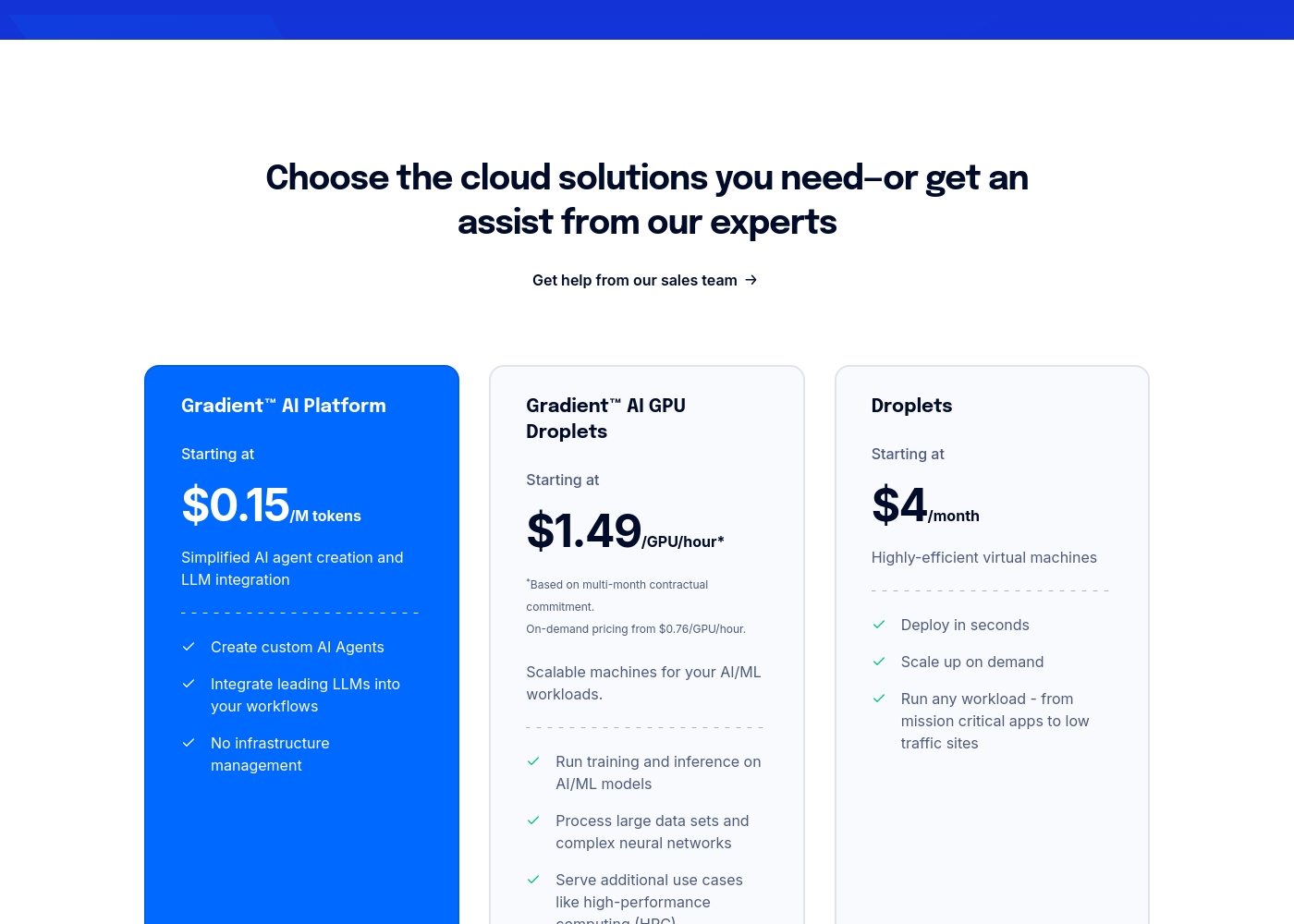
DigitalOcean costs between $0 and $15 per month with 13 core services, including App Platform at $0/month, Droplets at $4/month, and Databases starting at $15/month.
DigitalOcean offers simple, predictable pricing for all its core cloud solutions. Here are the starting costs and key features for some of the most popular infrastructures available.
Gradient™ AI Platform
Price: Starting at $0.15 /M tokens Websites Supported: Not explicitly stated Best For: Simplified AI agent creation and LLM integration Refund Policy: We do not offer refunds. Other Features:
- Create custom AI Agents
- Integrate leading LLMs into your workflows
- No infrastructure management
- Highly-efficient virtual machines
- Deploy in seconds
- Scale up on demand
- Simple, managed Kubernetes
- Includes load balancing and networking
- Fully managed and maintained
- High availability and scaling
- Simple, fully-managed infrastructure solution
- Zero base cost for basic usage
- Automatic application deployment
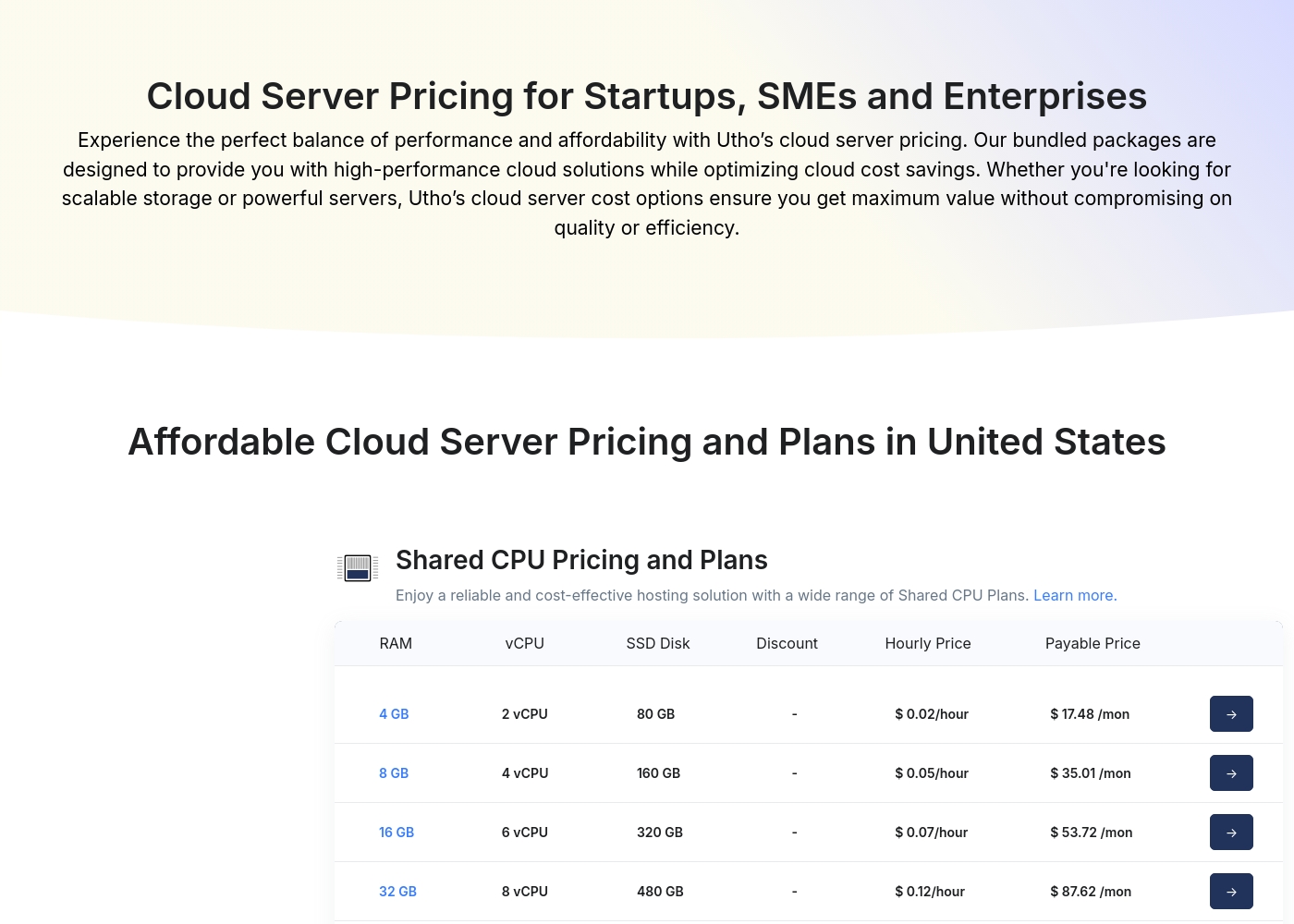
Utho costs between $17.48 and $87.62 per month for Shared CPU plans, with four tiers: 4 GB RAM at $17.48, 8 GB RAM at $35.01, 16 GB RAM at $53.72, and 32 GB RAM at $87.62.
Utho offers many different cloud products; the rates below detail the core Shared CPU tier options.
4 GB RAM Shared CPU Plan
Price: $17.48 per month ($0.02 per hour) Websites Supported: Not explicitly stated Best For: Not explicitly stated Refund Policy: Not explicitly stated Other Features:
- 2 vCPU
- 80 GB SSD Disk
- 4 GB RAM
- 2 vCPU
- 80 GB SSD Disk
- Billed hourly at $0.02
- 8 GB RAM
- 4 vCPU
- 160 GB SSD Disk
- Billed hourly at $0.05
- 16 GB RAM
- 6 vCPU
- 320 GB SSD Disk
- Billed hourly at $0.07
- 32 GB RAM
- 8 vCPU
- 480 GB SSD Disk
- Billed hourly at $0.12
Pricing Notes
- DigitalOcean’s entry price for basic compute starts very low at $4/month; Utho’s starts at $17.48/month.
- DigitalOcean provides a $200 credit for 60 days to test infrastructure, while Utho offers a 30-day money-back guarantee.
- Users widely praise DigitalOcean for clear, predictable, usage-based billing.
- Utho users report critical billing issues, stating they are charged immediately for the full month despite advertised hourly rates.
Pricing Head-to-Head
User Reviews
DigitalOcean consistently receives overwhelming praise across external review platforms, reflected in its impressive 4.6-star rating on Trustpilot. Customers frequently highlight the exceptional quality and responsiveness of the customer support team. Users often report that the support staff is helpful, patient, and provides detailed, clear explanations, frequently responding much quicker than the published 24-hour service level agreement (SLA). Many consumers state that DigitalOcean offers the best combination of pricing, value, and support in the cloud computing sector. The platform is described as straightforward and easy to use, featuring an intuitive control panel and extensive documentation that simplifies complex server configurations.
Reliability is a major selling point. Many long-term users report consistent performance and minimal, or even zero, downtime over several years, ensuring smooth project operation. Furthermore, the pricing structure is seen as economical, fair, and transparent, preventing unexpected monthly charges. Whether users are deploying simple web apps or handling advanced AI/ML workloads on beefy GPUs, the general sentiment confirms DigitalOcean provides a powerful, reliable hosting environment with excellent service delivery. 🤩
I have been using DigitalOcean for more than seven years now. I never experienced any downtime during this period, which is essential for our business continuity. Their support team has always been quick and helpful when I needed assistance.
Users universally describe Utho as unreliable and potentially deceptive based on the limited, but critical, feedback on Trustpilot (4 reviews, scoring 2.6). Recurring issues center on core stability: engineers reported catastrophic failures like filesystem corruption, VPS going spontaneously into read-only mode, and unexpected system freezes without any alerts or monitoring.
One user migrated back to their previous provider overnight to avoid total downtime, calling Utho immature for production usage. Furthermore, customers raised serious concerns regarding billing integrity and marketing accuracy.
I switched hoping to reduce costs, but Utho created critical, high-risk issues within days. My VPS went into read-only mode without warning, completely freezing the system. This cheap infrastructure nearly took my entire business down; stay away from Utho for production use.
Our Verdict
The decision between DigitalOcean and Utho boils down to a key trade-off: reliable stability versus aggressive cost savings. For almost any critical application, DigitalOcean is the safest and most professional choice. Utho’s tempting low prices are completely undermined by its alarming lack of reported stability. DigitalOcean’s superpower is its robust infrastructure and specialized AI tooling. You get rock-solid, predictable Linux Droplets starting at only $4/month. DigitalOcean provides verified access to H100 GPUs and the managed Gradient platform for serious builders. Their exceptional support ensures minimal downtime. Utho's core strength is affordability, claiming up to 60% cost reductions over competitors. Utho tries to attract budget-focused users with speedy deployment times and a 30-day money-back guarantee. Utho should only be considered if budget outweighs infrastructure integrity. The deciding factor is the risk to your business continuity. DigitalOcean users confirm excellent reliability and transparency. Utho users report critical failures like file corruption and dishonest billing practices. Never trust production loads to Utho. If you need professional uptime, superior support, and powerful AI technology, choose DigitalOcean immediately. If you are limited to simple testing environments and must cut costs drastically, Utho is a calculated gamble you can exit easily thanks to their money-back promise.
Frequently Asked Questions
Which cloud provider is more reliable, DigitalOcean or Utho?
DigitalOcean is overwhelmingly reported as highly reliable with near-zero downtime. Utho has critical user reports of filesystem corruption and unexpected read-only failures. DigitalOcean is the only safe choice for production environments.
Does DigitalOcean offer a money-back guarantee like Utho?
No, DigitalOcean explicitly does not offer refunds for utilized services or expired credit. Utho, conversely, offers a risk-free 30-day trial with a full money-back guarantee. If you are worried about commitment, Utho provides a better financial safety net.
Which is better for AI/ML workloads, DigitalOcean or Utho?
DigitalOcean is superior for AI/ML, offering specialized H100 GPU Droplets and the managed Gradient Platform. Utho advertises GPU services, but users report they are unavailable or restricted to unreliable beta status. Trust DigitalOcean for serious AI development.
How do DigitalOcean’s and Utho’s starting prices compare?
DigitalOcean has a lower entry cost for essential compute, starting Droplets at $4/month. Utho’s basic Shared CPU servers begin at $17.48/month. However, DigitalOcean gives a $200 credit to new users to test services.
Is Utho truly 2x faster than DigitalOcean?
Utho claims 2x faster performance due to optimized infrastructure. However, these speed boosts are meaningless if resources suffer critical instability. DigitalOcean offers high-performance computing without stability concerns.
Can I use a managed application deployment platform on Utho?
DigitalOcean offers the App Platform for simple, fully managed deployment with zero base cost. Utho does not offer an equivalent Platform-as-a-Service solution. Utho users must manage deployment using core VMs or tools like Kubernetes.
Ready to Choose?
Both tools have their strengths. Choose based on your specific needs.