DigitalOcean vs Vultr
DigitalOcean and Vultr are the leading contenders in the developer cloud space. DigitalOcean focuses on reliability, ease of use, and guaranteed excellent support. Vultr stakes its claim on raw power and immediate access to bleeding-edge GPU clusters.
Predictable Pricing, Powerful Dev Tools, Excellent Support
We find DigitalOcean excels by combining powerful Linux virtual machines and advanced AI infrastructure with remarkable ease of use and developer-centric pricing. The service consistently earns high marks for its stellar, quick customer support, strong reliability, and clear usage-based billing practices that prevent bill surprises. Overall, DigitalOcean is highly recommended for developers and businesses requiring predictable, high-value cloud services.
Pros
- Customer support is exceptionally quick, helpful, and provides detailed solutions.
- The platform is highly reliable with consistent performance and minimal reported downtime.
- Intuitive control panel and great guides make server setup very easy and clear.
- Overs a $200 free credit to new users for testing services over 60 days.
Cons
- The company strictly states that it does not offer refunds for utilized services.
- Occasional reports from long-time users concerning unexpected hardware failures.
- Users have noted an occasional lack of specific advanced features, often requiring workarounds.
Advanced Tech, Highly Problematic Support.
We recognize Vultr offers powerful, high-specification resources optimized for AI and HPC workloads, providing immediate access to cutting-edge global infrastructure. However, the user feedback clearly indicates severe instability regarding operational support, verification processes, and network reliability. Overall, Vultr is a high-risk provider where world-class technology is significantly undermined by pervasive customer service and account management failures.
Pros
- Access to cutting-edge AI and HPC hardware (NVIDIA HGX B200, AMD Instinct).
- Global reach with 32 cloud data center locations worldwide.
- Flexible hourly and monthly usage-based billing starting at $2.50/month.
- Managed services like Kubernetes Engine and databases are available.
Cons
- Customer support is consistently slow, unhelpful, ticket-based, and unresponsive.
- Arbitrary account suspensions and service terminations occur frequently (e.g., due to CPU spikes).
- Unreasonable, invasive mandatory verification steps (requiring ID, credit card photos).
- Reported difficulties obtaining refunds, especially for cryptocurrency deposits.
AboutDigitalOcean
DigitalOcean provides core infrastructure, focusing on versatile Linux cloud architecture. It’s the right choice for developers who need robust cloud services and specialized platforms. The service supports everything from fundamental system setup, like installing Docker on Ubuntu, to sophisticated deployments. If you're exploring open source AI platforms, or need the muscle of H100 GPUs for models like Ollama, this platform delivers. 💡
AboutVultr
Vultr provides a powerful full-stack cloud compute platform. It offers services ranging from configurable virtual machines to highly accelerated dedicated servers 💡. This platform is ideal for developers and enterprises focused on high-performance computing and complex AI model deployment. You can spin up general purpose or optimized configurations in under 60 seconds.
Highlights
Feature Comparison
Features Overview
We highlight the main differences and pick a winner for each feature.
AI and HPC Hardware
Vultr offers newer, dedicated high-end GPUs for serious AI workloads. DigitalOcean focuses on reliable, high-performance H100 GPU computing.
DigitalOcean provides strong GPU resources, including H100s, necessary for intense AI/ML training. Their Gradient™ Platform simplifies LLM integration for developers. Vultr offers immediate access reservations for revolutionary hardware like the NVIDIA HGX B200. Vultr's specialization in these cutting-edge clusters accelerates high-performance computing. This power gives Vultr a technical edge for large-scale, bleeding-edge AI research. Projects needing the absolute maximum raw compute power should look at Vultr's offerings.
Customer Support
DigitalOcean support is consistently praised as quick and helpful. Vultr's support is notoriously slow, unresponsive, and ticket-based.
DigitalOcean users frequently highlight the support team's quality and speed. They provide detailed solutions, often responding faster than 24 hours. Vultr’s external reviews consistently report terrible customer service. Support is ticket-based and replies can take many hours, impacting production. The reliability and quality of DigitalOcean’s support provides essential operational peace of mind. If your business needs fast issue resolution, DigitalOcean is the safer, clearer choice.
Pricing Transparency
DigitalOcean offers predictable, clear usage-based billing and huge starting credits. Vultr has hidden costs and mandatory add-on fees.
DigitalOcean ensures clear, transparent pricing, helping prevent unexpected monthly charges. New users get a significant $200 credit over 60 days to test heavy usage. Vultr uses hourly and monthly billing, but add-ons increase the total cost. Automatic backups, for example, add a 20% fee to the base price. DigitalOcean’s transparency and trial credit offer superior initial value and predictable budgeting. Vultr's best GPU rates may also require prepaid 36-month contracts for serious buyers.
Entry Level Cost
Vultr has the absolute cheapest published entry point for cloud compute services. DigitalOcean starts slightly higher for basic virtual machines (Droplets).
DigitalOcean’s highly efficient Droplets start at a low $4 per month. This provides a great foundation for foundational Linux compute. Vultr undercuts this ceiling with an entry-level instance starting at $2.50 per month. This low-cost VM is limited to IPv6 connectivity. If your focus is purely on achieving the lowest possible monthly expense, Vultr wins the price war. However, DigitalOcean offers significantly better base hardware and a generous $200 credit for testing.
Managed App Services
DigitalOcean offers a powerful App Platform with a $0 base cost. Vultr requires utilizing Vultr Kubernetes Engine or self-managing compute.
DigitalOcean's App Platform is a simple, managed infrastructure solution. Developers can use the $0 base cost to deploy static sites or basic functions. This platform supports functions, containers, and automated deployment pipelines. Vultr focuses more on powerful VMs and the Vultr Kubernetes Engine (VKE) for containers. VKE offers a free control plane, but requires more hands-on configuration for simple apps. DigitalOcean makes rapid web application deployment far simpler and more cost-effective for general use.
Developer Experience
DigitalOcean is praised for its intuitive control panel and low friction onboarding. Vultr suffers from high friction and constant account stability issues.
DigitalOcean users report a very easy setup process and clear control panel interface. This simplifies complex server management for developers. Vultr users complain about invasive verification steps (ID photos). Arbitrary account suspensions due to CPU spikes are common. DigitalOcean's focus on stability means less time spent dealing with account or service issues. Vultr’s operational instability makes it risky for mission-critical deployments unless you tolerate high risk.
Managed Kubernetes
Both DigitalOcean and Vultr offer services for managed container orchestration. Vultr makes the control plane free, lowering initial overhead.
DigitalOcean offers Managed Kubernetes, starting at $12 per month for cluster resources. It handles load balancing and networking for easy scaling. Vultr Kubernetes Engine (VKE) allows orchestration via a free Vultr control plane. Vultr's approach makes VKE a very cost-effective solution for launching and scaling containers. For budget-conscious teams scaling containerized apps, Vultr offers a clear cost advantage here.
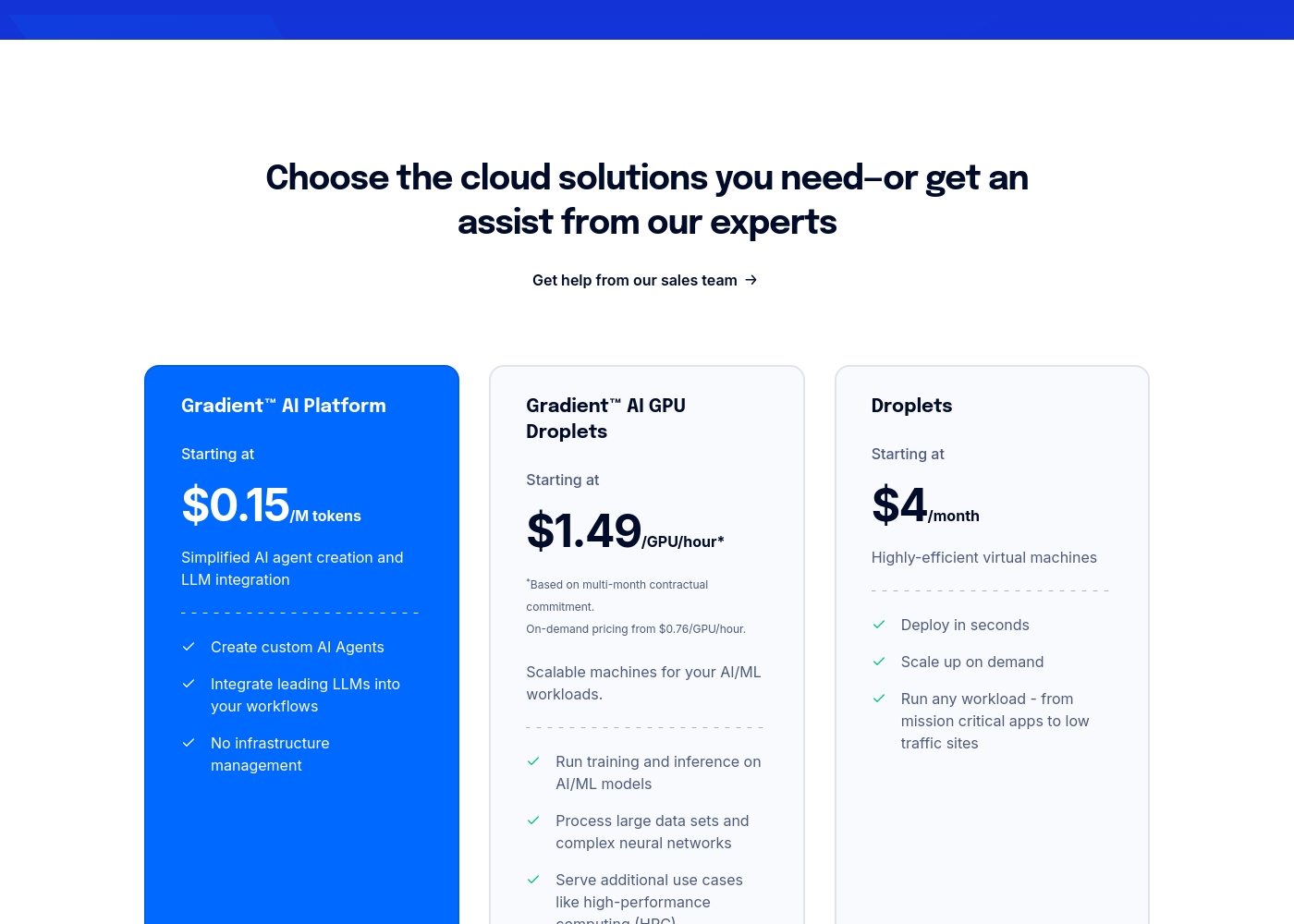
DigitalOcean costs between $0 and $15 per month with 13 core services, including App Platform at $0/month, Droplets at $4/month, and Databases starting at $15/month.
DigitalOcean offers simple, predictable pricing for all its core cloud solutions. Here are the starting costs and key features for some of the most popular infrastructures available.
Gradient™ AI Platform
Price: Starting at $0.15 /M tokens Websites Supported: Not explicitly stated Best For: Simplified AI agent creation and LLM integration Refund Policy: We do not offer refunds. Other Features:
- Create custom AI Agents
- Integrate leading LLMs into your workflows
- No infrastructure management
- Highly-efficient virtual machines
- Deploy in seconds
- Scale up on demand
- Simple, managed Kubernetes
- Includes load balancing and networking
- Fully managed and maintained
- High availability and scaling
- Simple, fully-managed infrastructure solution
- Zero base cost for basic usage
- Automatic application deployment
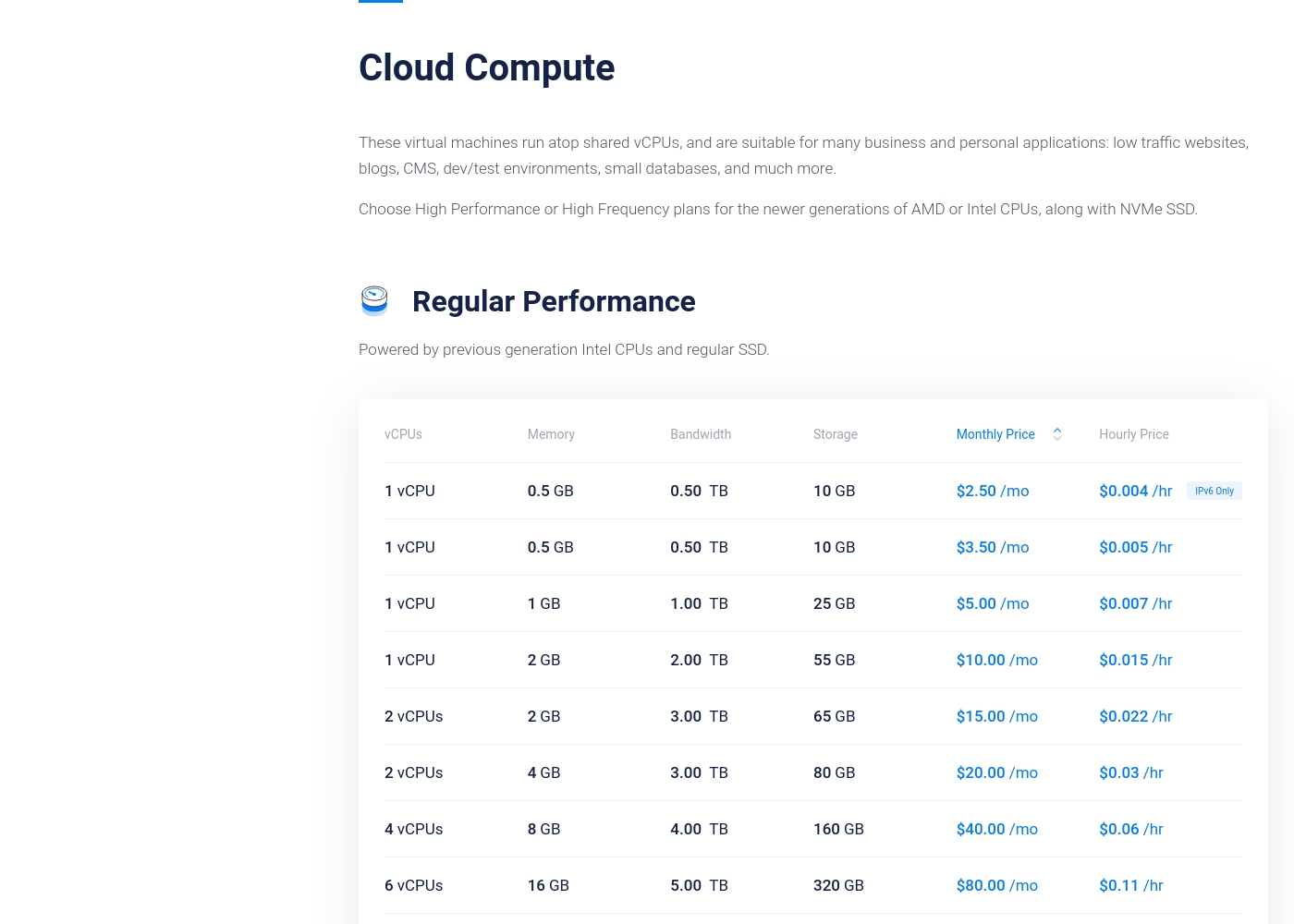
Vultr costs between $2.50 and $80.00 per month for Regular Performance Cloud Compute, featuring eight plans starting with the 1 vCPU / 0.5 GB configuration at $2.50/month.
Vultr’s Cloud Compute offerings are built on virtual machines using shared vCPUs. These machines are a great fit for everyday tasks like running low-traffic websites, simple databases, or small development environments. We've outlined a few of the available options below.
1 vCPU / 0.5 GB (IPv6 Only)
Price: $2.50 /month ($0.004 /hr) Websites Supported: Not explicitly stated Best For: Basic testing or staging environments Refund Policy: Not explicitly stated Other Features:
- 0.5 GB Memory
- 10 GB Storage
- 0.50 TB Bandwidth
- Powered by previous generation Intel CPUs
- 1 vCPU
- 0.5 GB Memory
- 10 GB Storage
- 0.50 TB Bandwidth
- 1 vCPU
- 1.0 GB Memory
- 25 GB Storage
- 1.00 TB Bandwidth
- 6 vCPUs
- 16 GB Memory
- 320 GB Storage
- 5.00 TB Bandwidth
Pricing Notes
- DigitalOcean offers a strong starting point with its $200 credit over 60 days to test heavy usage.
- Vultr's basic compute starts cheaper at $2.50/month for its IPv6-only Regular Performance instance.
- DigitalOcean has a free base for its App Platform, helping developers deploy projects with zero base cost.
- Vultr charges extra fees for basic features like Backups (20% added fee) and Windows licensing.
- The best GPU pricing on Vultr may require a prepaid 36-month commitment contract for maximum discount.
Pricing Head-to-Head
User Reviews
DigitalOcean consistently receives overwhelming praise across external review platforms, reflected in its impressive 4.6-star rating on Trustpilot. Customers frequently highlight the exceptional quality and responsiveness of the customer support team. Users often report that the support staff is helpful, patient, and provides detailed, clear explanations, frequently responding much quicker than the published 24-hour service level agreement (SLA). Many consumers state that DigitalOcean offers the best combination of pricing, value, and support in the cloud computing sector. The platform is described as straightforward and easy to use, featuring an intuitive control panel and extensive documentation that simplifies complex server configurations.
Reliability is a major selling point. Many long-term users report consistent performance and minimal, or even zero, downtime over several years, ensuring smooth project operation. Furthermore, the pricing structure is seen as economical, fair, and transparent, preventing unexpected monthly charges. Whether users are deploying simple web apps or handling advanced AI/ML workloads on beefy GPUs, the general sentiment confirms DigitalOcean provides a powerful, reliable hosting environment with excellent service delivery. 🤩
I have been using DigitalOcean for more than seven years now. I never experienced any downtime during this period, which is essential for our business continuity. Their support team has always been quick and helpful when I needed assistance.
Vultr receives poor external ratings, especially on Trustpilot (2.1), where customer experiences are highly polarized. While some users acknowledge Vultr's competitive pricing and the overall power of the servers, these positive attributes are frequently overshadowed by critical operational failures.
The most common complaint centers on terrible customer support which is described as slow, unresponsive, and strictly ticket-based. Users commonly report arbitrary account suspensions or terminations, often triggered by hitting unstated CPU usage limits or frivolous DMCA claims 😔.
The bad reviews here don't reflect my nine years of experience. I've been a customer for a long time only hosting one mail and web server. The initial offerings consistently held a great value, and the support used to be easy to reach.
Our Verdict
Choosing between DigitalOcean and Vultr largely boils down to support versus raw hardware power. For most developers and businesses, DigitalOcean will be the clear winner due to superior stability and service. Vultr should only be considered if your project requires its specific, cutting-edge AI hardware. DigitalOcean is renowned for its outstanding support and predictable billing practices. Their dependable Droplets are efficient Linux VMs, deployable within seconds. New users benefit from a generous $200 credit for 60 days to test the platform extensively. DigitalOcean’s App Platform also offers a cost-effective $0 base cost entry point for simple deployments. Vultr’s strength focuses on aggressive, specialized hardware resources and high-performance computing. Vultr gives immediate access reservations to bleeding-edge GPUs like the NVIDIA HGX B200. It also offers a very cheap entry-level VM starting at only $2.50/month. However, Vultr reviews constantly warn of terrible, unresponsive support and arbitrary account suspensions. The critical deciding factor is reliability and the overall developer experience. DigitalOcean customers consistently praise the intuitive control panel and quick response times. Vultr users often endure frustrating, invasive verification steps and sudden service termination closures. Choose DigitalOcean for peace of mind, transparent pricing, and excellent long-term support. Select Vultr only if your project absolutely demands the very newest GPU models that DigitalOcean does not yet offer. Otherwise, DigitalOcean provides a simply better, safer, and more stable cloud environment.
Frequently Asked Questions
Is DigitalOcean or Vultr better for customer support?
DigitalOcean is strongly preferred, cited for its quick, helpful support staff. Vultr frequently receives poor reviews for slow and unresponsive ticket-based support. DigitalOcean provides better operational stability and service reliability.
Which platform offers the better deal for new users to start with?
DigitalOcean is better, providing a substantial $200 credit usable over 60 days. Vultr does not explicitly offer a free trial or guaranteed credit for new sign-ups. DigitalOcean allows you to test heavier services for free immediately.
Does Vultr offer specialized hardware not available on DigitalOcean?
Yes, Vultr promotes immediate access to new high-end NVIDIA HGX B200 and AMD Instinct GPUs. DigitalOcean focuses on reliable H100 GPUs and simplifying integration via its Gradient AI Platform. Vultr targets the absolute bleeding edge of hardware.
Which is cheaper for a basic cloud computing virtual machine?
Vultr has the absolute lowest numerical entry point at $2.50/month. This is for an IPv6-only Regular Performance instance. DigitalOcean's basic, more efficient Droplet starts at $4/month.
Is billing more transparent with DigitalOcean or Vultr?
DigitalOcean offers clear, predictable usage-based pricing with spending alerts. Vultr has more mandatory add-on costs, such as a 20% fee for automatic backups. DigitalOcean is generally considered more transparent and less volatile.
Can I use managed Kubernetes on both DigitalOcean and Vultr?
Yes, both offer managed container orchestration services for development teams. Vultr’s Kubernetes Engine offers a free control plane, potentially making it cheaper. DigitalOcean’s services start at $12/month.
Ready to Choose?
Both tools have their strengths. Choose based on your specific needs.