Google Cloud vs Vultr
Google Cloud and Vultr are cloud infrastructure rivals built on technical power. Google Cloud is built for massive enterprise AI and complex data needs. Vultr focuses on raw performance and cutting-edge HPC components. Choosing depends heavily on your specific workload and support expectations.
Powerful Infrastructure, Risky Billing and Support.
We recognize Google Cloud delivers leading infrastructure, offering powerful AI integration and significant scaling for enterprise workloads. However, the high volume of reports detailing inaccessible customer support and confusing, non-transparent billing is deeply concerning. Overall, we see this platform as high-risk for users prioritizing responsive help or granular cost control.
Pros
- Access to top-tier generative AI tools like Gemini and Vertex AI.
- Supports open source, multilcloud, and hybrid development strategies.
- New users receive $300 in free credits upon signing up.
- Offers potential savings up to 57% via committed use discounts.
Cons
- Customer service support is frequently inaccessible and hidden.
- Users report non-transparent billing and unexpected charges despite having credits.
- Extremely high costs for technical support subscriptions (up to $12,500/month).
- Lack of hard spending limits for pay-as-you-go services is a common pain point.
Advanced Tech, Highly Problematic Support.
We recognize Vultr offers powerful, high-specification resources optimized for AI and HPC workloads, providing immediate access to cutting-edge global infrastructure. However, the user feedback clearly indicates severe instability regarding operational support, verification processes, and network reliability. Overall, Vultr is a high-risk provider where world-class technology is significantly undermined by pervasive customer service and account management failures.
Pros
- Access to cutting-edge AI and HPC hardware (NVIDIA HGX B200, AMD Instinct).
- Global reach with 32 cloud data center locations worldwide.
- Flexible hourly and monthly usage-based billing starting at $2.50/month.
- Managed services like Kubernetes Engine and databases are available.
Cons
- Customer support is consistently slow, unhelpful, ticket-based, and unresponsive.
- Arbitrary account suspensions and service terminations occur frequently (e.g., due to CPU spikes).
- Unreasonable, invasive mandatory verification steps (requiring ID, credit card photos).
- Reported difficulties obtaining refunds, especially for cryptocurrency deposits.
AboutGoogle Cloud
Google Cloud is a comprehensive cloud platform offering more than 150 products and capabilities. It helps businesses modernize existing infrastructure or build entirely new AI-driven applications from scratch. The service is designed for developers, business leaders, and startups ready to digitally grow and transform.
New customers can try Google Cloud with free usage of over 20 products. Plus, you’ll receive $300 in free credits upon signing up to help you explore. 💡
AboutVultr
Vultr provides a powerful full-stack cloud compute platform. It offers services ranging from configurable virtual machines to highly accelerated dedicated servers 💡. This platform is ideal for developers and enterprises focused on high-performance computing and complex AI model deployment. You can spin up general purpose or optimized configurations in under 60 seconds.
Highlights
Feature Comparison
Features Overview
We highlight the main differences and pick a winner for each feature.
AI & ML Capabilities
Google Cloud is the AI platform leader with Vertex AI and Gemini access. Vultr offers incredible raw hardware power for model training.
Google Cloud offers Vertex AI, a fully managed platform enhanced by Gemini. Users instantly access over 200 foundation models for complex AI agents. Google Cloud simplifies the application layer with developer tools like Gemini Code Assist for better workflows. Vultr provides immediate deployment access to specialized NVIDIA HGX B200 GPUs. Vultr focuses on raw horsepower for HPC and massive model training workloads. Vultr simplifies deployment using Serverless Inference, automatically managing scaling complexity. Ultimately, Google Cloud provides the full AI ecosystem, while Vultr provides bleeding-edge hardware components.
Pricing Structure
Vultr offers clear, low-cost hourly/monthly rates starting very cheaply. Google Cloud pricing is complex but offers massive credits and deep discounts.
Google Cloud uses a pay-as-you-go model with no upfront fees or termination charges. They offer significant savings, up to 57%, via committed use discounts. Vultr is highly transparent, with base Cloud Compute starting at just $2.50 monthly. Vultr uses hourly billing, which provides great flexibility for quick testing tasks. Google Cloud users report frequent unexpected charges despite having ample credits. Vultr's pricing is simpler, but adds 20% for backups and $10 for DDoS protection.
Deployment Speed
Vultr is built for raw speed, deploying core infrastructure in under a minute. Google Cloud is slower and its console is often deemed complex.
Vultr focuses heavily on deployment speed, spinning up optimized VMs in under 60 seconds. This capability makes Vultr ideal for rapid testing and infrastructure setup globally. Google Cloud generally offers variable deployment speeds depending on the complexity of the service. Google Cloud's console itself is frequently cited as slow and overly complex for simple tasks. Vultr gives users a high degree of control to select and deploy hardware configurations instantly. Getting a simple VM running quickly is much easier on Vultr than on Google Cloud.
Customer Support
Both Google Cloud and Vultr draw heavy, loud criticism for slow, inaccessible, and unhelpful customer support. Neither platform excels here.
Google Cloud users describe support as intentionally inaccessible or hidden from standard users. Technical support subscriptions cost thousands per month for enterprise users. Vultr's support is slow, ticket-based, and consistently unresponsive to critical issues. Vultr users also report arbitrary account suspensions triggered by temporary CPU spikes. Neither platform provides responsive or reliable support when outages or billing disputes occur. If responsive human support is a priority, avoid both Google Cloud and Vultr entirely based on user sentiment.
Data Analytics Scale
Google Cloud’s BigQuery is designed for petabyte-scale data warehousing. Vultr only offers standard managed databases for application purposes.
Google Cloud leverages BigQuery for massive, large-scale analytics capabilities. BigQuery offers 26%–34% lower TCO compared to alternative data warehouses. Google Cloud enables making smarter decisions faster using real-time processing tools. Vultr provides managed databases like MySQL and PostgreSQL designed to 'just work.' Vultr's focus is on efficient storage and reliable application backends. Google Cloud is the undeniable choice for serious, advanced data analysis and intelligence.
Global Reach
Vultr explicitly advertises 32 global cloud data center locations. Google Cloud operates globally but does not provide a specific location count.
Vultr details 32 distinct cloud data center locations worldwide for efficient deployment. This provides excellent geographic reach for global customer needs. Google Cloud operates on a massive world-class security and availability scale. Vultr ensures users can deploy infrastructure close to their global customers quickly. For infrastructure location specifics, Vultr provides clearer, quantifiable data for users. Both platforms support massive scaling across various geographical regions.
Security & Compliance
Google Cloud uses the same world-class security technology it relies on internally. Vultr provides baseline security measures for infrastructure environments.
Google Cloud offers a full suite of services, including Google Security Operations for investigation. Cloud Armor actively protects applications against denial of service and web attacks. Google Cloud emphasizes meeting global digital sovereignty requirements with leading threat intelligence. Vultr provides standard, secure cloud environments with flexible block and object storage. Vultr's focus is on infrastructure speed and control, not comprehensive compliance tooling. Google Cloud is superior for enterprise-level defense and compliance reporting.
Cost Management Tools
Google Cloud provides free tools to track costs, budgets, and alerts. Neither Google Cloud nor Vultr offers a hard spending limit option.
Google Cloud explicitly offers free cost management tools, including budgets and alerts. Users still report opaque billing practices and massive unexpected charges consistently. Vultr's hourly billing structure is easy to understand for simple resources. Vultr does not offer dedicated cost tracking tools found in Google Cloud's ecosystem. The fundamental lack of a hard spending limit on Google Cloud is a frequent and serious complaint. Managing costs successfully requires extreme vigilance on both Google Cloud and Vultr.
Google Cloud costs vary widely as it uses a usage-based payment structure, offering new customers $300 in free credits and access to 20+ free products.
You won't find fixed monthly plans here, but instead three flexible ways to utilize the platform's computational resources.
Pay-as-you-go (Standard Pricing)
Price: Not explicitly stated (Usage-based) Websites Supported: Not explicitly stated Best For: Organizations of all sizes needing flexible scaling Refund Policy: Not explicitly stated Other Features:
- You only pay for the services you use.
- No up-front fees or termination charges.
- Potential savings up to 57% with committed use discounts.
- Includes free 24/7 billing support.
- Only pay for the services you use
- No up-front fees or termination charges
- Save up to 57% with committed use discounts
- Free 24/7 billing support
- $300 in free credits
- Access to 20+ products for free
- Run, test, and deploy workloads
- Up to $350,000 in Cloud credits
- Customized support and solutions
- Scaling support for innovative companies
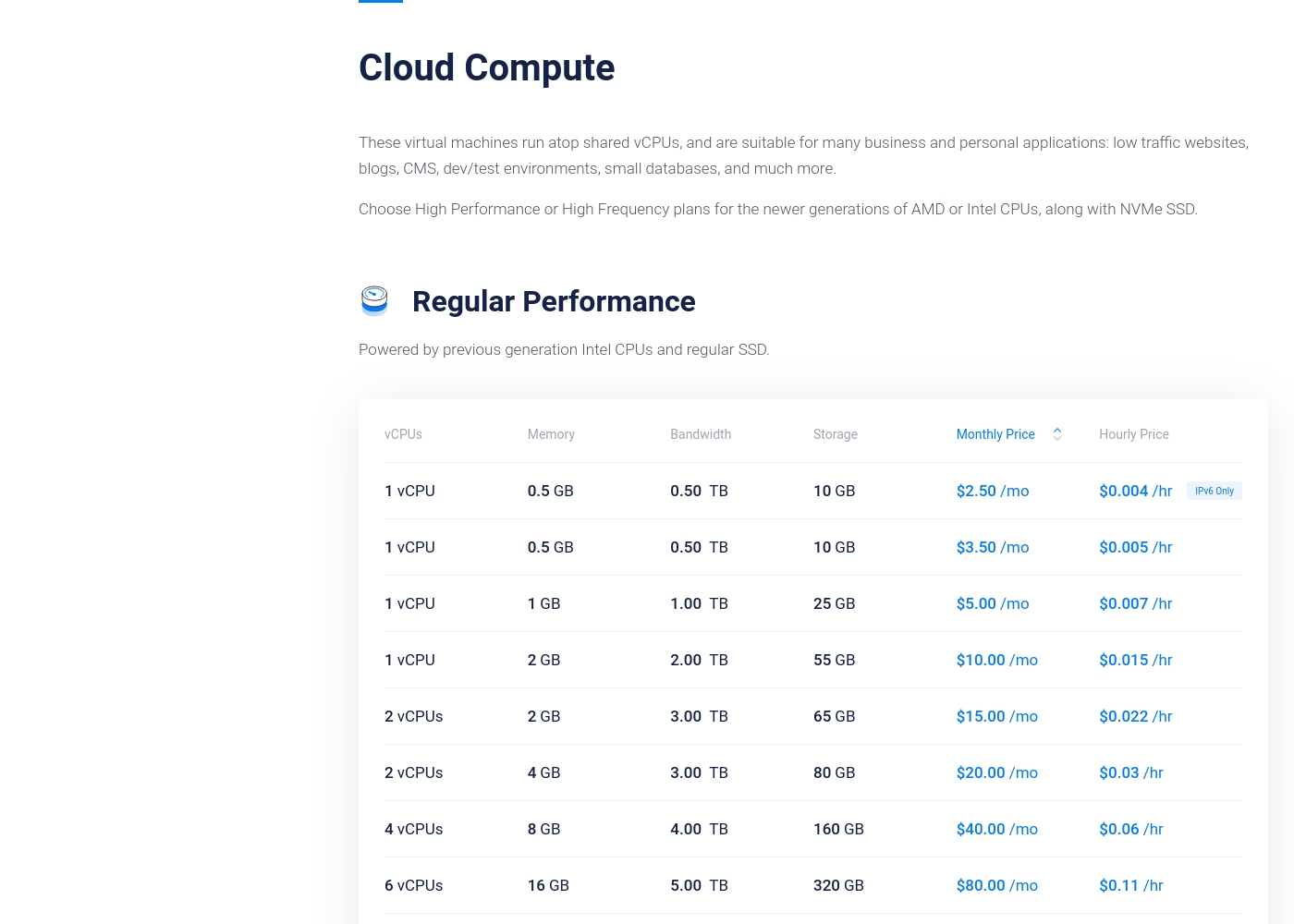
Vultr costs between $2.50 and $80.00 per month for Regular Performance Cloud Compute, featuring eight plans starting with the 1 vCPU / 0.5 GB configuration at $2.50/month.
Vultr’s Cloud Compute offerings are built on virtual machines using shared vCPUs. These machines are a great fit for everyday tasks like running low-traffic websites, simple databases, or small development environments. We've outlined a few of the available options below.
1 vCPU / 0.5 GB (IPv6 Only)
Price: $2.50 /month ($0.004 /hr) Websites Supported: Not explicitly stated Best For: Basic testing or staging environments Refund Policy: Not explicitly stated Other Features:
- 0.5 GB Memory
- 10 GB Storage
- 0.50 TB Bandwidth
- Powered by previous generation Intel CPUs
- 1 vCPU
- 0.5 GB Memory
- 10 GB Storage
- 0.50 TB Bandwidth
- 1 vCPU
- 1.0 GB Memory
- 25 GB Storage
- 1.00 TB Bandwidth
- 6 vCPUs
- 16 GB Memory
- 320 GB Storage
- 5.00 TB Bandwidth
Pricing Notes
- Google Cloud offers massive incentives like $300 in free credits and up to $350,000 for eligible startups.
- Vultr's base Cloud Compute pricing is highly affordable, starting at just $2.50 per month.
- A major risk is Google Cloud's non-transparent billing, causing repeated unexpected charges among users.
- Crucially, neither Google Cloud nor Vultr offers a hard spending limit for their pay-as-you-go services.
- Vultr may charge extra for standard features like automatic backups (20% instance fee) or DDoS protection ($10/month).
Pricing Head-to-Head
User Reviews
The external sentiment, primarily captured by Trustpilot, is overwhelmingly negative, resulting in a very poor 1.5-star rating. The most frequently cited issues revolve around non-transparent billing and absolutely dysfunctional customer support ⚠️. Users report unexpected charges, sometimes totaling hundreds of dollars, even when they possess substantial free credits. Many feel this lack of transparency is a "deliberate trap" designed for new users. Furthermore, getting help is nearly impossible; users describe support as intentionally hidden and unreachable, sending them into frustrating, endless loops. Those requiring technical help face exorbitant fees, with specialized technical support costing steep thousands per month.
Beyond cost management, users criticize the low ease of use. Complaints include the console being "unusably slow" and the process for simple tasks, like retrieving an API key, demanding excessive clicks. Users also struggle with important account management functions, such as deleting active projects that continue to generate fees or updating billing information. This strongly indicates that while the platform is technologically powerful, the surrounding user experience, administration, and financial control are severely flawed.
My account incurred €327 in API costs, even though I had €264 in free credits available which weren't used. Support is completely hidden and impossible to reach, making it seem like a deliberate trap. This platform has an extremely non-transparent pricing structure.
Vultr receives poor external ratings, especially on Trustpilot (2.1), where customer experiences are highly polarized. While some users acknowledge Vultr's competitive pricing and the overall power of the servers, these positive attributes are frequently overshadowed by critical operational failures.
The most common complaint centers on terrible customer support which is described as slow, unresponsive, and strictly ticket-based. Users commonly report arbitrary account suspensions or terminations, often triggered by hitting unstated CPU usage limits or frivolous DMCA claims 😔.
The bad reviews here don't reflect my nine years of experience. I've been a customer for a long time only hosting one mail and web server. The initial offerings consistently held a great value, and the support used to be easy to reach.
Our Verdict
The decision between Google Cloud and Vultr is truly a battle of two infrastructure giants. It comes down to whether you prioritize a full AI ecosystem or specialized raw infrastructure speed. Most large enterprises will find Google Cloud is the slightly safer bet. However, Vultr is quickly becoming the platform for serious, high-performance workloads. Google Cloud’s superpower is its unrivaled AI and data ecosystem maturity. Vertex AI puts Gemini and over 200 foundation models at your fingertips instantly. BigQuery offers 26–34% lower TCO for running massive analytics workloads smoothly. Google Cloud also gives scaling startups up to $350,000 in very valuable cloud usage credits. Vultr’s strength lies in providing immediate access to specialized, cutting-edge hardware components. Need the latest NVIDIA HGX B200 GPU cluster? Vultr can deploy it much faster than Google Cloud. Vultr is also significantly cheaper for basic compute, with plans starting at $2.50/month. This makes Vultr perfect for specific, performance-hungry jobs needing global deployment in 32 locations. The deciding factor centers entirely on your tolerance for administrative risk and customer support. Google Cloud provides tools for cost control, but its complex billing still generates mass user complaints. Vultr simplifies infrastructure but is plagued by reports of unreliable support and arbitrary account suspensions. Choose Google Cloud if you are building enterprise-grade products around AI or need robust security offerings. Pick Vultr if your workload demands the fastest, cheapest access to the very latest HPC resources globally. Both offer power, but Vultr offers speed, and Google Cloud offers depth.
Frequently Asked Questions
Which platform is better for deep learning and HPC: Google Cloud or Vultr?
Vultr is the clear winner for highly specialized HPC and deep learning workloads. Vultr lets you deploy cutting-edge NVIDIA HGX B200 GPUs instantly. Google Cloud offers a robust AI platform, but Vultr specializes in raw, immediate hardware speed.
Why do users complain about hidden charges on Google Cloud?
Google Cloud uses a non-transparent billing system, leading to unexpected charges, often despite users having credits. Users also lack a hard spending limit to prevent budget overruns completely. Always monitor your usage closely on Google Cloud.
Is Vultr’s $2.50 per month instance competitive with Google Cloud’s free tier?
Vultr offers very cheap cloud compute starting at $2.50 monthly for IPv6 only VMs. Google Cloud offers $300 in free credits and 20+ products permanently free. Google Cloud is better if you need persistent access to many different service types.
Does Vultr offer managed services like Google Cloud?
Yes, Vultr offers managed services including the Vultr Kubernetes Engine (VKE) for containers. Vultr also provides reliable managed databases like MySQL and PostgreSQL. Google Cloud’s managed services are deeper, including BigQuery and Spanner.
Which is faster for basic VM deployment: Google Cloud or Vultr?
Vultr is significantly faster for simple VM deployment, often completing setup in under 60 seconds. Google Cloud's console is frequently cited as being slower and overly complex for managing basic tasks.
Which has better customer support: Google Cloud or Vultr?
Both providers have very poor reputations for customer service based on user reviews. Google Cloud's support is often inaccessible or very expensive for technical issues. Vultr users report slow support combined with arbitrary account terminations.
Ready to Choose?
Both tools have their strengths. Choose based on your specific needs.