Hive vs IFTTT
Hive and IFTTT solve very different problems. Hive is a project management hub, while IFTTT connects apps for simple automations. Your choice depends on whether you need team collaboration or cross-app triggers.

Powerful hub for connected teams.
We found Hive excels at centralizing work across multiple tools into a single, AI-assisted workspace. Its flexible views and automation are strong assets, though the pricing structure and some user experiences around support warrant careful consideration. Overall, it's a robust choice for teams prioritizing integration and workflow efficiency.
Pros
- Centralizes work from tools like Slack, Salesforce, and email into one unified workspace.
- Offers flexible project views including Kanban, Gantt, Calendar, and Table.
- Integrates Buzz AI for smart search, summaries, and turning conversations into tasks.
- Provides a free forever tier and a free trial with no credit card required.
Cons
- Some users report confusion or dissatisfaction with billing and subscription management.
- Advanced features and support are often reserved for higher-tier, more expensive plans.
- Requires upfront integration setup to realize its full value, which may not suit all teams.
- Pricing details for some modules or support levels are not fully transparent upfront.
Vast connectivity, but unreliable performance.
We recognize IFTTT's technical strength in connecting a massive catalog of services, offering powerful automation potential for both home and business users. However, significant user reports indicate that reliability has dropped substantially while the pricing structure has become overly aggressive. Overall, we find that the high cost and unpredictable performance make it difficult to rely on for mission-critical automation.
Pros
- Vast ecosystem connecting over 900 different services and apps.
- Available permanent free plan for testing basic automation needs.
- Pro tiers offer advanced developer features like webhooks and filter code.
- Multi-action Applets allow for complex workflows from a single trigger.
Cons
- Severe and frequent reliability issues; applets are often delayed or fail to activate.
- Aggressive pricing model and constant shrinking of free plan functionality.
- Customer support is reportedly unresponsive and adheres to strict non-refund policies.
- Users express a deep lack of trust due to fluctuating feature limitations.
AboutHive
Hive is a project management platform built for teams of all kinds. From agencies and marketing teams to non-profits and education groups, it’s designed to organize collaboration and automate workflows. It’s not just a task list; it’s a connected system where your work happens. 💡
AboutIFTTT
IFTTT is the leading no-code platform designed for powerful automation across both your business and home life. It offers an easy way to connect over 900 different services, including tools like Google Calendar, Spotify, and YouTube, using simple Applets. You can automate from anywhere, anytime, thanks to the dedicated iOS and Android apps, ensuring continuous productivity. It’s built on a massive community of over 27 million users and 900+ brands already using the platform. 💡
Highlights
Feature Comparison
Features Overview
We highlight the main differences and pick a winner for each feature.
Core Purpose
Hive is for managing team projects. IFTTT is for automating tasks between apps.
Hive centralizes team collaboration. It's a workspace for tasks, files, and communication. IFTTT connects disparate apps. It triggers actions in one service based on events in another. Hive focuses on project execution. IFTTT focuses on task automation and connectivity.
Automation Style
Hive automates within projects. IFTTT automates between different apps.
Hive uses templates and action automations for recurring project tasks. IFTTT uses Applets. A trigger in one app causes an action in another. Hive's automation is project-centric. IFTTT's is service-agnostic and broader in scope.
User Interface
Hive offers multiple project views. IFTTT has a simple Applet builder.
Hive provides Kanban, Gantt, calendar, and table views for flexible project visualization. IFTTT's interface is focused on creating and managing simple if-this-then-that Applets. Hive's UI is complex but powerful for project management. IFTTT's is simple for automation.
Integration Ecosystem
IFTTT connects to 900+ services. Hive integrates with key business tools.
IFTTT boasts connections to over 900 services, from smart home devices to social media. Hive integrates with core business tools like Slack, Salesforce, and email systems. IFTTT has a much wider integration reach. Hive's integrations are deeper for business workflows.
Pricing Model
Hive charges per user. IFTTT charges per account for feature tiers.
Hive uses per-seat pricing ($5-$12/user/month). Costs scale with team size. IFTTT uses tiered plans ($0-$8.99/month) based on features and Applet limits. Hive is more expensive for teams. IFTTT is cheaper for individual automation needs.
Customization
Hive customizes project workflows. IFTTT customizes automation logic.
Hive offers custom labels, views, and project templates for team workflows. IFTTT Pro+ provides filter code and queries for advanced Applet logic. Customization goals differ. Hive for project process, IFTTT for trigger/action logic.
Scalability
Hive scales for growing teams. IFTTT scales for more automations.
Hive scales from small teams to enterprises with larger plans and features. IFTTT scales by allowing more Applets and advanced features on higher tiers. Hive scales with team size. IFTTT scales with automation complexity and volume.
Learning Curve
Hive requires setup for team adoption. IFTTT is simpler to start.
Hive requires initial setup, tool integration, and team training for full adoption. IFTTT allows users to start building simple Applets immediately with no code. IFTTT has a gentler initial learning curve. Hive has a steeper curve but deeper payoff.
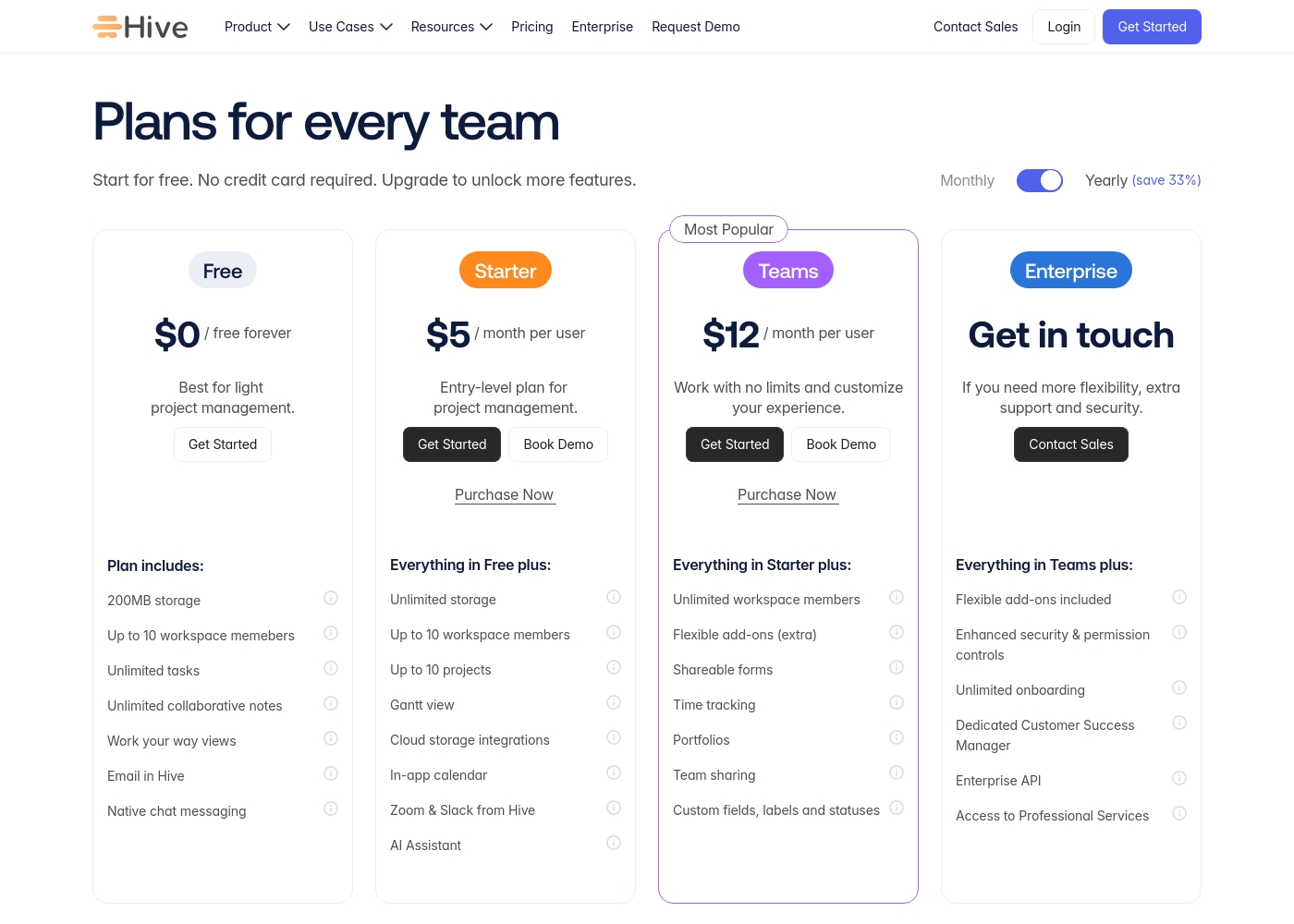
Hive pricing: Hive offers a range of options from a $0 free forever tier to a $12/month per user Teams plan. Subscriptions range from free tools for individuals to robust, feature-rich environments for growing organizations and enterprises alike.
Yearly billing is available to help you save on total costs over time. Monthly plans provide maximum flexibility if you prefer less commitment.
Pricing scales with features, allowing you to pay for only the power you need as your projects grow more complex. Add-ons like Buzz AI and time tracking are extra costs on mid-tier plans, which makes the pricing structure modular and customizable.
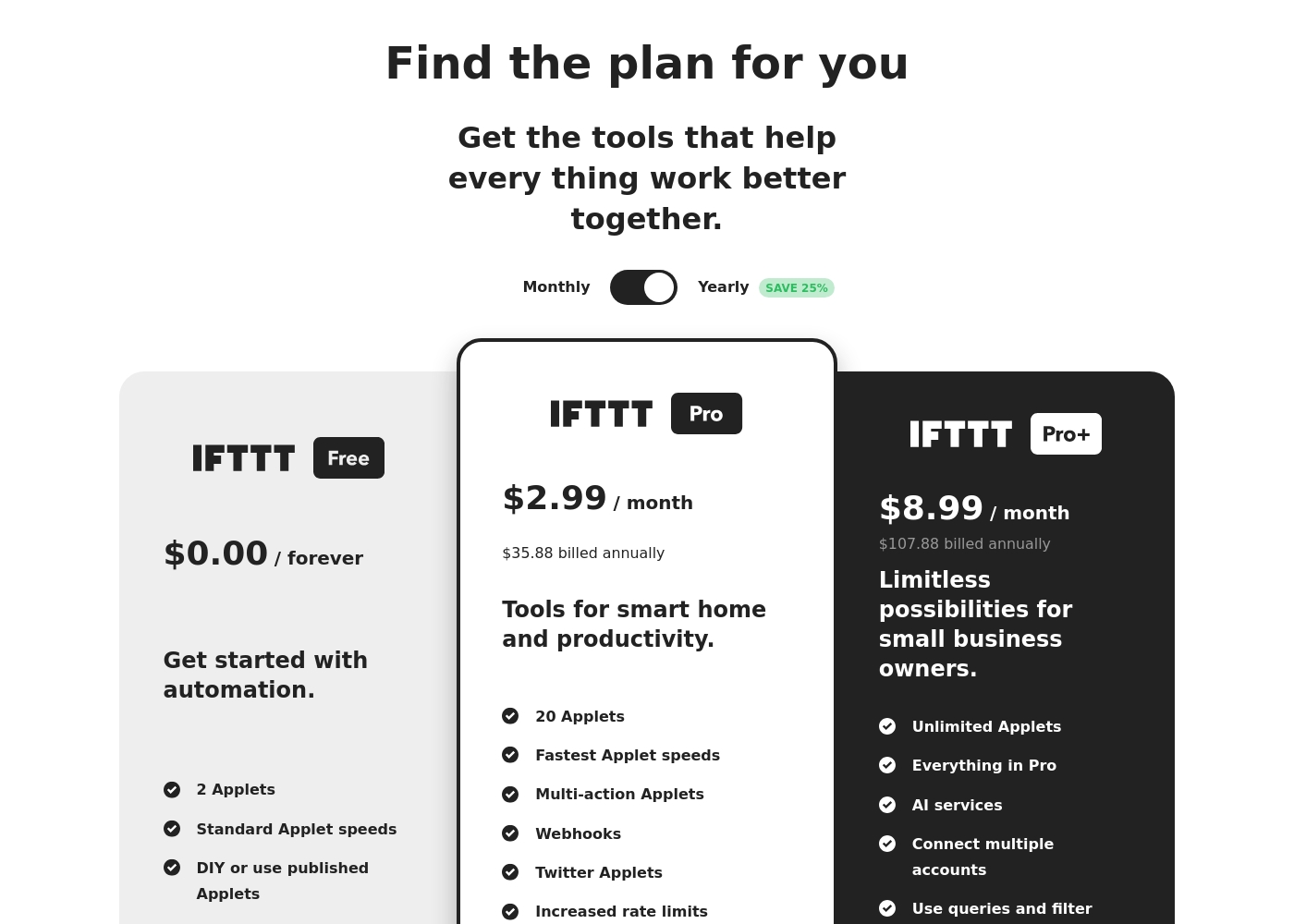
IFTTT costs between $0.00 and $107.88 per year with three plans: IFTTT Free at $0.00, IFTTT Pro at $35.88/year, and IFTTT Pro+ at $107.88/year.
Let's explore the three available plan options in detail to find the right amount of automation for your needs.
IFTTT Free
Price: $0.00 / forever Websites Supported: N/A - Automation Platform Best For: Get started with automation Refund Policy: Not explicitly stated Other Features:
- 2 Applets
- Standard Applet speeds
- DIY or use published Applets
- Unlimited Applet runs
- Free mobile app access and simple no-code integrations
- 2 Applets
- Standard Applet speeds
- DIY or use published Applets
- Unlimited Applet runs
- Free mobile app access
- 20 Applets
- Fastest Applet speeds
- Multi-action Applets
- Webhooks
- Twitter Applets
- Unlimited Applets
- All features from Pro
- AI services
- Connect multiple accounts per service
- Use queries and filter code
Pricing Notes
- Hive charges per user, so a team of 10 on the Teams plan costs $120/month.
- IFTTT charges per account, not per user. Pro is $2.99/mo, Pro+ is $8.99/mo.
- Hive's free plan is limited but functional for small teams. IFTTT's free plan is severely limited to 2 Applets.
- Both offer free trials for paid features. Hive's trial is 14 days.
Pricing Head-to-Head
User Reviews
Reviewing Hive's external reputation, we found Trustpilot reviews to be mixed but often positive regarding the product's functionality and customer service responsiveness. Users frequently praise the platform's ease of use and comprehensive features for project management, noting its helpful support team. 📊 On the other hand, some reviews highlight concerns with pricing transparency and occasional billing issues, which can affect overall value perception. ⭐ Capterra's detailed review page was inaccessible due to security restrictions, preventing a full cross-platform synthesis. Based on the available Trustpilot snippets, the sentiment leans towards appreciation for Hive's core toolset and collaborative environment, though experiences with account management and subscription handling are less consistent.
Hive has been a game-changer for our marketing team. The ability to see all our projects in different views, like Gantt charts, helps us stay on top of deadlines. Customer support has also been very responsive whenever we had questions.
External feedback for IFTTT paints a picture of extreme user dissatisfaction, particularly among long-time customers who experienced the platform before significant pricing reforms. Reliability is a core issue; many users report that Applets are highly unreliable, suffering from failures or severe delays, sometimes up to several hours.
The most frequent complaint centers on the shift toward an aggressive commercial model. Users feel misled by the frequent and substantial reduction in the free plan's Applet limit, which has dropped to just two, pushing them unnecessarily towards paid tiers that they find too expensive.
This service could be great, but it is unfortunately very unreliable now. It doesn't fire the triggers correctly, and the delay keeps increasing to the point where it takes several hours to run. We need stable automation, not delays.
Our Verdict
For team project management, Hive is the clear winner. For simple, cross-app automation, IFTTT has the edge. The decision isn't about which is better overall, but which solves your specific problem. Hive's superpower is creating a single, connected workspace. It pulls emails, Slack messages, and CRM data into one view. This eliminates context-switching for teams juggling multiple apps. IFTTT's superpower is massive connectivity. It links over 900 services with simple Applets. You can sync Instagram to Twitter or get weather alerts without writing code. The deciding factor is your primary need. If you manage projects with a team, Hive's collaboration tools are essential. If you just want to automate tasks between personal apps, IFTTT is sufficient. Choose Hive if you're an agency or marketing team needing Gantt charts and task automation. Choose IFTTT if you're an individual wanting to connect Spotify to a smart light. They serve different masters entirely.
Frequently Asked Questions
Can I use IFTTT to manage my team's projects like Hive?
No. IFTTT is for app-to-app automation, not project management. It lacks task assignments, deadlines, and team collaboration views. Use Hive for managing team projects.
Is Hive good for connecting different apps like IFTTT?
Hive integrates with key business tools like Slack and Salesforce. However, IFTTT connects to over 900 services. For broad app connectivity, IFTTT is superior. For deep business tool integration, Hive is better.
Which is cheaper for a single user?
IFTTT is cheaper for a single user. Its Pro plan is $2.99/month. Hive's Starter plan is $5/user/month. For one person needing simple automation, IFTTT offers lower cost.
I need to automate tasks between my marketing tools. Which should I choose?
It depends on the tools. If your tools are in IFTTT's 900+ catalog, use IFTTT. If you need to manage the marketing project itself (tasks, timelines), choose Hive. Many teams use both.
Are there limits on the free plans?
Yes. Hive's free plan limits workspace members and projects. IFTTT's free plan is limited to just 2 Applets. Hive's free plan is more functional for small team use.
Can I migrate my data from Hive to IFTTT or vice versa?
No, they are different tool types. You can't migrate project data from Hive to IFTTT. You can, however, use IFTTT to trigger actions in Hive if an integration exists.
Ready to Choose?
Both tools have their strengths. Choose based on your specific needs.