Nickel vs Odoo
Nickel streamlines payments and cash flow. Odoo delivers a broad, customizable suite of apps.
Solid for payments and cash flow.
Overall, we find Nickel to be a capable platform for consolidating payment collection, bill pay, and basic credit operations into a single dashboard. Its strong value lies in the free ACH tier and clear pricing, though teams needing advanced reporting or very fast support may encounter some limitations.
Pros
- Free core plan with unlimited ACH transfers.
- Clean, intuitive interface for managing payments.
- Strong integration with QuickBooks Online.
- Transparent, scalable pricing with no hidden fees.
Cons
- Customer support response times can vary.
- Advanced reporting and analytics are somewhat limited.
- Learning curve for setting up credit decision workflows.
- Transaction limit on the free tier may be restrictive.
Powerful Integration, Complex Setup.
We find Odoo to be an exceptionally flexible and powerful all-in-one business platform, celebrated by users for its comprehensive application suite and superb customer support responsiveness. Overall, based on its high feature value and dedication to integration, we rate Odoo very highly, despite user friction surrounding setup complexity and occasional clarity issues regarding total implementation costs.
Pros
- Access to a comprehensive suite of fully integrated business applications.
- High level of flexibility and customization supported by Odoo Studio and 40,000+ community apps.
- Support team is highly responsive, knowledgeable, and willing to assist even free users.
- Affordable and clear per-user pricing structure with a permanent free plan option.
Cons
- Initial setup and implementation process is often slow, complex, and requires significant client time.
- Some users report unexpected costs related to custom code or specific hosting solutions.
- Website functionality can sometimes break after major platform updates or upgrades.
- Advanced users report issues with external API reliability.
AboutNickel
Nickel is a unified payment and credit platform built for businesses. It replaces your fragmented stack of financial tools. ✅
You can accept payments, pay bills, and offer net terms to customers—all from a single dashboard. It's designed to give you full control over your money cycle.
AboutOdoo
Odoo is a comprehensive platform designed to handle nearly all aspects of your business operations. It combines a vast collection of apps that are perfectly integrated and ready to install with a single click. If you identify an issue or process you want to improve, there is likely an app for that purpose.
Odoo offers ultimate flexibility, catering to companies from micro businesses to large enterprises. It comes in two versions: the Community edition, which is 100% free and open source, and Enterprise, which includes extra apps, infrastructure, and professional services. This robust system is supported by a global developer community of over 100,000 people. ✅
Highlights
Feature Comparison
Features Overview
We highlight the main differences and pick a winner for each feature.
Unified Platform
Nickel unifies money moves; Odoo unifies apps.
Nickel unifies A/R, A/P, and trade credit in one platform. That means fewer tools and less admin work. Odoo also covers many business apps in one suite, designed for broad integration. Nickel focuses on payments and cash flow, while Odoo emphasizes breadth and customization. Real-world impact: a small team closes deals faster with real-time sync and consolidated statements.
Payments & Cash Flow
Nickel shines in payments; Odoo covers operations.
Nickel offers card, ACH, and check payments with fast turnarounds and Bill Pay. Odoo focuses on end-to-end business processes with apps that mean one-click setup for many teams. The trade-off: Nickel prioritizes payments speed; Odoo prioritizes customization and breadth. Real-world impact: Nickel users speed up collections; Odoo users automate end-to-end workflows.
Customization & App Ecosystem
Odoo leads with customization; Nickel stays tighter and simpler.
Nickel Pro adds credit tools and workflows but customization is more limited. Odoo Studio enables deep customization and access to 40k+ community apps. The key trade-off: speed and simplicity with Nickel vs. flexibility and scale with Odoo. Real-world impact: large teams tailor processes in Odoo; small teams get starter throughput with Nickel.
Onboarding & Support
Nickel offers white-glove onboarding; Odoo maintains broad support.
Nickel provides white-glove onboarding and 24/5 live chat / email. Odoo offers paid and free support across its plans with multilingual help. The choice depends on need: guided setup vs. broad vendor-backed support. Real-world impact: faster start with Nickel; deep tech help with Odoo when customizing.
Security & Data Ownership
Both emphasize security; Odoo prioritizes ownership and flexibility.
Nickel uses PCI and SOC 2 compliance, encryption, and sponsor banks. Odoo emphasizes data ownership and no vendor lock-in, plus PostgreSQL storage and source code access. The trade-off: Nickel focuses on secure payments; Odoo emphasizes freedom and control. Real-world impact: choose Nickel for payment security; choose Odoo for data ownership and hosting options.
Pricing & Value
Nickel offers a free core tier; Odoo has a free app and trials.
Nickel Core is $0/mo; Plus is $35/mo; Pro pricing not stated. Odoo One App Free exists with paid Standard/Custom tiers; discounts apply for annual billing. The trade-off: Nickel is simple and budget-friendly for payments; Odoo provides breadth with per-user pricing. Real-world impact: start cheap with Nickel for payments; scale with Odoo when you need hundreds of apps.
Integrations & API Access
Odoo shines with API access; Nickel integrates with QuickBooks Online.
Nickel offers native QuickBooks Online sync for invoices and bills. Odoo provides external API access on the Custom plan and a broad app store. The trade-off: Nickel ties to QB ecosystem; Odoo enables broader, customizable integration. Real-world impact: pick Nickel if QuickBooks is central; pick Odoo if you need diverse integrations.
Speed & Performance
Odoo touts speed; Nickel focuses on payments flow efficiency.
Odoo claims sub-90ms operations in reviews, aided by AI. Nickel emphasizes fast payment turns around and real-time sync with QB Online. The trade-off: Odoo's speed is across many apps; Nickel's speed is in financial workflows. Real-world impact: choose Odoo for general fast ops; choose Nickel for rapid payment cycles.
Nickel pricing: Nickel offers a range of payment management plans starting from a free tier up to custom enterprise solutions. Pricing is designed to scale with your business needs, featuring unlimited free ACH transfers on all plans and a 20% discount for annual billing on the Plus tier.
- Nickel Core: $0/month
- Nickel Plus: $35/month (billed annually) or $45/month (billed monthly)
- Nickel Pro: Custom pricing for specialized credit operations
All plans include standard card payment processing at a 2.9% flat rate and native QuickBooks Online integration to streamline your financial workflows.
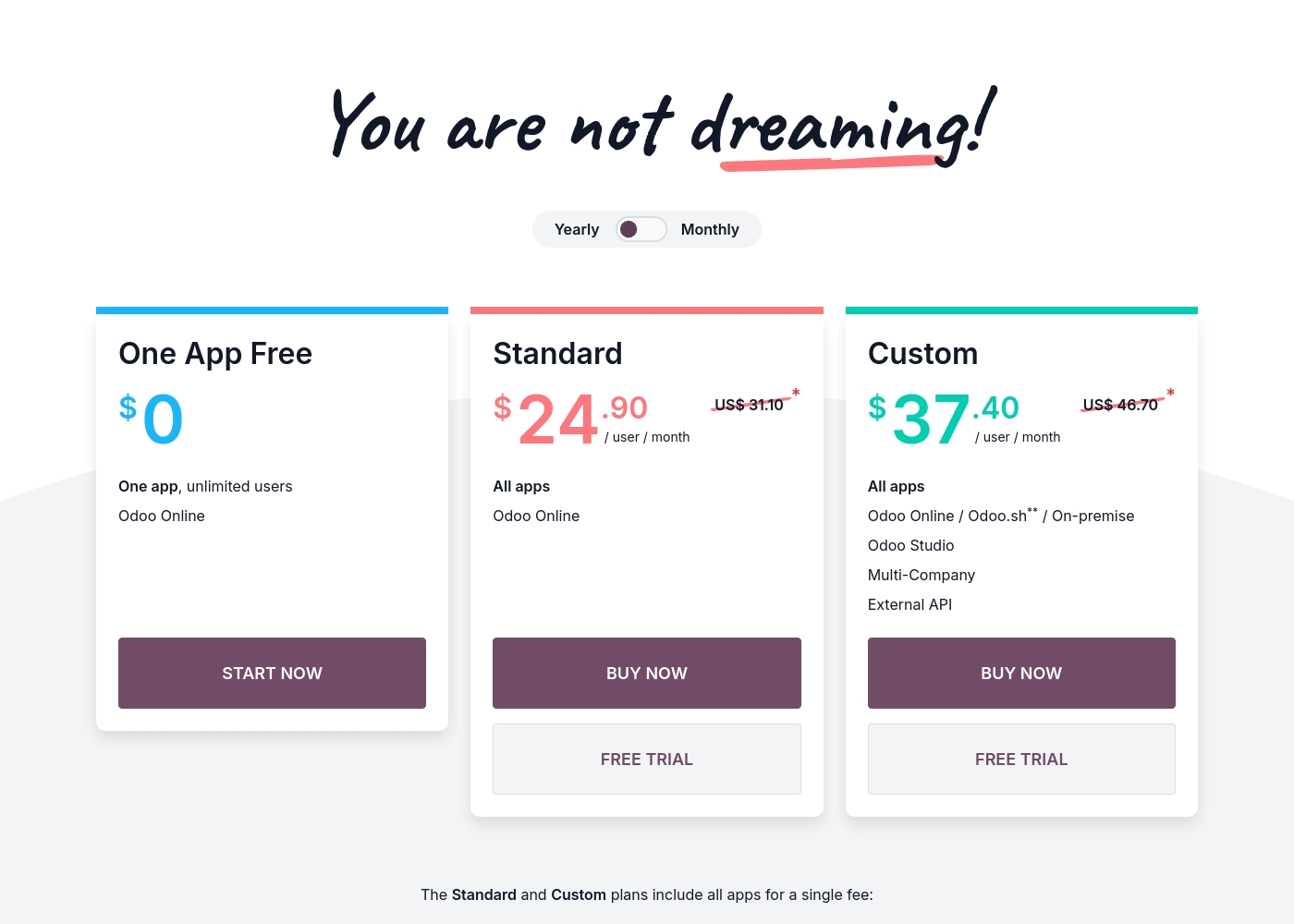
Odoo costs between $0 and $37.40 per user/month annually with three plans: One App Free at $0, Standard at $24.90, and Custom at $37.40.
These plans are designed to accommodate businesses of all sizes, offering scalable solutions based on your need for integrated apps and deployment flexibility.
One App Free
Price: $0 Websites Supported: Not explicitly stated Best For: Small teams or individuals focusing on a single core operation. Refund Policy: Not explicitly stated Other Features:
- One application included
- Unlimited users
- Hosted on Odoo Online
- One application included
- Unlimited users
- Hosted on Odoo Online
- Access to all apps
- Hosted on Odoo Online
- Unlimited support, hosting, and maintenance
- Access to all apps
- Odoo Studio
- Multi-Company support
- External API access
- Flexible hosting: Odoo Online, Odoo.sh, or On-premise
Pricing Notes
- Nickel: Pro pricing not stated; annual billing offers ~20% savings per site notes.
- Odoo: Free trial available for Standard and Custom; discounts apply for annual billing.
- Odoo One App Free includes unlimited users for the core app; other apps may be dependencies.
Pricing Head-to-Head
User Reviews
We found that external feedback on Nickel is generally positive, with users highlighting its ease of use and impact on cash flow. Many appreciate the intuitive interface for handling payments and the significant time saved through automation and QuickBooks integration.
😊 The free ACH transfers and transparent pricing are frequently praised as major value drivers for small businesses. However, some reviews point to occasional customer support delays and a learning curve for more advanced features like credit management.
Nickel has been a game-changer for our small business. Getting paid via ACH for free and paying our vendors through the same platform saves us so much time and money. The QuickBooks sync is flawless.
Odoo users generally praise the platform's flexibility and power, noting its ability to manage diverse business processes like invoicing, stock control, and subscriptions all in one integrated system. Many customers highlight the exceptional quality and responsiveness of the Odoo support team 🌟.
Reviewers often mention individual support members by name for providing timely, knowledgeable, and multilingual assistance, even to those on free plans. The system is frequently described as robust regarding cybersecurity, maintenance, and upgrades.
Thanks to Odoo, I can now manage all my processes through one single software. Having everything integrated helps save money by stopping the usage of other tools and also saves significant time. The system is very complete and flexible for our specific needs.
Our Verdict
Nickel vs Odoo is often a tie, but your needs decide the winner. Nickel shines with payments and onboarding, while Odoo excels in breadth and customization. If you want a fast, payments-first setup, Nickel wins for you. If you need a massive app ecosystem and open hosting options, go with Odoo. For many teams, it’s about choosing the right tool for your workflow, not declaring a universal winner. Pick Nickel for quick cash flow gains; pick Odoo when you want one platform to run everything.
Frequently Asked Questions
Which is better for small teams: Nickel or Odoo?
Nickel is great for small teams needing a free Core plan and fast payments. Odoo offers more apps and customization, but at a higher complexity. Start with Nickel Core; consider Odoo if you need hundreds of apps.
Does Nickel have integration with QuickBooks Online like Odoo?
Yes, Nickel has real-time QuickBooks Online sync for invoices and bills. Odoo integrates broadly via apps and APIs, depending on plan. Check which QB workflows you need before choosing.
Is Odoo worth the extra cost over Nickel?
If you need many apps and heavy customization, yes. If you only need payments, Nickel may be enough. Assess your app count and hosting needs first.
Can I migrate from Nickel to Odoo easily?
Migration depends on your data. Plan data export and app connectors. Budget for migration time and potential mapping tasks.
How do pricing and trials compare?
Nickel Core is free; Plus is $35/mo; Pro pricing isn’t stated. Odoo offers a free One App Free plan and trials for Standard and Custom.
Does Nickel support net terms like Odoo?
Yes, Nickel offers Net 60 terms for customers with credit insights. Odoo focuses more on workflows than net terms.
Ready to Choose?
Both tools have their strengths. Choose based on your specific needs.