NinjaOne vs ThreatDown
Choosing between NinjaOne and ThreatDown is like picking between a Swiss Army knife and a high-tech vault. NinjaOne unifies your entire IT operation into one fast, cloud-native platform. ThreatDown focuses on building a proactive, impenetrable security fortress around your endpoints.
Unified, fast, and user-friendly IT ops.
We find NinjaOne excels as a consolidated IT management platform, delivering on its promise of streamlined operations and rapid deployment. Overall, it offers powerful automation and a clean interface, making it a strong choice for teams looking to replace multiple single-purpose tools.
Pros
- Unified console for RMM, patching, backup, and service desk.
- Rapid deployment and user proficiency, often in under a month.
- Strong, responsive customer support and free unlimited training.
- Automated patch management that significantly cuts remediation time.
Cons
- Public pricing requires a sales consultation for exact quotes.
- Not suitable for on-premise deployment needs.
- May offer more features than very small teams require.
- Dependence on cloud connectivity for all operations.
Proactive, layered protection with clear pricing.
We found ThreatDown offers a strong, proactive security model focused on prevention and hardening. Its tiered pricing is transparent and scalable, making it a solid choice for organizations wanting managed services or a flexible DIY approach. Overall, it's a reliable platform for building a more resilient digital environment.
Pros
- Focuses on proactive hardening and threat prevention before execution.
- Offers clear, transparent tiered pricing that scales with device count.
- Provides flexible options from self-managed tools to fully-managed 24/7 MDR.
- Includes features like instant rollback and ransomware remediation.
Cons
- Top-tier custom pricing requires direct sales contact.
- Detailed feature differences between tiers are not fully listed here.
- External user reviews were inaccessible for this assessment.
AboutNinjaOne
💡 NinjaOne is a unified IT operations platform designed for IT teams and managed service providers (MSPs). It acts as a central hub to manage all your endpoints, secure devices, automate patching, handle backups, and provide remote support.
The software is built to replace multiple single-purpose tools. It's for organizations that want to streamline device management, improve security compliance, and boost helpdesk efficiency from one place.
AboutThreatDown
ThreatDown is a comprehensive managed security service designed to protect your entire digital environment. 🛡️ It’s built for businesses that want a layered, proactive defense strategy rather than a reactive one. Think of it as a complete security shield, combining managed services with a DIY SOC (Security Operations Center) for flexible, powerful protection.
Highlights
Feature Comparison
Features Overview
We highlight the main differences and pick a winner for each feature.
Core Purpose
NinjaOne unifies IT management. ThreatDown specializes in proactive security.
NinjaOne is a single console for managing all your IT endpoints. It replaces RMM, patching, backup, and service desk tools. One director cut their tool count from 15 to 1. ThreatDown is a managed security service. It hardens your perimeter and stops threats before they run. Its focus is purely on building a resilient security shield. The key difference is scope: NinjaOne manages everything IT. ThreatDown focuses deeply on security.
Deployment & Speed
NinjaOne deploys in days. ThreatDown's setup time isn't specified.
NinjaOne promises full deployment in under 30 days. Teams gain operator proficiency in under 10 days. There's no infrastructure to build. ThreatDown does not publicly state a deployment timeline. As a managed service, setup likely involves a configuration period. For speed-to-value, NinjaOne has the clear advantage. You can be operational in weeks.
Security Model
NinjaOne automates patching. ThreatDown actively neutralizes threats.
NinjaOne's security relies on fast, automated patching. It uses AI to prevent bad updates and cut patch cycles from 72 hours to minutes. ThreatDown uses layered defenses. It includes payload analysis, machine learning, and ransomware detection to stop code before it executes. It can also roll back ransomware changes. NinjaOne speeds up your existing security processes. ThreatDown provides an advanced, active defense layer.
Remote Support
NinjaOne offers fast, single-click remote access. ThreatDown is not a support tool.
NinjaOne provides fast, single-click remote control from its console. Users report connecting in seconds, not minutes. This is a core feature for helpdesks. ThreatDown is a security platform. It does not offer remote support or helpdesk functionality. Its endpoint isolation is for threat containment, not user assistance. If remote employee support is a need, NinjaOne is the only choice.
Management Flexibility
NinjaOne is a DIY management platform. ThreatDown offers managed or DIY options.
NinjaOne is a self-managed IT platform. Your team configures and operates it. It includes free training to empower your staff. ThreatDown offers a spectrum. You can choose fully-managed 24/7 MDR or a more DIY Security Operations Center (SOC) approach. ThreatDown provides more flexibility in service level. NinjaOne provides a consistent, powerful management tool.
Pricing Transparency
NinjaOne gives a price range. ThreatDown shows exact starting prices.
NinjaOne's pricing is $1.50-$3.75 per device monthly, but you need a quote for exact costs based on volume and products. ThreatDown shows clear starting prices. For example, $276/year for 5 devices on a 3-year term. Tiers are clearly defined. ThreatDown is more transparent upfront. NinjaOne's final cost depends on your specific scale.
Feature Breadth
NinjaOne covers a wider range of IT functions. ThreatDown is security-deep.
NinjaOne includes RMM, MDM, backup, patching, and a service desk. It's designed to be your one-stop IT platform. ThreatDown's features are all security-focused. It includes DNS filtering, threat neutralization, and MDR. It does not include general IT management tools. Choose NinjaOne for breadth. Choose ThreatDown for specialized security depth.
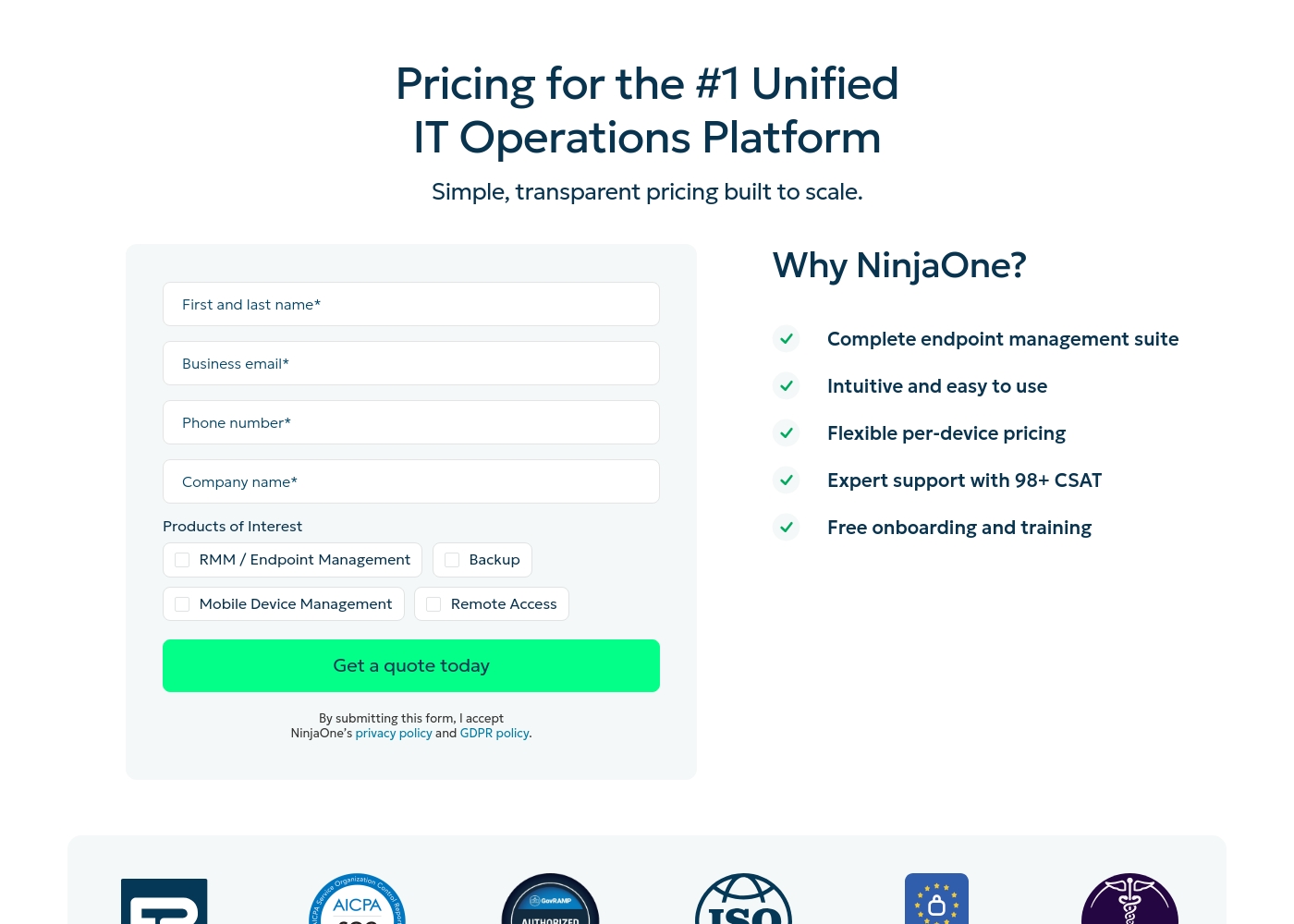
NinjaOne costs between $1.50 and $3.75 per endpoint each month with one flexible plan that scales based on your device count and specific product needs.
Here is how their pricing model works for your team.
Unified IT Operations
Price: From $1.50 to $3.75 per device monthly Websites Supported: Not explicitly stated Best For: MSPs and IT departments managing multi-OS environments Refund Policy: 60-day cancellation notice Other Features: Remote monitoring and management, autonomous patch management, endpoint security, backup, and free unlimited training.
- RMM / Endpoint Management
- Autonomous Patch Management
- Mobile Device Management (MDM)
- Endpoint and SaaS Backup
- Remote Control & Service Desk
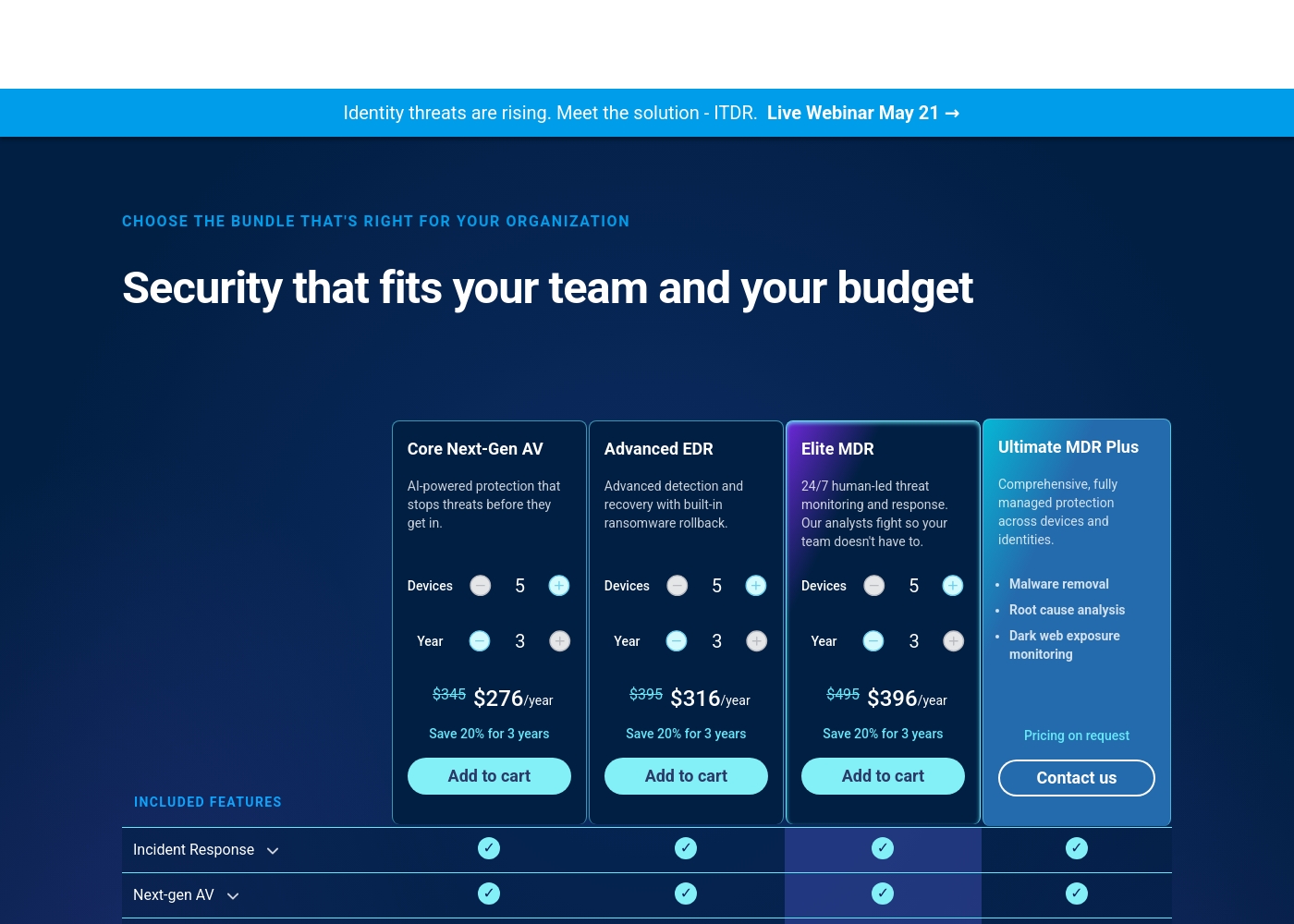
ThreatDown pricing: ThreatDown offers tiered security plans starting at $276/year for 5 devices on a multi-year term. Pricing is based on the number of devices and the length of your subscription commitment (1-3 years).
direct purchase is available for the first three tiers, while the top-tier plan requires a custom quote from the sales team. Each plan includes a core suite of protection tools with options for managed services and 24/7 human-led endpoint detection and response (MDR).
Pricing becomes more cost-effective with longer-term commitments, such as 3-year plans which offer a 20% savings compared to annual rates. Organizations can choose between self-managed AV and fully-managed security operations to fit their technical capacity and specific risk profile.
Pricing Notes
- NinjaOne's price decreases as you add more endpoints, making it cost-effective at scale.
- ThreatDown offers significant savings (20%) for longer, 3-year commitments compared to annual rates.
- NinjaOne includes free onboarding, support, and training with all plans.
- ThreatDown's top-tier MDR plan requires a custom quote from sales.
- NinjaOne has a 14-day free trial. ThreatDown does not advertise a public free trial.
- NinjaOne's pricing is based on a sales consultation. ThreatDown's starting prices are clearly listed on its website.
Pricing Head-to-Head
User Reviews
NinjaOne enjoys strong praise on both Trustpilot and Capterra for its intuitive interface and responsive support. 👍 Users consistently highlight the platform's ease of use, noting that the unified console simplifies managing endpoints across multiple operating systems.
The automated patch management is frequently cited as a major time-saver, reducing security risks and manual workloads. Customer support receives high marks for being fast, knowledgeable, and proactive.
NinjaOne replaced about 10 different tools for us. The interface is clean, and support is always helpful when we need it. Deployment was smoother than we expected.
We could not access external review snippets from Trustpilot or Capterra for ThreatDown due to access restrictions. Therefore, our review is based solely on the provided website information and pricing details. We cannot synthesize user sentiment or provide a summary of external reviews.
Our Verdict
It's not a simple tie—NinjaOne and ThreatDown solve fundamentally different problems. Your choice depends on whether you need to manage your IT or secure it. NinjaOne's superpower is unification. It brings RMM, patching, backup, and service desk into one clean, cloud-native console. Teams report going from 15 tools to 1 and deploying in under 30 days. ThreatDown's superpower is proactive defense. It builds a hostile environment for attacks using DNS filtering, threat neutralization, and 24/7 MDR. It can even roll back ransomware changes to reset your environment. The deciding factor is your primary pain. If you're drowning in IT tool sprawl and slow remote support, choose NinjaOne. If you're worried about sophisticated attacks and need a security shield, choose ThreatDown. For most IT teams managing mixed environments, **NinjaOne** is the more versatile choice. For organizations where security is the absolute top priority and you want managed services, **ThreatDown** is the specialist. Pick your pain point, and the right tool becomes clear.
Frequently Asked Questions
Which is better for small teams: NinjaOne or ThreatDown?
NinjaOne is often better for small IT teams needing to consolidate tools. ThreatDown is ideal for small businesses wanting managed security services without a big security team.
Does NinjaOne have security features like ThreatDown?
NinjaOne has strong security through automated patch management and compliance controls. ThreatDown offers more advanced, active layers like ransomware rollback and MDR for threat neutralization.
Is ThreatDown worth the extra cost over NinjaOne?
ThreatDown's cost is for a dedicated security service, not general IT management. It's worth it if you need proactive threat prevention and expert-led monitoring beyond standard patching.
Can I get a free trial with NinjaOne vs. ThreatDown?
NinjaOne offers a 14-day free trial to test its platform. ThreatDown does not advertise a public free trial; you'll need to contact their sales team.
Which tool deploys faster?
NinjaOne is designed for rapid deployment, often fully operational in under 30 days. ThreatDown's setup time is not specified, but it likely involves a managed onboarding process.
Does ThreatDown include remote support features?
No, ThreatDown is a security platform and does not include remote desktop or helpdesk tools. NinjaOne includes fast, single-click remote access as a core feature.
Ready to Choose?
Both tools have their strengths. Choose based on your specific needs.