Qwary vs Survicate
Qwary and Survicate pull from different playbooks, so choosing isn’t obvious. Qwary leans into AI analytics and deep product insights; Survicate centers on cross-channel feedback and speed. If you need analytics depth, pick Qwary; if you want fast, channel-spanning feedback, pick Survicate.
Data-driven toolkit for product teams.
We view Qwary as a potent, specialized toolkit designed to empower product teams by replacing assumptions with reliable, user-generated data. The platform’s strength lies in its AI analysis and deep integration potential, offering critical insights to optimize adoption and reduce churn. Overall, Qwary provides a robust, if pricey, solution for organizations dedicated to continuous, in-depth user engagement analysis.
Pros
- Specialized platform for Product, CX, and PX professionals.
- Utilizes AI Analysis to effectively unpack user sentiments.
- Clear path to Enterprise features with custom pricing and SLA.
- Deep analytics including Heatmaps and Trends for actionable insights.
Cons
- Starter plan is costly at $199 per month (billed annually).
- Entry-level features are heavily limited (e.g., only 1 Converse AI session).
- API access and Premium Integrations require custom Enterprise pricing.
- High price point may exclude budget-conscious or small teams.
Excellent scaling for serious feedback teams.
We recognize Survicate as an all-in-one feedback platform designed to handle complex customer journeys and high-volume data collection across channels. The generous Free plan allows early testing, but the platform truly shines in its Advanced tiers with powerful AI functionality and enterprise-level system integrations. Overall, we recommend Survicate for growing and mature organizations prioritizing dedicated, continuous feedback management programs.
Pros
- Free plan is available with powerful core features and integrations.
- Supports complex, multi-channel customer journey tracking.
- Strong focus on enterprise needs, compliance, and custom solutions.
- Offers advanced features like AI insights and personalization for teams.
Cons
- Advanced plans require a significant financial commitment (yearly required).
- High starting price point for advanced tiers ($299–$499+ per month).
- Pricing details for the mid-level Starter and Growth tiers are undefined in public materials.
- Focus on yearly commitment may restrict financial flexibility for some users.
AboutQwary
Qwary is designed as the comprehensive toolkit specifically for product teams. It equips you with the necessary resources for gaining deep insights and optimizing user engagement throughout the product lifecycle. The platform empowers teams to move seamlessly from ideation to final execution. ✅
The system is built to support critical product development roles. This includes Product Managers who focus on delivering resonant products, and User Researchers who need varied data to drive user-centric design. Qwary also provides strategic insights to Business Leadership for high-level decision-making and market leadership.
AboutSurvicate
Survicate provides an all-in-one customer feedback software solution. This tool helps you build the ultimate program for understanding your customers. It’s a structured platform designed to capture and analyze feedback efficiently. Put simply, it’s where you gather insights and decide how to act on them. 💡
Highlights
Feature Comparison
Features Overview
We highlight the main differences and pick a winner for each feature.
In-Product Surveys
Qwary offers in-product prompts; Survicate supports multi-channel collection including in-app moments.
Qwary can deploy in-product surveys during critical moments to collect context-rich feedback. Survicate captures feedback across channels, including in-app moments, to keep responses centralized. The trade-off is depth versus breadth: Qwary excels at in-context data, Survicate excels at channel coverage. Real-world impact: use Qwary at onboarding prompts to improve retention, while Survicate collects post-purchase sentiment across channels.
Automation & Workflows
Both offer end-to-end feedback flow, with Qwary leaning into CX analytics.
Qwary provides workflows, case management, and CX analytics for end-to-end optimization. Survicate focuses on capturing, identifying themes, and driving action in one place. The key trade-off: Qwary packs deeper analytics; Survicate emphasizes faster closed-loop action. Real-world impact: use Qwary to prioritize product changes; use Survicate to rally teams around top themes quickly.
Integrations
Survicate touts 40+ tool integrations; Qwary offers key native connections and premium connectors.
Survicate integrates widely, enabling responses to flow into many tools. Qwary supports common business tools (Sheets, Slack, Jira, etc.) and premium integrations in Enterprise (Zendesk, Salesforce, Snowflake). The trade-off: breadth (Survicate) versus depth with premium connectors (Qwary). Real-world impact: Survicate helps quickly embed feedback into existing workflows; Qwary accelerates data consolidation in large orgs.
Pricing & Value
Qwary uses a fixed Starter price and custom Enterprise; Survicate starts free with paid tiers.
Qwary Starter is $199/month billed annually, with Enterprise pricing customized. Survicate offers a Free plan and plans from $0, with volume-based options for higher usage. The trade-off: Qwary targets depth at a higher entry price; Survicate targets affordability and accessibility. Real-world impact: small teams can start for less with Survicate, while growing teams invest in Qwary for deeper insights.
Security & Enterprise Readiness
Qwary emphasizes Enterprise-grade features like SLA; Survicate includes security in higher plans.
Qwary Enterprise includes a Service Level Agreement and dedicated features. Survicate positions security in Growth/Enterprise tiers with white-glove options. The trade-off: stronger formal guarantees with Qwary, broader security options via Survicate’s Enterprise tier. Real-world impact: regulated teams may prefer Qwary’s SLA, while others value Survicate’s security options at scale.
Learning Curve
Survicate is often praised for ease; Qwary’s depth can require more setup.
Survicate’s onboarding and setup are frequently highlighted as straightforward. Qwary’s feature depth—AI, heatmaps, and advanced analytics—can require a steeper ramp. The trade-off: speed to value with Survicate versus deeper, longer-term insights with Qwary. Real-world impact: teams prioritizing speed of adoption lean Survicate; teams seeking deep analytics lean Qwary.
Analytics Depth
Qwary leans into AI-driven insights; Survicate focuses on themes and rapid action.
Qwary provides AI Analysis, Trends Analysis, heatmaps, and journey dashboards for deep product insights. Survicate emphasizes automatic theme identification and cross-channel dashboards for quick actions. The trade-off: deeper, more granular analytics in Qwary; faster, theme-driven actions in Survicate. Real-world impact: use Qwary when you need precise drivers of adoption; use Survicate when you need fast bets on what to fix next.
Adoption & Collaboration
Both platforms centralize feedback, helping teams align and act together.
Qwary provides Customer Journey Dashboards and collaboration-ready features like workflows. Survicate centralizes feedback to rally teams and drive cross-functional alignment. The trade-off: Qwary’s depth supports advanced teams; Survicate’s collaboration focus helps broader teams move faster. Real-world impact: use Qwary for governance in large orgs; use Survicate for cross-team alignment in smaller groups.
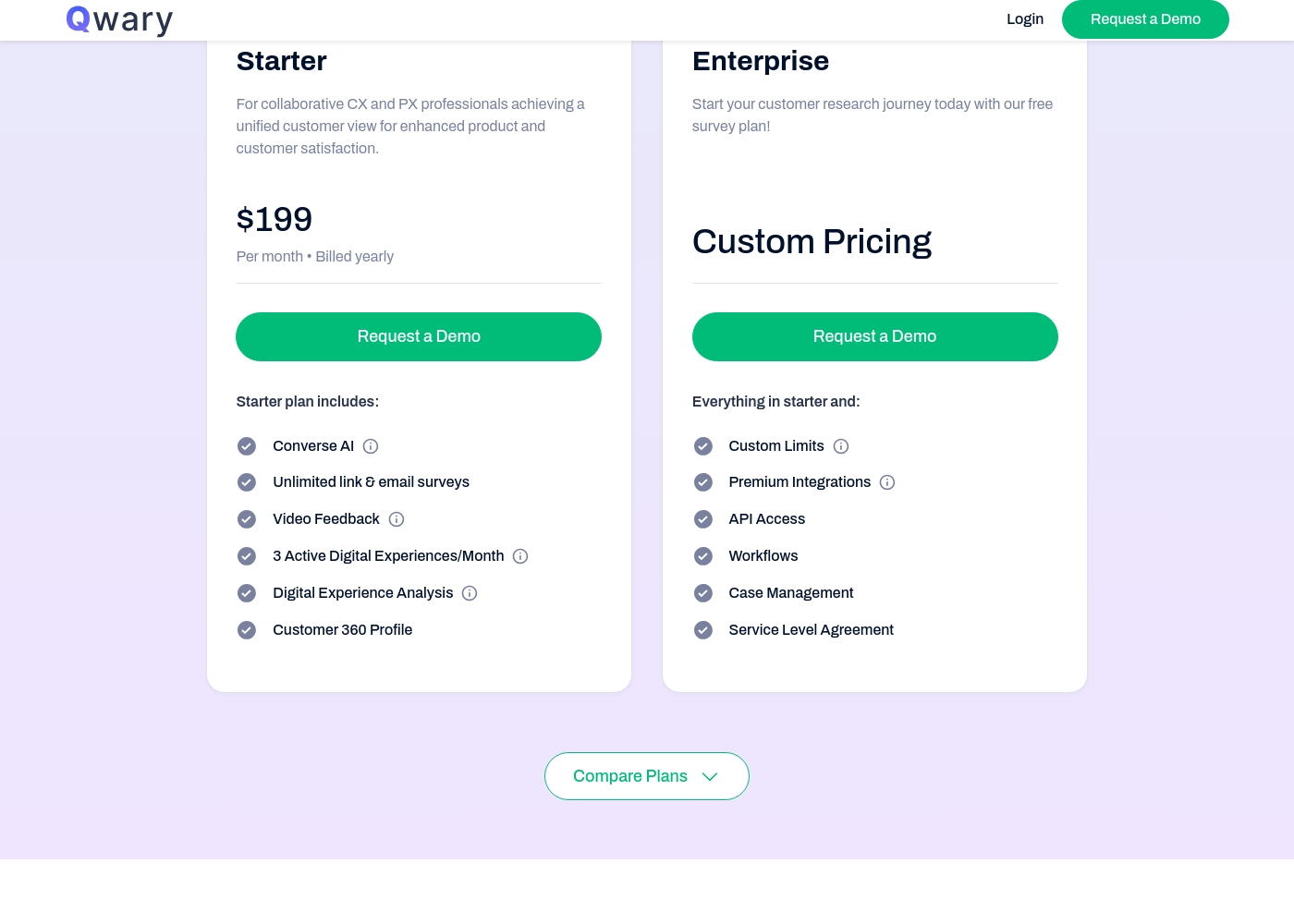
Qwary costs between $199 per month (when billed annually) and custom pricing with two main plans: Starter at $199/month and Enterprise (Custom Pricing).
Choosing the right Qwary plan depends entirely on your team's size and required scale. Here is a friendly breakdown of the features and what you can expect from each option.
Starter
Price: $199 per month, Billed yearly Websites Supported: Not explicitly stated Best For: Collaborative CX and PX professionals achieving a unified customer view Refund Policy: Not explicitly stated Other Features:
- Converse AI (limited to 1 per month)
- Unlimited link and email surveys
- Video Feedback (limited to 2 per month)
- 3 Active Digital Experiences/Month
- Digital Experience Analysis
- Converse AI (1/Month)
- Unlimited link & email surveys
- Video Feedback (2/Month)
- 3 Active Digital Experiences/Month
- Digital Experience Analysis
- Custom Limits
- Premium Integrations (Zendesk, Salesforce, Snowflake)
- API Access
- Workflows
- Case Management
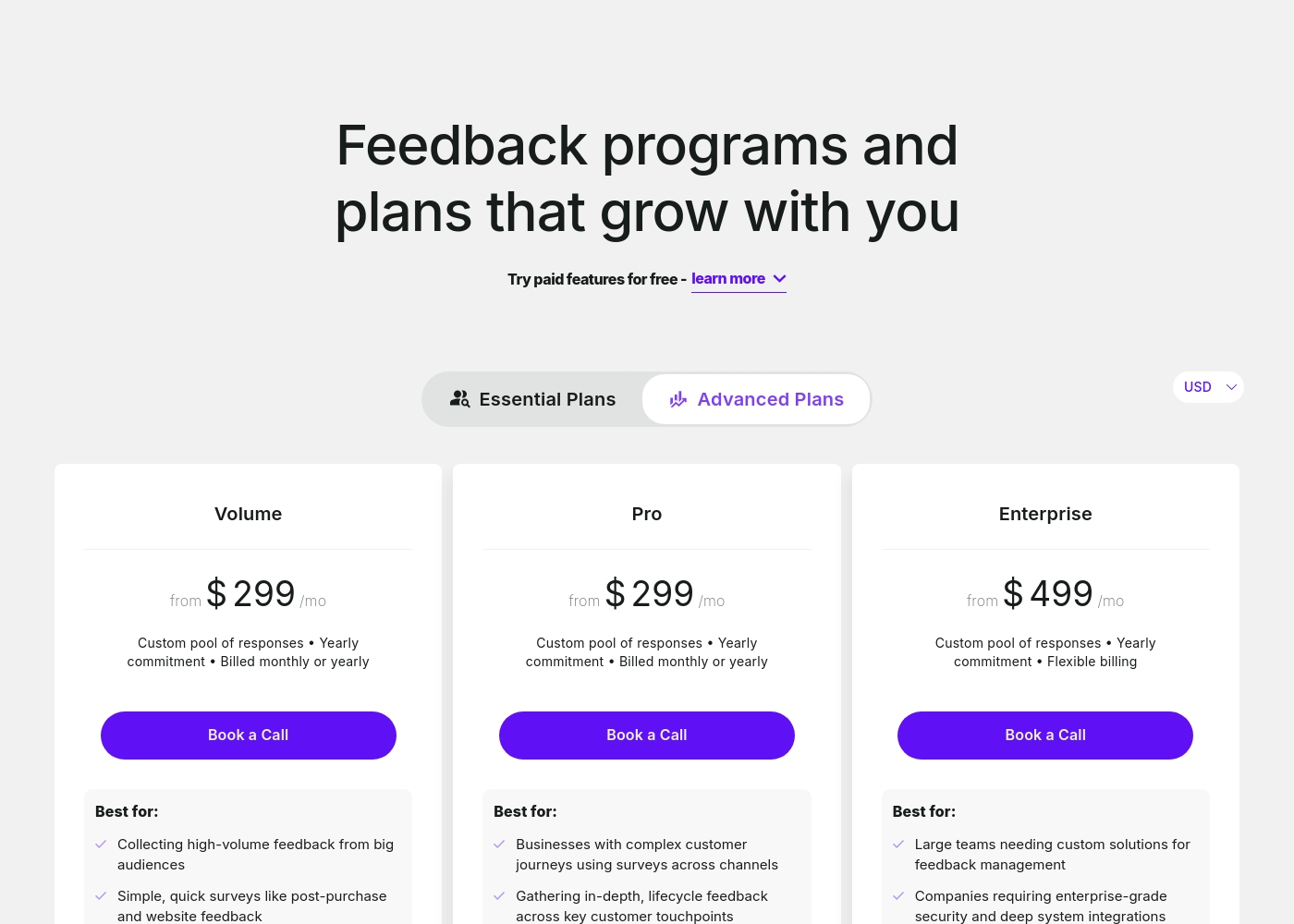
Survicate costs between $0 and $499+ per month with six plans: Free ($0/mo), Starter (Not explicitly stated), Growth (Not explicitly stated), Volume ($299/mo), Pro ($299/mo), and Enterprise ($499/mo).
Survicate offers a range of options, starting with a generous free tier and scaling up to enterprise-level solutions. Let's look closer at what each plan provides for you and your team.
Free
Price: $0 per month Websites Supported: Not explicitly stated Best For: Getting started with ease Refund Policy: Not explicitly stated Other Features: Run email, link, website & in-product surveys, 25 responses per month, Powerful integrations, Built-in security
- 25 responses per month
- Track feedback & spot trends
- Powerful integrations
- Built-in security
- Collect essential feedback
- Professional branding
- Clear and actionable insights
- Human support
- Monthly billing
- Easy continuous feedback
- Personalize every interaction
- Advanced insights with AI
- Built for teams
- Yearly billing
- Custom pool of responses
- Billed monthly or yearly
- Collecting high-volume feedback
Pricing Notes
- Qwary Starter has feature limits (1 Converse AI, 2 Video Feedback, 3 Digital Experiences).
- Qwary Enterprise offers API access and premium integrations with SLA.
- Survicate offers a Free plan and a path to higher usage via volume-based pools.
- Survicate promotes paid-feature trials; duration not specified.
Pricing Head-to-Head
User Reviews
We accessed the provided review platform links to gauge real-world user satisfaction. While Qwary utilizes Capterra for collecting feedback (the URL is available), we did not find any specific, actionable user snippets from either Trustpilot or Capterra listed in the provided data set.
This absence means we cannot currently synthesize concrete user sentiment regarding critical operating elements like customer support responsiveness, platform accuracy, ease of implementation, or software reliability. Typically, external reviews offer valuable confirmation on whether the aggressive pricing model ($199/month Starter plan) is perceived as providing good value, or if the premium features like Converse AI and Video Feedback are being utilized effectively by the users.
Survicate positions itself as a robust, all-in-one feedback solution designed for growth and enterprise needs. Users likely immediately appreciate the tremendous value of the generous Free plan, which allows organizations to start surveying immediately with core features and powerful integrations.
For scaling teams, the platform boasts advanced capabilities like AI-powered insights, personalization, and handling complex customer journey tracking. Businesses dedicated to continuous feedback management find the depth and specialization of the tool beneficial, especially its focus on enterprise-grade security and compliance.
The free plan was perfect for us to start testing surveys right away. We love having powerful integrations available even at the lowest tier, which really helped track our initial metrics. It's a fantastic entry point into serious feedback management.
Our Verdict
Short answer: it’s a tie for most teams. Both Qwary and Survicate fit different needs, so your choice hinges on what you value most. If you crave AI-driven product insights and advanced analytics, Qwary stands out. If you want fast, cross-channel feedback and simple collaboration, Survicate shines. In the end, the right pick depends on team size, budget, and your top use cases. For many teams, a careful mix of both approaches could even make sense.
Frequently Asked Questions
Which is better for small teams: Qwary or Survicate?
Survicate offers a Free plan starting at $0 and up to 25 responses monthly. Qwary Starter is $199/month billed annually with feature limits. For tight budgets, Survicate is typically cheaper to start; for deeper analytics, Qwary may be worth the tilt.
Does Qwary have multilingual surveys like Survicate?
Yes, Qwary supports multilingual surveys. Survicate language support isn’t specified in the data. If multilingual surveys are crucial, Qwary has the edge here.
Is Survicate worth the extra cost over Qwary?
If you need a low entry price and cross-channel speed, Survicate is appealing. If you need AI-driven insights and advanced analytics, Qwary may justify the cost.
Can I migrate from Qwary to Survicate easily?
Migration details aren’t provided here. For a smooth transition, contact sales to discuss data export and onboarding.
What integrations does Survicate support?
Survicate supports 40+ integrations. Qwary Starter covers core tools like Google Sheets, Slack, and Jira; Enterprise adds Zendesk, Salesforce, Snowflake.
Does Qwary offer a free trial, and how can I access it?
Yes, Qwary offers a free trial of the Starter plan. You need to request a demo to activate it.
Ready to Choose?
Both tools have their strengths. Choose based on your specific needs.