Utho vs Vultr
Utho and Vultr offer affordable, high-speed cloud compute but with major reliability trade-offs. Utho focuses on cost and simplicity with a fixed monthly cap. Vultr accelerates performance using cutting-edge GPUs for advanced workloads. The choice depends on prioritizing cost versus access to specialized hardware.
Affordable pricing, but critical stability risks.
We observe Utho presents an ambitious, affordable, usage-based cloud model designed for significant cost savings. However, numerous user reports criticize fundamental infrastructure reliability, citing critical failures like filesystem corruption and unscheduled outages. Overall, given the severe risk to stability and integrity issues reported by users, we cannot endorse Utho for professional or production deployment at this time.
Pros
- Usage-based pricing structure with a predictable monthly cap.
- Advertised up to 60% cost reduction compared to global competitors.
- Promises high performance, claiming operations are 2x faster.
- Offers core Shared CPU plans starting from $17.48 per month.
Cons
- Servers reported as critically unreliable and unsuitable for production use.
- Users report critical failures like filesystem corruption and read-only VPS errors.
- Reported billing conflicts with advertised hourly rate (instant monthly billing upon creation).
- Marketing claims (GPU access, free trial periods) reported as false or misleading after sign-up.
Advanced Tech, Highly Problematic Support.
We recognize Vultr offers powerful, high-specification resources optimized for AI and HPC workloads, providing immediate access to cutting-edge global infrastructure. However, the user feedback clearly indicates severe instability regarding operational support, verification processes, and network reliability. Overall, Vultr is a high-risk provider where world-class technology is significantly undermined by pervasive customer service and account management failures.
Pros
- Access to cutting-edge AI and HPC hardware (NVIDIA HGX B200, AMD Instinct).
- Global reach with 32 cloud data center locations worldwide.
- Flexible hourly and monthly usage-based billing starting at $2.50/month.
- Managed services like Kubernetes Engine and databases are available.
Cons
- Customer support is consistently slow, unhelpful, ticket-based, and unresponsive.
- Arbitrary account suspensions and service terminations occur frequently (e.g., due to CPU spikes).
- Unreasonable, invasive mandatory verification steps (requiring ID, credit card photos).
- Reported difficulties obtaining refunds, especially for cryptocurrency deposits.
AboutUtho
Utho is India’s first robust cloud platform, trusted by over 22,000 users and growing. It provides a full spectrum of cloud server solutions designed for businesses and developers alike. This platform focuses on offering unbeatable value and high performance for your operations.
They deliver a seamless cloud experience tailored entirely to your specific requirements. Utho works through partnerships with top-tier datacenters, ensuring your needs are prioritized within a reliable infrastructure. 💡
AboutVultr
Vultr provides a powerful full-stack cloud compute platform. It offers services ranging from configurable virtual machines to highly accelerated dedicated servers 💡. This platform is ideal for developers and enterprises focused on high-performance computing and complex AI model deployment. You can spin up general purpose or optimized configurations in under 60 seconds.
Highlights
Feature Comparison
Features Overview
We highlight the main differences and pick a winner for each feature.
AI & HPC Focus
Vultr provides cutting-edge GPU hardware; Utho lagged behind with promised features.
Vultr is specifically built for High-Performance Computing and complex AI workloads. Vultr users get immediate access to powerful specialized hardware like NVIDIA HGX B200 GPUs. Utho prominently advertised GPU instances for AI training. However, users reported these features were unavailable or stuck in misleading Beta stages. For serious AI or deep learning needs, Vultr offers a true modern hardware ecosystem.
Pricing Predictability
Utho caps monthly costs for heavy usage; Vultr is pay-as-you-go hourly.
Utho uses hourly billing but guarantees a predictable monthly cap at 672 hours. This structure ensures heavy users never pay more than the capped monthly rate. Vultr’s base pricing starts much lower, at $2.50/month for minimal instances. Vultr lacks a confirmed monthly cap, risking higher bills for sustained 24/7 usage. While Vultr has a cheaper entry point, Utho provides safer cost predictability.
Customer Support
Utho offers reliable human support; Vultr support is widely reported as failing.
Utho strongly highlights its dedicated 24/7 human support available via chat, phone, and email. Utho provides migration specialists to guide complex infrastructure moves. Vultr's customer service is notoriously slow, ticket-based, and often unresponsive to critical issues. Users reported being stranded during production site failures with Vultr. Utho’s commitment to human support is a massive differentiating factor.
Infrastructure Reliability
Both platforms suffer from severe, critical stability concerns reported by users.
Utho users documented critical infrastructure failures like filesystem corruption and read-only VPS states. Utho was called unstable and unsuitable for any enterprise production use. Vultr also faces consistent reports of network instability and arbitrary account terminations from CPU spikes. Both cloud providers carry far higher stability risk than industry-standard competitors. Users must weigh Utho's corruption risk versus Vultr's arbitrary suspension risk.
Managed Services
Vultr has a richer suite of robust managed offerings; Utho focuses on basic cloud services.
Vultr offers robust managed tools, including the Vultr Kubernetes Engine and Serverless Inference. Vultr maintains fully managed databases like PostgreSQL and Apache Kafka®. Utho provides general services like Managed Kubernetes and optimized database solutions. Vultr’s suite is better suited for developing advanced, modern cloud-native applications. Vultr allows developers to focus on code, not infrastructure maintenance.
Global Reach
Vultr provides specific global locations; Utho claims global footprints too.
Vultr operates across an extensive network of 32 specific cloud data center locations worldwide. This gives Vultr users immense flexibility for latency optimization. Utho also claims to be globally scalable with consistent pricing structure across footprints. Vultr provides explicit location choice; Utho is less transparent about physical presence. For wide international deployment, Vultr is arguably more comprehensive.
Onboarding Friction
Utho starts easily; Vultr requires invasive identity verification.
Vultr has a high-friction onboarding process for many users who deposit funds. Vultr often demands invasive verification, including identification and credit card photos. Utho offers a standard setup process focusing on rapid 30-second deployment. Utho supports a simple 30-day money-back guarantee with no questions asked. Choosing Utho avoids Vultr’s notoriously frustrating, invasive verification requirements.
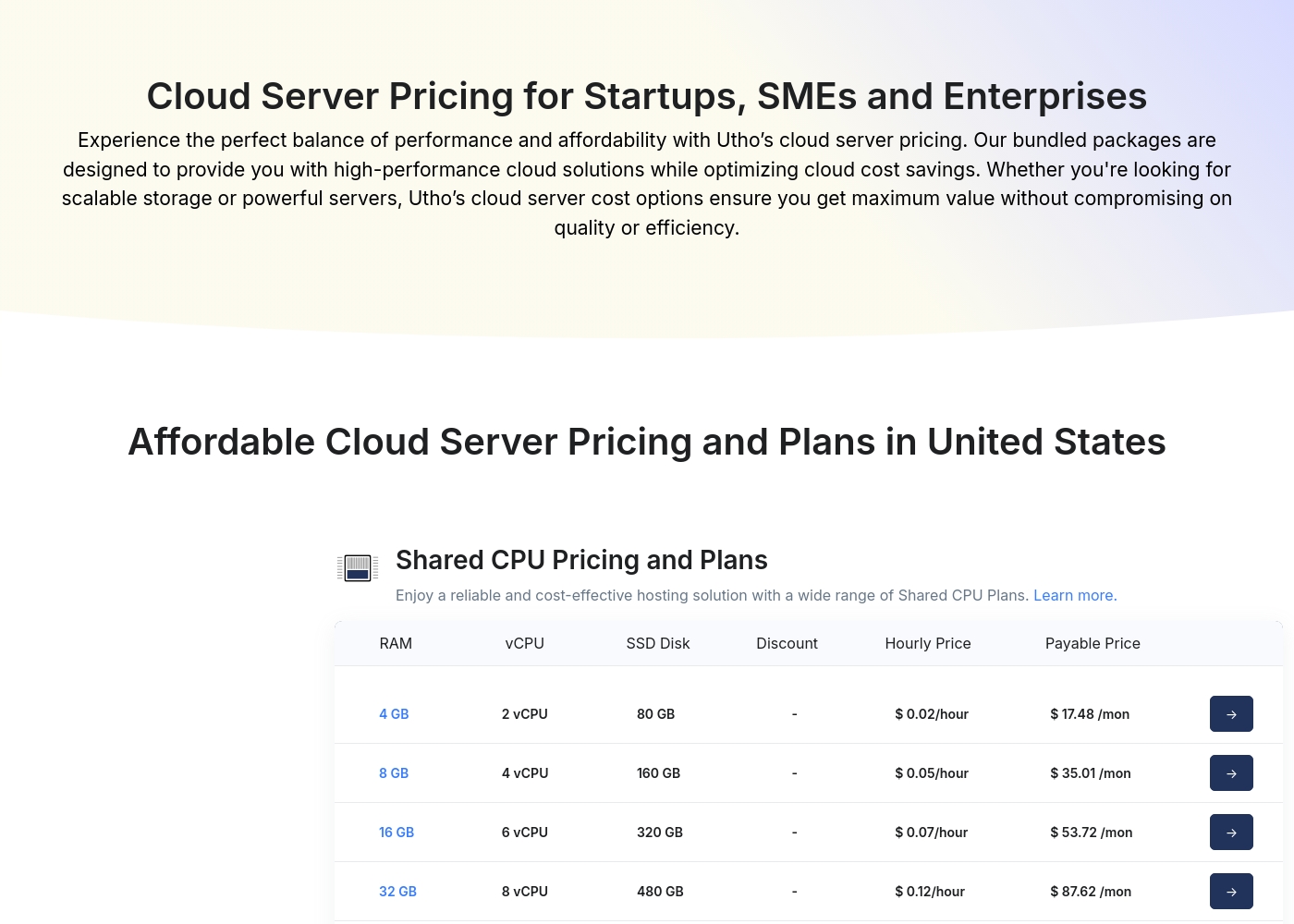
Utho costs between $17.48 and $87.62 per month for Shared CPU plans, with four tiers: 4 GB RAM at $17.48, 8 GB RAM at $35.01, 16 GB RAM at $53.72, and 32 GB RAM at $87.62.
Utho offers many different cloud products; the rates below detail the core Shared CPU tier options.
4 GB RAM Shared CPU Plan
Price: $17.48 per month ($0.02 per hour) Websites Supported: Not explicitly stated Best For: Not explicitly stated Refund Policy: Not explicitly stated Other Features:
- 2 vCPU
- 80 GB SSD Disk
- 4 GB RAM
- 2 vCPU
- 80 GB SSD Disk
- Billed hourly at $0.02
- 8 GB RAM
- 4 vCPU
- 160 GB SSD Disk
- Billed hourly at $0.05
- 16 GB RAM
- 6 vCPU
- 320 GB SSD Disk
- Billed hourly at $0.07
- 32 GB RAM
- 8 vCPU
- 480 GB SSD Disk
- Billed hourly at $0.12
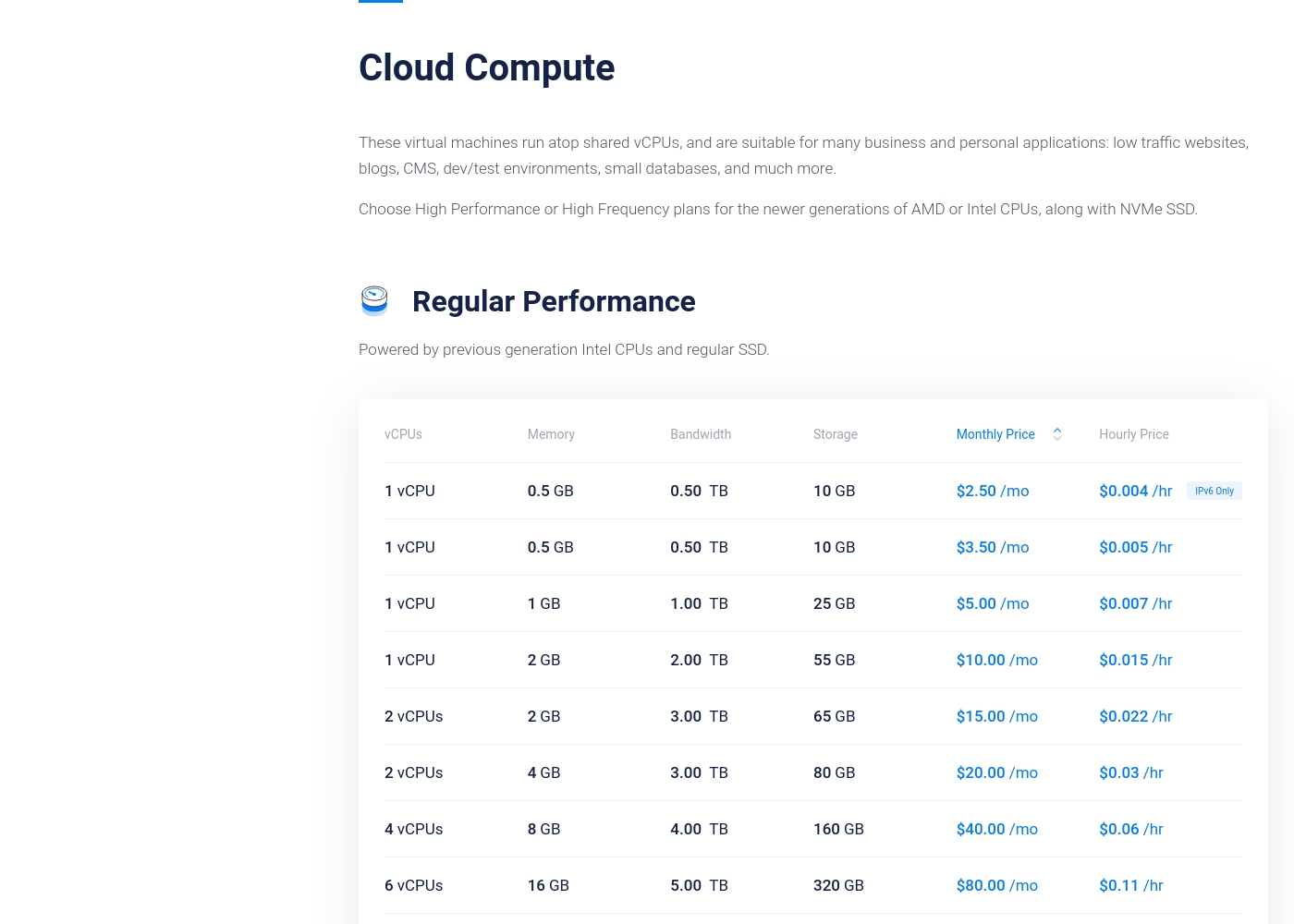
Vultr costs between $2.50 and $80.00 per month for Regular Performance Cloud Compute, featuring eight plans starting with the 1 vCPU / 0.5 GB configuration at $2.50/month.
Vultr’s Cloud Compute offerings are built on virtual machines using shared vCPUs. These machines are a great fit for everyday tasks like running low-traffic websites, simple databases, or small development environments. We've outlined a few of the available options below.
1 vCPU / 0.5 GB (IPv6 Only)
Price: $2.50 /month ($0.004 /hr) Websites Supported: Not explicitly stated Best For: Basic testing or staging environments Refund Policy: Not explicitly stated Other Features:
- 0.5 GB Memory
- 10 GB Storage
- 0.50 TB Bandwidth
- Powered by previous generation Intel CPUs
- 1 vCPU
- 0.5 GB Memory
- 10 GB Storage
- 0.50 TB Bandwidth
- 1 vCPU
- 1.0 GB Memory
- 25 GB Storage
- 1.00 TB Bandwidth
- 6 vCPUs
- 16 GB Memory
- 320 GB Storage
- 5.00 TB Bandwidth
Pricing Notes
- Utho offers a 30-day risk-free money-back guarantee, which Vultr does not explicitly provide.
- Vultr has a much lower entry price point starting at $2.50 per month for minimal instances.
- Utho's usage-based billing is capped monthly, providing predictable costs for heavy users.
- Vultr adds surcharges, such as a 20% backup fee and $10/month for DDoS protection.
- Users reported that Utho sometimes bills for the full month immediately, despite advertising hourly rates.
Pricing Head-to-Head
User Reviews
Users universally describe Utho as unreliable and potentially deceptive based on the limited, but critical, feedback on Trustpilot (4 reviews, scoring 2.6). Recurring issues center on core stability: engineers reported catastrophic failures like filesystem corruption, VPS going spontaneously into read-only mode, and unexpected system freezes without any alerts or monitoring.
One user migrated back to their previous provider overnight to avoid total downtime, calling Utho immature for production usage. Furthermore, customers raised serious concerns regarding billing integrity and marketing accuracy.
I switched hoping to reduce costs, but Utho created critical, high-risk issues within days. My VPS went into read-only mode without warning, completely freezing the system. This cheap infrastructure nearly took my entire business down; stay away from Utho for production use.
Vultr receives poor external ratings, especially on Trustpilot (2.1), where customer experiences are highly polarized. While some users acknowledge Vultr's competitive pricing and the overall power of the servers, these positive attributes are frequently overshadowed by critical operational failures.
The most common complaint centers on terrible customer support which is described as slow, unresponsive, and strictly ticket-based. Users commonly report arbitrary account suspensions or terminations, often triggered by hitting unstated CPU usage limits or frivolous DMCA claims 😔.
The bad reviews here don't reflect my nine years of experience. I've been a customer for a long time only hosting one mail and web server. The initial offerings consistently held a great value, and the support used to be easy to reach.
Our Verdict
Deciding between Utho and Vultr requires accepting a major operational trade-off. Both services promise high-speed cloud infrastructure at highly competitive prices. Unfortunately, both platforms suffer from serious, persistent stability problems documented by users. Neither Utho nor Vultr is currently recommended for mission-critical production environments. Utho's killer feature is its cost structure and dedicated human support model. Utho provides a fixed monthly cap, making budgeting 100% predictable for heavy usage. You get dedicated 24/7 human support when core issues arise quickly. Utho is best for teams focused on extreme budget cutting and simple 30-second deployment. Vultr conquers the highly specialized, high-tech market globally. Vultr provides instant access to the newest GPU clusters for intense AI and HPC workloads. You can leverage powerful managed services like Vultr Kubernetes Engine and Serverless Inference. Vultr’s entry price is extremely low, starting at just $2.50/month. The choice is whether you trust Utho's support more than Vultr's technology. Utho risks critical infrastructure failure like file system corruption, which is severe. Vultr risks arbitrary account suspensions and unresponsive, nonexistent support that frustrates users. Choose Vultr if your workload immediately demands cutting-edge AI hardware and global multi-region reach. Pick Utho for unparalleled value and guaranteed human support, despite the higher stability risks. If reliable uptime is your priority, carefully consider the drawbacks of both Utho and Vultr.
Frequently Asked Questions
Which platform is cheaper: Utho or Vultr?
Vultr has a lower entry price, starting at $2.50 per month for basic instances. Utho's lowest plan is $17.48 per month, but Utho offers up to 60% cost reduction overall. Utho's monthly billing cap makes costs more predictable for heavy users. Vultr costs may increase quickly with optional add-ons.
Which platform is better for advanced AI and machine learning?
Vultr is superior for advanced AI and machine learning workloads. Vultr offers immediate access to specialized hardware like the NVIDIA HGX B200 and Serverless Inference tools. Utho markets GPU instances, but users reported them as unavailable or stuck in Beta.
Does either Utho or Vultr offer a free trial period?
Utho provides a 30-day risk-free money-back guarantee, acting as a limited trial period. Vultr does not explicitly offer a free trial or money-back guarantee. Vultr does utilize flexible hourly pricing, allowing low-cost resource testing.
How does Vultr's customer service compare to Utho's?
Utho's human support is demonstrably better than Vultr's ticket system. Utho promises dedicated 24/7 human support via chat, phone, and email channels. Vultr's support is notoriously slow, ticket-based, and unresponsive according to extensive user feedback. Utho provides a clear support advantage.
Is Utho or Vultr better for running standard web applications?
Both Utho and Vultr offer standard Cloud Compute plans suitable for web applications. Vultr has better global redundancy with 32 locations available. However, Utho's 24/7 human support might be crucial if hosting stability issues arise. Choose based on your tolerance for infrastructure risk.
Are there known stability issues with Utho or Vultr infrastructure?
Yes, both Utho and Vultr have widely reported stability and reliability issues. Utho suffers from critical infrastructure failures like file corruption and read-only VPS errors. Vultr users complain about network instability and strict account termination policies for usage spikes.
Ready to Choose?
Both tools have their strengths. Choose based on your specific needs.